
Here's what's changed: most districts don't run radios as a standalone system anymore. They pair them with GPS tracking, dispatch consoles, and routing platforms to build a complete communication loop. This guide covers why radios still matter, how to integrate them with modern transportation technology, what compliance looks like, and how to pick the right setup for your fleet.
Key Takeaways
- Two-way radios give drivers hands-free comms federal rules accept instead of cell phones
- Pairing radios with GPS gives dispatchers location context the moment a call comes in
- Match mobile, portable, or PTT-over-cellular radios to fleet size, coverage, and budget
- Treat FCC licensing and FERPA-aligned data practices as non-negotiable in every rollout
Why Two-Way Radios Remain Essential for School Bus Safety
Handheld cell phone use is restricted for commercial drivers under federal rules. The FMCSA mobile phone restrictions prohibit holding a phone to dial, talk, or reach for it while driving a covered commercial vehicle.
Two-way radios were specifically discussed in the 2011 federal rulemaking as a compliant alternative to a phone's push-to-talk feature: a hands-free option that doesn't require dialing or holding a device.
That's one reason radios have staying power. Here are three more:
- They don't depend on cell coverage. Rural routes and dead zones make cellular calls unreliable. Radios operate on independent frequencies, so a driver on a backroad has the same connection as one downtown.
- Push-to-talk (PTT) reaches everyone at once. Dispatch doesn't need to call each bus individually during a weather event or road closure. One transmission reaches the entire fleet simultaneously.
- Training guides treat radio dispatch as standard practice. NHTSA's supervisor training materials specifically instruct dispatchers to update drivers on changing weather conditions via radio.
Real-World Scenarios Where Radios Solve Problems Faster
Mechanical breakdown: A driver notices a warning light and pulls over. One PTT call and dispatch is coordinating a replacement bus before the driver even finishes describing the issue. No dialing, no hold music.
Student behavioral incident: A situation escalates in the back of the bus. The driver keys the radio, requests backup guidance, and keeps both hands on the wheel the entire time.
Weather rerouting: Snow starts falling faster than forecast. Dispatch broadcasts a single message to every driver on affected routes, redirecting them before conditions worsen. No phone tree, no delay.

Integrating Two-Way Radios with GPS and Routing Software
A radio alone tells dispatch that something is happening. It doesn't tell them where. That's the gap GPS integration closes.
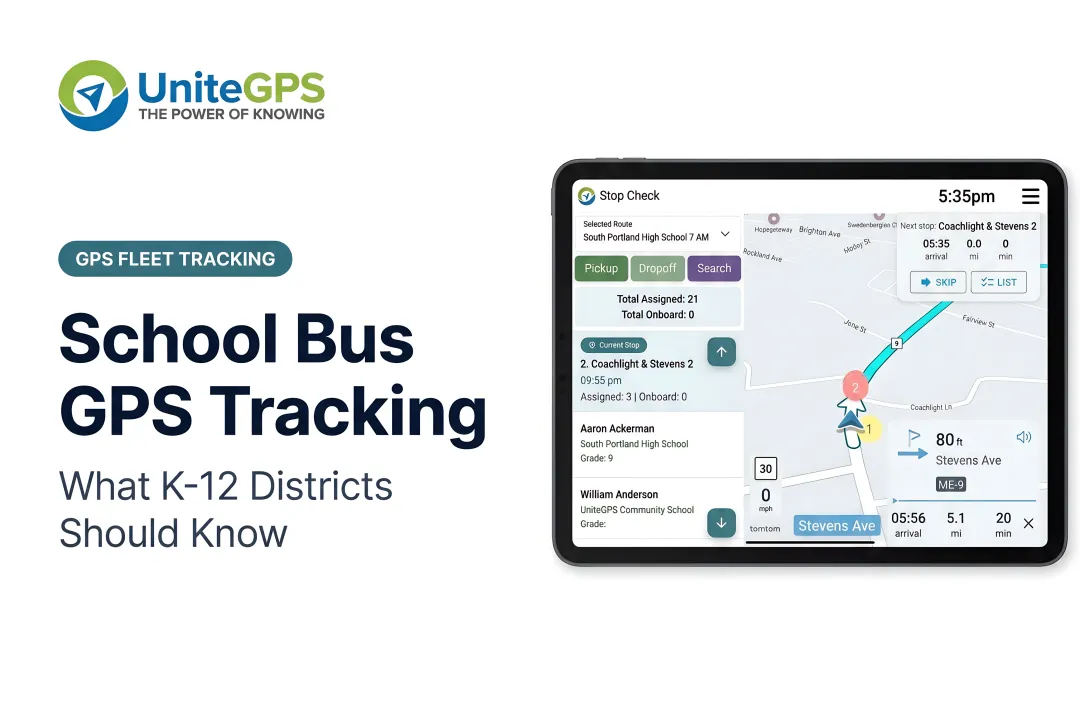
Standalone radios handle voice only. Pair them with a GPS and routing platform, and dispatchers get visual context with every call: exact bus location, route status, and stop progress. When a driver keys up about a breakdown, dispatch isn't asking "where are you?" They're already looking at the map.
How the Combination Plays Out in Practice
Modern transportation dashboards can surface which bus is transmitting and its live position the moment a radio call comes through. Instead of dispatch guessing or asking the driver to read off a street sign, they already see:
- The bus's exact location on a live map
- Whether it's on schedule or delayed
- Recent stop history for that route
UniteGPS's Crosswalk platform gives transportation directors this kind of real-time visibility, with GPS positions updating every few seconds — every five seconds on the GPS Tracking & Routing tier.
Paired with radio communication, dispatchers can answer a driver's call with full route context instead of relying on the driver's description.

The same setup also cuts parent call volume:
- Staff pull up the live map and answer a late-bus question in seconds, without radioing the driver
- Crosswalk's "Find My Routes" feature lets parents check bus location themselves, so fewer calls hit the transportation office
Supporting Substitute Drivers
Radio-plus-GPS context helps in other tight spots too — especially with substitute drivers.
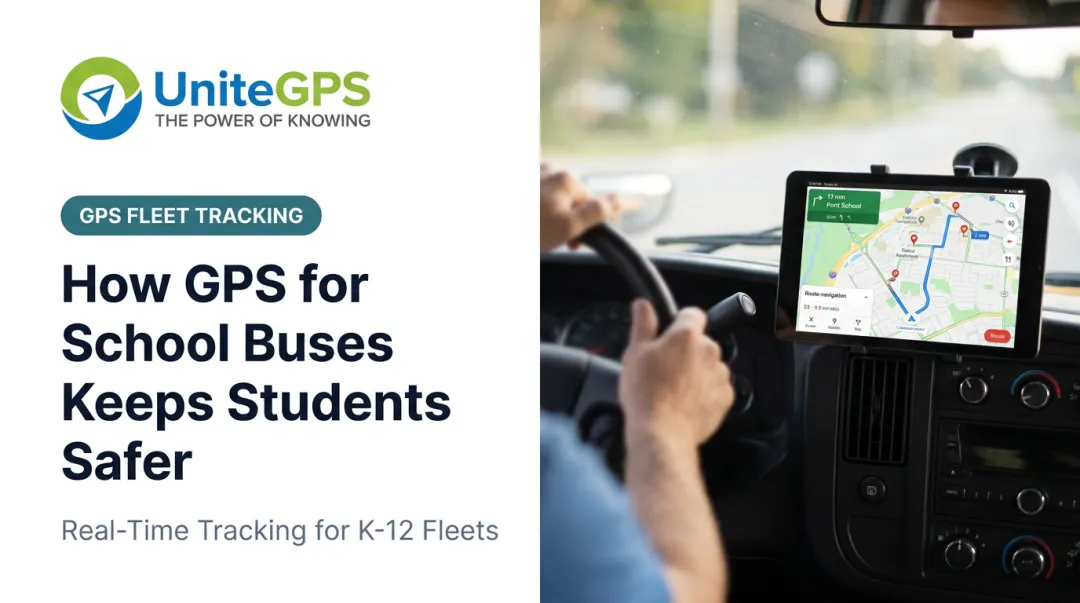
Subs often face unfamiliar routes on short notice. Turn-by-turn tablet navigation walks them through each stop, while dispatch watches live position on the fleet map. If a sub gets confused or falls behind, a quick radio call plus a glance at the map lets dispatch guide them back without guesswork.
Choosing the Right Radio System for Your Fleet
Not every district needs the same setup. The right choice depends on fleet size, geography, and how staff move between vehicles.
| System Type | Best For | Trade-offs |
|---|---|---|
| Mobile radios | Permanently installed in buses, higher power, better range | Fixed to the vehicle; no use outside the bus |
| Portable radios | Supervisors, mechanics, yard staff who need mobility | Lower power, shorter range, battery-dependent |
| PTT-over-Cellular (PoC) | Districts wanting wide coverage without traditional radio infrastructure | Relies on cellular/Wi-Fi networks and a subscription cost |
Many districts run both mobile and portable radios side by side. Buses get fixed mobile units; field supervisors carry portables so they're reachable whether they're at the yard, on a route check, or in the office.
PoC radios are worth a look for districts covering wide, spread-out service areas. They packetize voice and route it over cellular or Wi-Fi networks. Interoperability gateways can bridge PoC devices with traditional land-mobile radios, which helps if you're phasing in new technology without replacing everything at once.

Features to prioritize:
- Audio clarity in noisy bus environments (engine noise, chatter, road vibration)
- A dedicated emergency alert button that flags dispatch instantly
- Battery life that covers a full driver shift without a midday swap
Compliance and Budget Considerations
Radio deployment carries regulatory requirements alongside the hardware purchase.
FCC licensing: Operating on Industrial/Business Pool frequencies requires a radio-station license from the FCC. Educational institutions are an explicitly eligible category.
New frequency assignments typically need coordination through a certified frequency coordinator before you're cleared to transmit. Confirm this step before you buy hardware, not after.
Budget planning: Radio funding often competes with other transportation priorities. Sources worth checking include:
- Local or state school-bus safety grants (confirm radios are listed as covered equipment)
- Transportation infrastructure funding cycles
- Annual budget allocations for end-of-life equipment replacement
Don't assume a "safety equipment" grant covers radios just because it sounds broad enough. Get written confirmation before allocating grant dollars.
Data privacy: Once radio communication intersects with any platform handling student information, FERPA compliance matters. Any integrated system touching student data should:
- Operate under a formal data processing agreement
- Limit access to what's operationally necessary
- Encrypt data both in transit and at rest
Best Practices for Deploying Radios Across a District
A rollout goes smoother with a clear structure from day one:
- Equip every bus with a mobile radio. This is your baseline: non-negotiable for driver-to-dispatch coverage.
- Give field supervisors portable radios. They need to stay reachable outside the vehicle, at stops, in the yard, or during route checks.
- Set up a dispatch console at the transportation office. One centralized point where staff can reach the entire fleet or a single bus.
- Train drivers on radio protocols before go-live. Emergency procedures shouldn't be an afterthought bolted on after deployment.
- Run a coverage test on actual routes. Rural stretches and low-signal pockets need verification before you commit the whole fleet to one system.
Skipping the coverage test is the most common mistake. A radio that works fine in the parking lot can drop out entirely three miles down a rural route.

Frequently Asked Questions
Can two-way radios communicate with other radios?
Radios on the same frequency and channel communicate directly with each other. Different radio types, such as traditional land-mobile radios and PTT-over-cellular devices, need an interoperability gateway to bridge them.
What kind of walkie-talkies do schools use?
Small campuses sometimes use license-free FRS radios for short-range needs. Larger districts typically use licensed business-band radios and mobile units installed permanently in buses for fleet-wide coverage.
What are the 5 C's of radio communication?
Applied to driver-dispatcher exchanges, this means keeping transmissions clear, concise, complete, correct, and courteous. Following this structure keeps channels open and reduces confusion during time-sensitive calls.
What is the 3-3-3 rule for radios?
This is an informal etiquette guideline some districts use: transmit in short bursts of about three seconds, then pause three seconds before the next transmission. It's not an official FCC or DOT standard, so check your district's own written radio procedure.
Do school bus drivers need a license to use two-way radios?
The district operating the radio system typically needs an FCC license for its assigned frequencies. License-free options like FRS radios don't require this, but they come with shared channels and lower operating limits.
How do radios work with GPS bus tracking systems?
GPS platforms like UniteGPS's Crosswalk give dispatchers a live view of bus location. When a radio call comes in, staff already know where that bus is and what's happening on its route.