
"On the way" isn't information. It's a placeholder.
ETA prediction technology has moved well past the simple GPS dot. Modern systems combine live location data with traffic patterns, historical stop timing, and route logic to generate arrival windows that actually mean something. This guide breaks down how that prediction works, why school buses are a uniquely tough problem to solve, and what districts should look for before choosing a platform.
Key Takeaways
- Accurate ETAs combine live GPS, traffic, route path, and historical stop dwell data
- School bus routes are harder to predict than city transit because of dense residential stops and variable dwell times
- Reliable ETA tools cut transportation office phone calls and unsupervised wait time at stops
- Evaluate accuracy, SIS integration, live support, and FERPA compliance before choosing a provider
Why School Bus ETA Prediction Is Harder Than Regular Transit
City buses run on relatively predictable infrastructure: dedicated stops, consistent traffic patterns, and simplified boarding sequences. School buses don't get that luxury.
A single route might wind through a residential subdivision with 40 stops. Dwell time at each one is unpredictable:
- How many kids are waiting at the curb
- Whether a parent needs to walk a kindergartner across the street
- Whether a car is blocking the stop
Peer-reviewed school-bus routing research treats travel times as stochastic and time-dependent, citing accidents, weather, and congestion as built-in sources of uncertainty rather than exceptions (Sun et al., 2018).
School buses also face conditions city transit rarely deals with:
- School-zone traffic surges right before bell time, when parent drop-offs and buses converge on the same streets
- Railroad crossings under federal rule 49 CFR 392.10, which require buses to stop within 50 feet of the tracks, look, listen, and avoid shifting gears—adding mandatory dwell time
- Weather sensitivity: a 2024 peer-reviewed study of more than 300,000 NYC school-bus delays found that a 1°C drop in temperature increased borough-level delays by 1.6%

Why Simple GPS Location Isn't Enough
Knowing where a bus is right now tells you almost nothing about when it will arrive. A raw distance calculation ignores road curvature, upcoming stop sequence, and current traffic — it treats the trip like a straight line when it's actually a series of turns, slowdowns, and stops.
Researchers studying bus arrival-time prediction have found that naive "point and shoot" distance estimates are often wildly inaccurate without smarter modeling (Fan et al., 2015).
Their study used only GPS-derived stop data, yet still needed time of day, station ID, and elapsed travel time from the route's origin to produce a usable prediction. Location alone was never the hard part.
How Reliable ETA Prediction Actually Works
Modern ETA systems layer several data sources on top of each other rather than relying on any single input.
Three inputs carry most of the load:
- Real-time GPS tracking: Position updates continuously, so the system always knows where the bus is versus where the schedule says it should be
- Historical stop-to-stop data: Past segment and stop times surface patterns a live GPS ping alone won't catch, like the corner stop that always runs two minutes long
- Live traffic and route conditions: Detours, construction slowdowns, and school-zone backups shift the ETA in real time instead of waiting for the bus to show up late
Validating these predictions is its own discipline. Researchers compare a prediction made at a defined point before arrival against what actually happened.
They also weigh errors differently by direction. An ETA that's a few minutes early counts as a more serious miss than one that's a few minutes late, because an early bus can leave before a waiting student arrives.
Regression-based and machine-learning models used in public transit research continuously refine these predictions by learning patterns: weekday versus weekend timing, peak versus non-peak hours, and seasonal shifts.
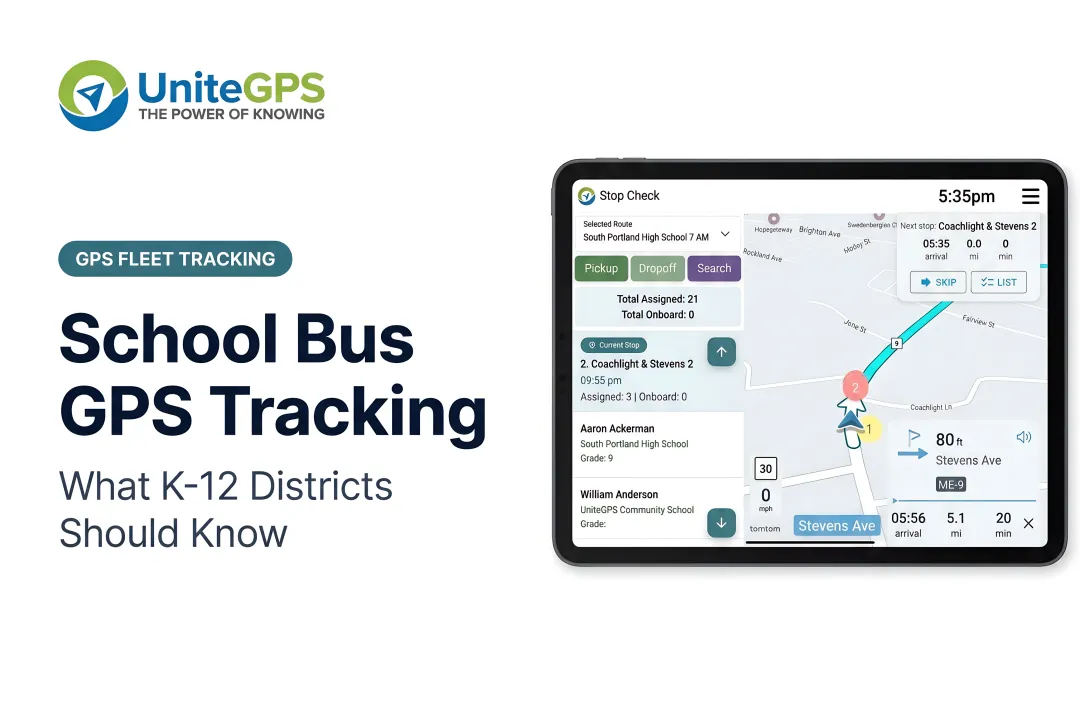
This is the kind of layered approach UniteGPS built into its Crosswalk platform. GPS positions update every 5 seconds, and the system's Stop Time Automation recalculates downstream arrival times whenever a stop is added or removed, so the parent app and dispatcher dashboard aren't working off a stale schedule.

Key Data Inputs That Improve ETA Accuracy
No single data feed makes an ETA reliable. Accuracy comes from combining several of them:
- Live GPS position: the vehicle's current, continuously updating location
- Posted route and schedule data: the planned stop sequence and timing against which live movement is measured
- Historical travel-time patterns: how long specific segments or stops have taken in the past under similar conditions
- Real-time traffic feeds: current congestion, incidents, or closures affecting the route right now
For school routes specifically, student ridership and stop-level dwell data sharpen the estimate further. Crosswalk, for example, captures timestamped boarding and alighting events through student card or barcode scans, alongside GPS-verified arrival and departure at each stop.
That combination of scan data and location data shows transportation offices where time is actually spent on a route, not only where the bus is.

Benefits of Reliable ETA Insights for Districts, Drivers, and Families
When ETAs are trustworthy, the ripple effects show up across the whole operation.
Fewer disruptive phone calls. Every "where's the bus" call pulls a staff member away from other work. A parent-facing app with live location and an honest ETA gives families a reason to check the app instead of dialing the transportation office.
Safer waiting conditions. Kids standing at a cold or unfamiliar stop for longer than necessary is a real safety concern, not just an inconvenience. Real-time visibility lets families time their walk to the stop instead of guessing.
Better substitute driver coverage. A substitute covering an unfamiliar route benefits from live, predictive routing rather than a static printed schedule. Crosswalk's Stop Time Automation keeps downstream arrival estimates current even when a route changes mid-run.
Those gains show up clearly once staff and families share the same live picture. At Benton Community School District, Transportation Director Tim Lyons said Crosswalk made a "huge difference." Staff could see exactly where a bus and its students were at any point. That visibility let them quickly verify whether a bus had actually stopped somewhere when a parent called in confused.

Common Limitations and Challenges in ETA Prediction
No ETA system is perfect, and honest vendors will say so.
- Data quality sets the ceiling. Missing or delayed GPS pings degrade every prediction built on them. GTFS Realtime best practices recommend location data no older than 90 seconds; stale data weakens the whole system.
- Unpredictable events remain unpredictable. Accidents, road closures, and severe weather introduce error no model can fully eliminate.
- Overly complex models can become a black box. If a transportation director can't explain why an ETA suddenly jumped by ten minutes, that's a trust problem, not just a technical one.
There's no single industry-wide accuracy benchmark for school bus ETAs. Published performance figures depend heavily on route type, prediction horizon, and how "arrival" is defined, so any vendor claiming a universal percentage should be asked to show their work.
What to Look for in a School Bus ETA Solution
When evaluating platforms, run through this checklist:
- Real-time GPS accuracy — how frequently does the system refresh vehicle position, and is that GPS-verified against the stop sequence?
- SIS and GTFS integration — can the platform sync student rosters and route data without manual re-entry?
- Live support, not ticket queues — when an ETA looks wrong during a live route, can staff reach a real person immediately?
- FERPA-compliant data handling — is there a signed Data Processing Agreement, encryption in transit and at rest, and district ownership of the data? Districts should also weigh whether a provider was built specifically for K-12 transportation or is a generic fleet-tracking tool retrofitted with a school skin. Crosswalk's routing, ridership, and ETA features grew out of more than a decade of direct conversations with transportation directors. That work started with the founder's own kids waiting in the Maine cold with no ETA at all, then expanded one feature at a time based on what districts actually asked for.
Frequently Asked Questions
Is there a way to track school buses?
Yes. GPS-based platforms like UniteGPS Crosswalk K-12 let parents and administrators view live bus locations and predicted arrival times in a companion app. Positions typically update every few seconds.
How accurate are school bus arrival predictions?
Accuracy depends on data quality and model sophistication, but predictions typically narrow to within a few minutes as the bus gets closer to the stop. Don't trust a vendor claiming a fixed universal accuracy number.
Why does my school bus tracking app show the wrong ETA sometimes?
Sudden traffic, weather, or a longer-than-usual stop can throw off a prediction temporarily. The estimate should self-correct as new GPS data comes in.
Can parents get real-time notifications when the bus is close?
Many platforms offer live location visibility so parents can time their walk to the stop. Some also provide scan-based notifications confirming when a student boards or exits the bus.
What technology is used to predict bus arrival times?
A combination of live GPS tracking, historical stop-to-stop travel data, and route/schedule information, often refined by traffic conditions and time-of-day patterns.
Does ETA tracking help with school bus safety?
Yes. It reduces the time kids spend waiting unsupervised at a stop and helps transportation staff quickly spot and respond to delays or route issues.