Introduction
It's 7:12 AM. A parent calls asking where her son's bus is. The transportation director has one tab open for routing, another for GPS, a third for ridership scans, and a fourth for syncing enrollment changes with the student information system.
By the time she finds the answer, three more calls are waiting.
This scenario plays out daily in transportation offices nationwide. School buses carry 26 million children every school day in the United States, according to NHTSA's school bus safety data. Most of that logistics work still runs through disconnected software.
Districts are shifting away from stitching together separate routing, GPS, and ridership tools. This guide compares the leading K-12 transportation platforms available in 2026, breaking down what each does best and which districts each one fits.
Key Takeaways
- Integrated platforms combine routing, GPS, and ridership tracking into one system, cutting duplicate data entry
- UniteGPS, Transfinder, Zonar Systems, Busology Tech, and Versatrans cover five distinct strengths—unified platform, deep routing, inspections, mid-market value, and enterprise scale
- Pricing transparency varies widely: per-bus models scale predictably, while quote-based enterprise pricing often hides true costs until contract signing
- District size and priorities (deep routing vs. verified inspections vs. one unified system) should drive the decision
- Require a 90-day free trial so the district can prove real-world fit before committing budget
Overview of School Transportation Software in the K-12 Industry
School transportation management software handles the operational backbone of getting students to and from school safely. That typically includes:
- Routing and scheduling — planning stops, calculating mileage, and building driver schedules before the school year starts
- GPS/telematics — live vehicle tracking, speed monitoring, and geofencing during actual routes
- Ridership tracking — recording exactly which students boarded which bus and when
- SIS (Student Information System) synchronization — pulling enrollment and address data automatically instead of manual re-entry
- **Driver navigation and fleet maintenance** — turn-by-turn guidance for drivers, plus inspection and compliance support
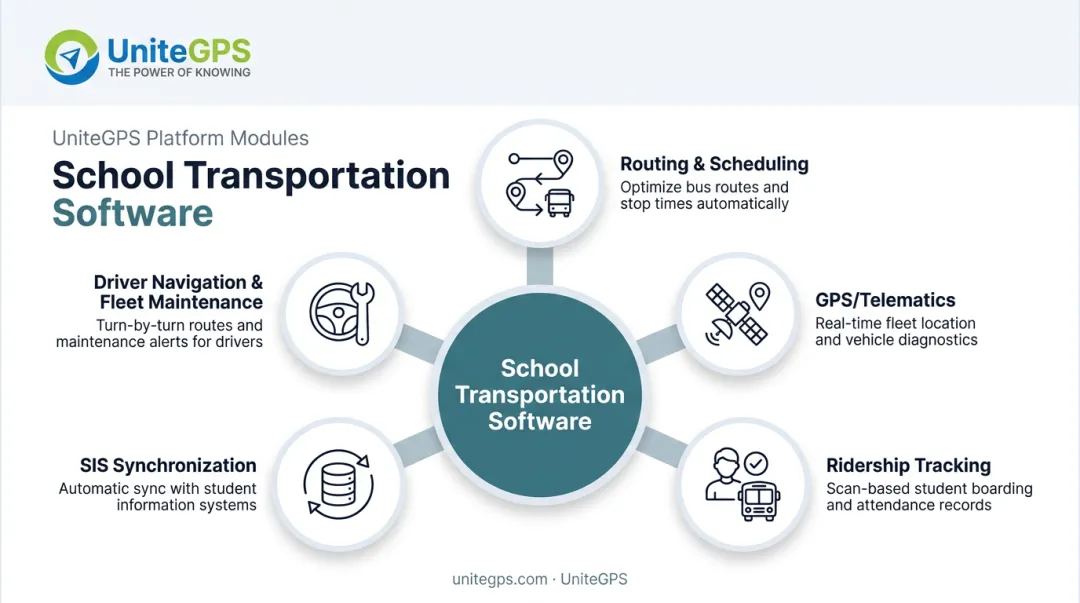
At national scale, about 26 million students ride buses daily. Even small inefficiencies compound fast across a district fleet, which is why the software behind routing, tracking, and ridership matters so much.
For years, two camps have dominated this market: legacy enterprise vendors with deep feature sets but clunky administration, and platforms absorbed into larger private-equity-backed portfolios. Both models tend to prioritize scale over responsiveness. That gap has left room for customer-funded alternatives to compete on service and transparency, not just feature checklists.
The next section ranks the top platforms on integration depth, pricing transparency, and district fit.
Top School Transportation Software Platforms Compared
Each platform below is evaluated on six criteria: routing capability, GPS/tracking accuracy, ridership tracking, SIS/data integration, pricing transparency, and support model. Here's how the five leading options stack up.
UniteGPS (Crosswalk Platform)
UniteGPS's Crosswalk platform is a fully integrated K-12 transportation system. It combines routing, real-time GPS tracking, student ridership scanning, driver tablets, and SIS synchronization in one product.
It was built specifically for districts and small-to-medium transit agencies, not retrofitted from a general logistics tool.
What sets it apart:
- Founder-led and fully bootstrapped since 2014, with no private equity involvement
- Serves 100+ districts across all 50 states
- FERPA compliant, backed by annual third-party audits and a formal Data Processing Agreement
- Unlimited live support with no ticket queues, across every pricing tier
- 90-day free trial, no credit card required, with routes built by the UniteGPS team during onboarding
| Aspect | Details |
|---|---|
| Core Focus | One unified platform for routing, GPS, ridership, and driver navigation, without stitching together separate tools |
| Pricing Model | Transparent per-bus pricing, from $49/month flat for small fleets up to $39/bus/month for the full tablet suite |
| Best For | Small-to-mid-sized K-12 districts and transit agencies wanting one system instead of three vendor contracts |
Tim Lyons, Director of Transportation at Benton Community School District, called the platform a "game changer" for resolving parent disputes. Staff can pull timestamped data instead of investigating manually.
Transfinder
Transfinder is one of the longest-established names in K-12 routing, founded in 1988 and used by more than 2,500 school districts and municipalities across 47 states. Its Routefinder PLUS product supports calendar-based route planning, GPS-based on-time reporting, and custom mileage reports.
Strengths include deep routing logic and strong reporting. The tradeoff is a steeper administrative learning curve tied to its legacy architecture, and setup complexity that can strain smaller transportation offices.
| Aspect | Details |
|---|---|
| Core Focus | Routing, scheduling, and GPS tracking with strong reporting and analytics |
| Pricing Model | Quote-based, typically scaled per student annually; no public list price, less transparent for smaller districts |
| Best For | Large districts with dedicated administrative staff to manage setup complexity |
Zonar Systems
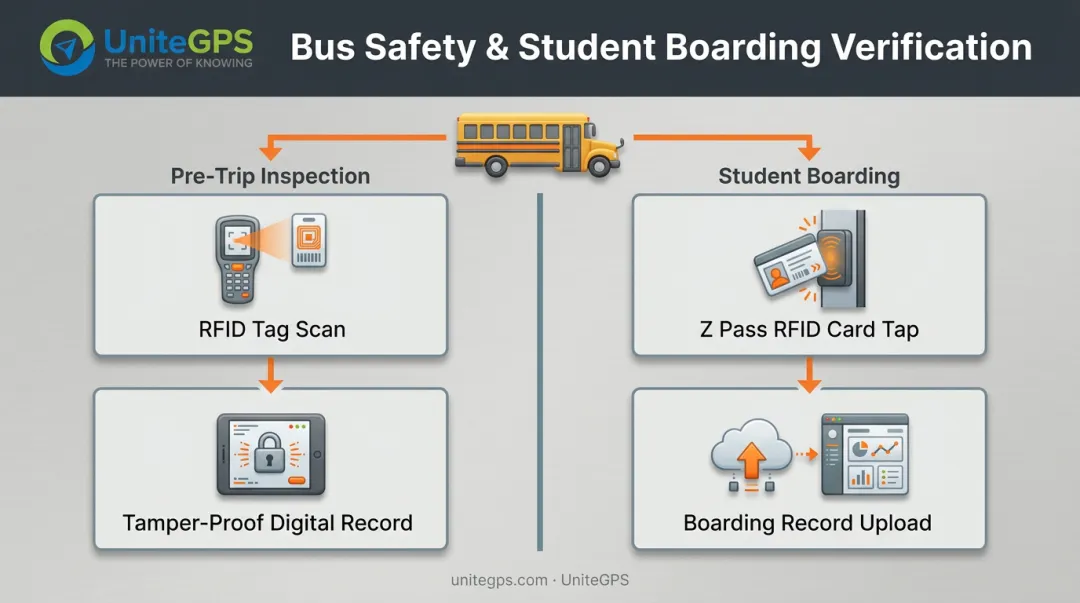
Zonar built its reputation on hardware-verified compliance. Its EVIR system uses RFID-encoded inspection tags to create tamper-proof pre-trip inspection records, while Z Pass tracks student boarding through passive RFID cards.
That compliance depth is Zonar's clear strength. Ridership and maintenance features are less developed than what dedicated integrated platforms offer.
Zonar joined GPS Trackit's portfolio in December 2024 after merging with the Inverness Graham-backed firm earlier that year.
| Aspect | Details |
|---|---|
| Core Focus | RFID-verified inspections, Z Pass student tracking, and compliance record-keeping |
| Pricing Model | Quote-based, generally requiring hardware investment (readers, RFID tags) alongside subscription fees |
| Best For | Districts prioritizing tamper-proof inspection and compliance documentation above other features |
Busology Tech (formerly TripSpark School)
Busology Tech is a modern cloud platform operating under the Modaxo group, offering routing, real-time GPS, and RFID-based student ridership tracking. It launched as a dedicated brand in 2023 after more than a decade operating as TripSpark School.
It's positioned as an all-in-one system with SIS synchronization for rosters and route changes. As part of a larger corporate portfolio, though, its product roadmap competes with priorities across Modaxo's broader software lineup.
| Aspect | Details |
|---|---|
| Core Focus | Routing, real-time GPS, and RFID student ridership tracking |
| Pricing Model | Enterprise-oriented, quote-based pricing |
| Best For | Mid-to-large districts comfortable working within a larger corporate software ecosystem |
Versatrans (Tyler Technologies)
Versatrans sits within Tyler Technologies' broader school transportation suite, which the company says serves more than 1,900 districts and transports over 7 million students. It covers route planning, scenario analysis, and integrated telematics.
Pricing runs high. One public district procurement document for a fleet of up to 280 vehicles totaled $184,284 in the first year, combining one-time services and recurring SaaS fees. That's one configured quote, not a universal starting price, but it signals the scale districts should expect.
| Aspect | Details |
|---|---|
| Core Focus | Routing and scheduling as part of a larger district software suite |
| Pricing Model | Often well into five figures annually; best suited to districts already invested in Tyler's ecosystem |
| Best For | Large districts already using Tyler Technologies for other administrative systems |
Why "One Platform" Beats Stitching Together Point Solutions
Running separate routing, GPS, and ridership tools creates hidden costs that rarely show up on an invoice.
The reconciliation problem. When a student's address changes, staff often update it in the SIS, then again in the routing tool, then again in the ridership system. Miss one, and a bus shows up at the wrong stop, or a parent gets an inaccurate ETA.
SIS synchronization is the clearest fix. When routing, ridership, and GPS all pull from a single synced source, such as PowerSchool, Skyward, or Infinite Campus, enrollment changes flow through automatically instead of getting re-entered three or four times.
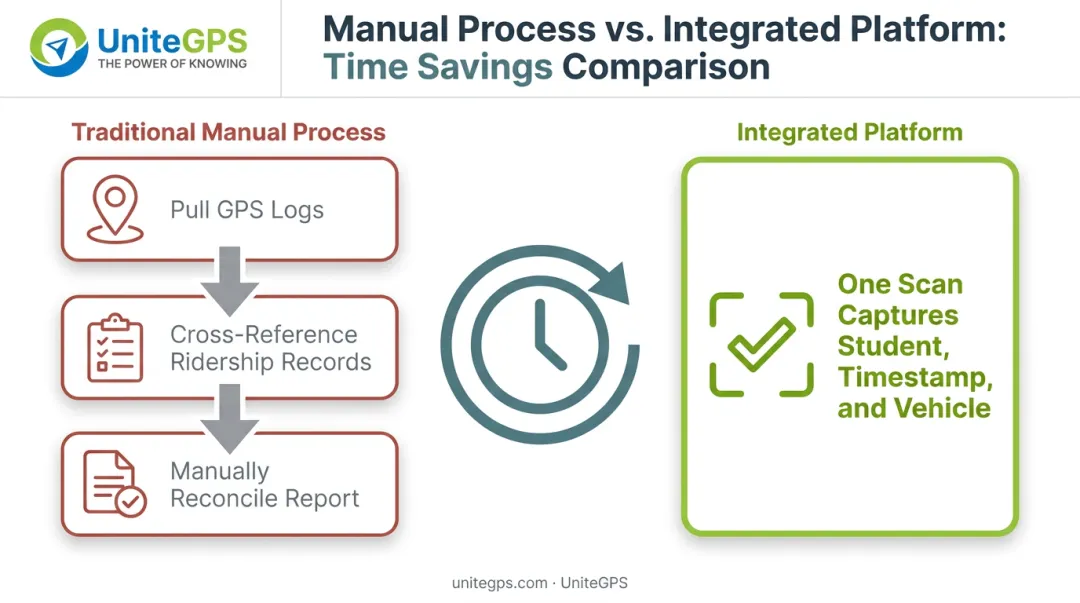
Medicaid billing is another pressure point. Documenting special-education transportation for reimbursement traditionally means:
- Pulling GPS logs to confirm a bus location at a specific time
- Cross-referencing paper or spreadsheet ridership records for the same window
- Manually reconciling both into a claim-ready report
On an integrated platform, a single scan event captures the student, timestamp, and vehicle simultaneously, producing billing-ready documentation without manual cross-referencing.
Parent call volume. Consolidation cuts it directly. School Bus Fleet reported in 2025 that digital ride notifications and self-service tools reduce "where's my bus?" calls by roughly 25%, freeing dispatch staff from constant phone interruptions during route execution.
When location, ridership, and ETA data all live in one connected system, there's simply less for a parent to call about.
How We Chose the Best School Transportation Platforms
We evaluated platforms on three factors:
- Integration depth: whether routing, GPS, and ridership run as one system or as separate modules bolted on later
- Pricing transparency: whether districts can see real costs upfront versus waiting on a sales quote
- Real district feedback: weighted more heavily than marketing claims or feature checklists
A common mistake districts make is treating routing and GPS as two separate purchasing decisions. That approach often uncovers integration costs and data-sync gaps only after both contracts are signed.
Each factor maps to a measurable outcome: fewer hours reconciling data, lower per-bus costs over the contract term, and higher parent satisfaction from real-time visibility instead of static schedules.
Conclusion
The best school transportation software unifies routing, GPS, and ridership so your team runs one system—not three vendor relationships and three support lines.
When you compare options, weigh long-term partnership and scalability as heavily as sticker price. Bootstrapped, customer-funded platforms answer to districts; private-equity-backed tools answer to investors first.
Curious how a unified system compares to your current patchwork of tools? UniteGPS's 90-day free trial requires no credit card and includes routes built for your district at no cost.
Frequently Asked Questions
What is the best transportation management software?
The "best" platform depends on district size and needs, but the strongest options integrate routing, GPS, and ridership tracking into one system rather than requiring separate tools. That integration is what reduces administrative overhead most.
What is the best routing software for school buses?
Dedicated routing platforms like Transfinder are strong for large districts with complex routing constraints. Integrated platforms like UniteGPS pair routing with GPS and ridership for districts that want one system instead of several.
What is the best GPS system for school bus tracking?
GPS accuracy matters, but the real value comes when GPS data connects directly to ridership records and parent notifications, rather than existing as a standalone tracking map with no context.
What's the difference between routing software and GPS tracking software?
Routing software plans stops and schedules before the school year starts. GPS tracking software monitors live bus location during actual routes. Integrated platforms combine both so planning and execution stay connected.
How much does school transportation software cost?
Dedicated routing or ERP-style platforms often run into five figures annually for large districts. Per-bus priced integrated platforms are typically more transparent and scalable, especially for small-to-mid districts with tighter budgets.
Can small districts afford a fully integrated transportation platform?
Per-bus pricing models and free trial periods make integrated platforms accessible even for districts with limited budgets. UniteGPS Routing Essentials starts at $49/month for up to five buses, with a 90-day free trial to evaluate fit.