 By Christopher Bunnell, September 5, 2026
When UniteGPS began offering student tracking solutions in 2019, we believed we were the first vendor in the market to bring this capability to school districts leveraging tablets. From day one, we deployed RFID scanners. Like many early adopters, we were drawn to the promise of contactless, automated tracking. But after several real-world deployments, we learned a critical lesson: RFID cards are significantly more difficult to deploy and maintain than barcode-based cards. What started as a technology decision became an operational reality check.
This article shares what we have learned, backed by contemporary research, so your district can make an informed decision which technology suits your school districts situation best.
What Is Actually on the Card? RFID Chip vs. Barcode
To understand why one approach is simpler than the other, it helps to know what each card actually contains.
The RFID Chip: A Microcomputer on a Plastic Card
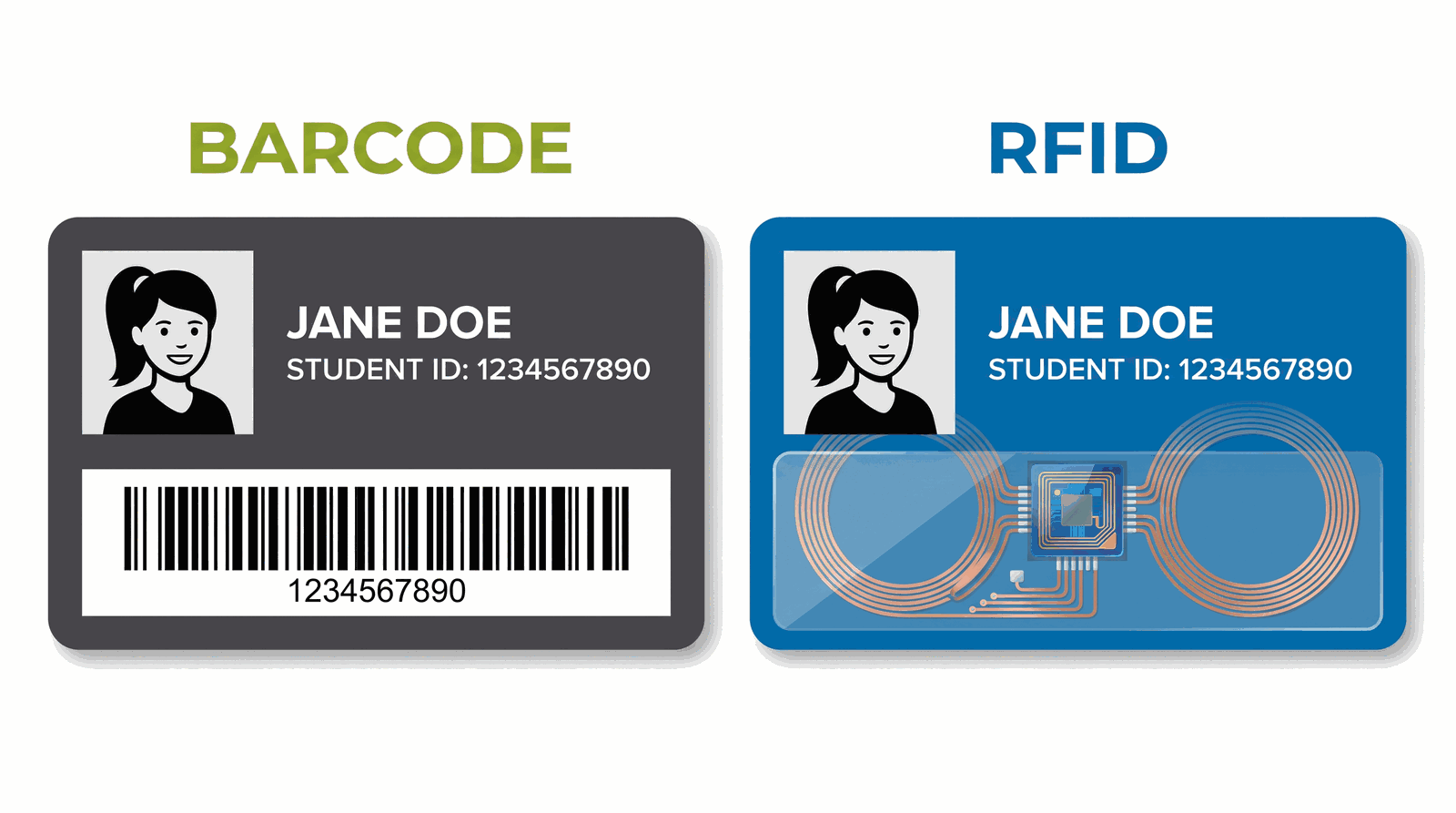
An RFID (Radio Frequency Identification) student ID card contains two core components embedded inside the card: a microchip and an antenna. The most common chips used in student ID applications are the MIFARE family, particularly MIFARE Classic and MIFARE DESFire. Source: CardCube
The MIFARE DESFire chip, for example, operates at 13.56 MHz using the ISO 14443 standard. It performs encryption using Triple DES or AES algorithms and contains a Unique Identifier (UID), a permanent numeric code burned into the chip at the factory that cannot be changed. Source: CardLogix When a student taps their card near a reader, radio waves power the chip and transmit its stored data. No physical contact is required.
The Barcode: A Simple Image of a Number
A barcode, by contrast, is nothing more than a visual image that represents the student's ID number. It is typically printed directly on the card surface as a standard 1D barcode (like a Code 128) or a 2D QR code. There is no chip, no antenna, and no embedded electronics. The barcode scanner reads the pattern of lines or dots and converts it back to the student ID number. It is optically scanned, not radio-transmitted.
This fundamental difference, an encrypted microchip with a factory-assigned UID versus a printed image of a known number, is the root of nearly every operational distinction that follows.
The Complexity Gap: Why RFID Is Harder to Deploy
Because the RFID chip comes with its own factory-programmed number, districts face an immediate data-mapping challenge. You have two options, and both add friction:
- Load the chip's UID into your system and maintain a translation table that maps the chip's internal number to the student's actual ID number.
- Write the student ID number directly onto the chip, which requires encoding hardware, software, and additional setup time.
With a barcode, neither step is necessary. The student's ID number is the barcode. You print it, you scan it, and the system recognizes it immediately. There is no encoding, no UID mapping, and no secondary database to maintain.
This simplicity matters enormously when you are issuing thousands of cards across multiple schools.
Universal Compatibility: One Card, Many Uses
One of the most underappreciated advantages of the barcode approach is interoperability. The student ID number is already the lingua franca of school systems. Your library management platform (like Destiny), your cafeteria point-of-sale system (like My School Bucks), and your student information system (like Infinite Campus, PowerSchools, Skyward) already know that number.
When the barcode is the student ID number, the card works everywhere. No middleware, no translation layer, no integration project is required. RFID cards, by contrast, often require custom integration work to make the chip's UID meaningful to each separate system.
Our experience has shown that the more good reasons you give a student to carry their card, the more likely they are to bring it. When that same card gets them on the bus, checks out a library book, and pays for lunch, it becomes an essential daily item rather than a single-purpose burden.
Scanning Reliability: Why Barcodes Win on the Bus
Here is where our field experience aligns with the broader technical reality. On school buses, UniteGPS observed that barcode scanning achieved nearly 100% scan rates, while RFID cards consistently achieved only around 86%. That 14-point gap is not trivial when student safety is on the line.
Contemporary industry analysis confirms that RFID's reliability is highly dependent on environmental conditions. According to a 2025 overview from Lowry Solutions, barcode precision typically falls between 95% and 98% in operational environments, while RFID systems deliver 90% to 99%+ accuracy only when properly designed and integrated. Source: Lowry Solutions The catch is that achieving RFID's upper range requires precise tag placement, correct tag selection, antenna tuning, and controlled read zones.
In a school bus, none of those ideal conditions exist. The bus frame is metal. Students board quickly, often in groups. Cards are waved at variable angles and distances. Under these conditions, RFID's well-documented vulnerabilities surface:
- Metal interference: Metal reflects, absorbs, or detunes RF signals, causing inconsistent reads, shortened read ranges, or complete signal loss. Source: CYKEO RFID
- Signal corruption: In environments with multiple RF sources, RFID read rates fluctuate unpredictably. Source: CoreRFID
- Tag orientation and collision: When multiple tags enter the read zone simultaneously, data collision can occur, causing missed reads. Source: SEUIC
A barcode scanner, by contrast, simply reads what it sees. As RedBeam notes in a 2024 analysis, one of RFID's biggest disadvantages is that "UHF signals weaken around metal and liquids" and "very high tag populations can cause signal collisions without proper tuning." Source: RedBeam On a school bus, these are daily realities, not edge cases.
In retail and POS environments, barcode scanning has proven exceptionally reliable. Industry data shows barcode scanning drops the manual data entry error rate to roughly 1 in 3 million scans, and retailers using barcode systems report accuracy rates exceeding 99% for order fulfillment. Source: POSZEO
The bottom line: RFID can achieve high accuracy in carefully engineered warehouse environments. A school bus is not a warehouse. The barcode's simplicity becomes its greatest strength.
Scanner Hardware Costs: The Price Gap Is Enormous
The cost difference between barcode and RFID scanners is staggering, and it is one of the most overlooked factors in district budgeting.
At UniteGPS, the barcode scanner we deploy costs $50 per unit. That is it. Fifty dollars.
Tyler Technologies (Traversa/Versatrans) prices an RFID reader kit at $205 per unit. That $205 is the reader kit, not the whole in-bus system. Source: Guardian Route, citing Allen ISD TIPS Contract #210101, approved April 29, 2024. Found to be true on that page as of August 29, 2026. The same Allen ISD schedule lists a Tyler Drive tablet at $1,050 and a mounting kit at $290. Reader kit plus tablet plus mount is $1,545 per bus before software, cellular, or cards.
A typical dedicated industrial RFID reader (the warehouse-style unit, not a bus kit) is $1,000 to $3,500+. Source: Atlas RFID Store fixed-reader listings as of August 29, 2026.
The math, written so the numbers cannot fight:
- Four UniteGPS barcode scanners for the price of one Tyler RFID reader kit ($205).
- About 31 barcode scanners for Tyler’s tablet + mount + RFID kit ($1,545).
- 20 to 70 barcode scanners for one dedicated industrial RFID reader ($1,000 to $3,500).
Card Economics: What Districts Actually Pay
Cost is a decisive factor for most districts, and the gap between barcode and RFID cards is substantial.
The Card Itself
| Card Type | Technology | Approximate Cost per Card (Bulk) |
|---|---|---|
| Blank white PVC card (30 mil) | Barcode | ~$0.06 to $0.25 |
| PVC card with Hi-Co magnetic stripe | Barcode | ~$0.45 |
| RFID-enabled card (MIFARE Classic/DESFire) | RFID | ~$0.50 to $2.00+ |
Blank PVC cards for standard barcode printing are available in bulk for as little as $0.06 to $0.25 each. Source: ID Card Group RFID cards, which contain an embedded chip and antenna, start at roughly $0.50 to $2.00 or more depending on the chip type and volume. For a district with 10,000 students, that per-card difference alone can mean thousands of dollars in annual replacement costs.
The Printing System
For districts that want to print their own cards, a complete on-site printing system (printer, software, camera, and initial supplies) typically ranges from $2,000 to $4,000 for a modern student-ID setup. Source: Education Week Individual printer hardware ranges from approximately $1,595 to $2,995 for models suitable for K-12 environments. Source: ID Card Group
CI Solutions: A Proven Partner for Districts
For districts that do not currently print their own cards, or that want to upgrade their process, we recommend CI Solutions (cardintegrators.com). CI Solutions has built a strong reputation specifically in the K-12 space, offering both full-service print programs and turnkey on-site printing systems.
Westminster Public Schools in Colorado provides a referenceable case study. When the district decided to distribute RFID-enabled cards to track school bus riders, they selected CI Solutions to produce, sort, and distribute each student's ID card before the first day of school. The cards were integrated with their Infinite Campus SIS and also worked with their existing Destiny library and My School Bucks cafeteria programs. CI Solutions then installed RFID card printing systems at each school site so staff could print replacements and new-student cards locally. Source: STN Online
A major cost-saving feature CI Solutions offers is pre-printed card stock. The blanks arrive already printed with your district logo, school colors, and back-of-card information. Your staff only prints the unique student data, name, photo, and barcode, dramatically reducing ribbon usage and print time. Source: CI Solutions
Note on specific CI Solutions pricing: While CI Solutions does not publish standardized district pricing publicly (they provide custom quotes based on volume, card technology, and service level), the industry benchmarks above provide a useful framework for budgeting discussions. For a detailed quote, districts can contact CI Solutions directly at 800-599-7385 or 562-431-2594. Source: CI Solutions
Student Compliance: The Make-or-Break Factor
The best card technology in the world is worthless if students do not bring it to school. This is, in our view, the single most important factor in the success of a deployment.
Approaches that do not require personal responsibility on the part of the student tend to fail. If there is no consequence for forgetting a card, students will forget it. If the card is only used for one thing, say, bus boarding, it is easily dismissed as optional. But when that same card is required for lunch, library checkout, and building access, the incentive structure changes completely.
This is not just about logistics; it is about life skills. Adults carry a pocketful of essential cards every day: driver's licenses, health insurance cards, credit cards, transit passes. Learning to keep track of a physical credential is a small but meaningful step toward personal responsibility. Schools are the right place to teach that lesson.
Industry observers agree that card damage, loss, and forgetfulness are primary failure points in student ridership systems. Source: BusBoss Building a card culture requires district-wide consistency: clear expectations, easy replacement processes, and most importantly, real consequences for non-compliance.
The Smartphone Backup: Meeting Students Where They Already Are
Here is one more reason the barcode approach is future-ready: students already carry cameras in their pockets.
Smartphone ownership among K-12 students is now nearly universal at the secondary level and growing rapidly among younger students:
| Age Group | Smartphone / Cellphone Ownership |
|---|---|
| Up to age 8 | 25% (1 in 4 have their own smartphone) |
| Ages 8 to 12 | 43% own a cellphone |
| Ages 13 to 17 | 95% have access to a smartphone |
Sources: Common Sense Media (2024), UCLA/Transform Schools Collaborative (2025), Pew Research Center (2024)
Because a barcode is simply an image of a number, a student can take a photo of their card and store it on their phone. If they forget the physical card, the bus driver or cafeteria attendant can scan the barcode directly from the phone screen, just like boarding an airplane or entering a concert venue. This is not possible with RFID, which requires physical proximity to a powered chip.
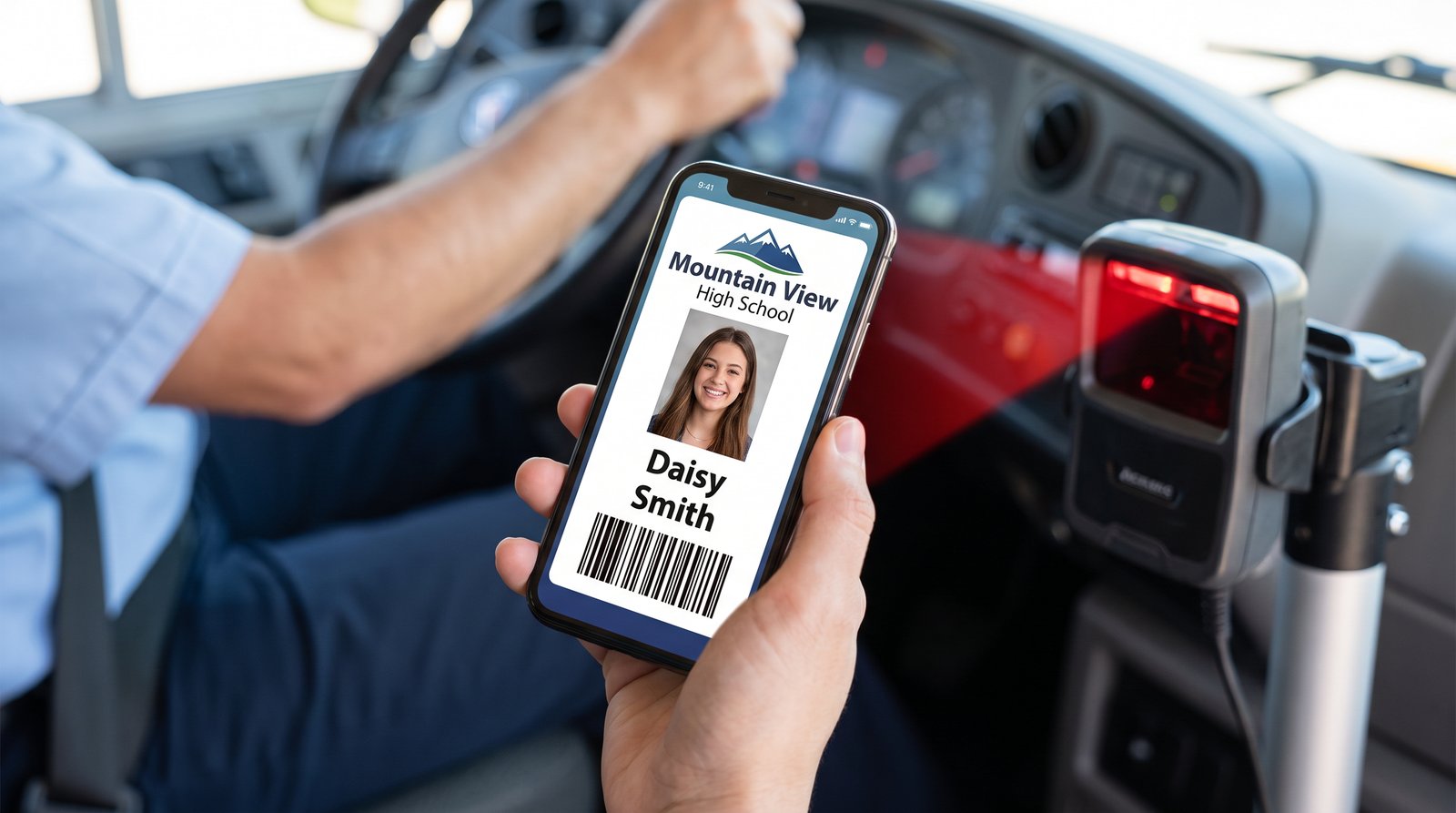
This digital backup option dramatically reduces the operational friction of lost cards while still encouraging students to keep track of the physical credential.
The UniteGPS Digital Student ID: Reducing Reprints Even Further
UniteGPS takes the smartphone backup concept one step further. Through the UniteGPS mobile app, we provide students with a scannable digital student ID that displays their barcode directly on their phone. This means even if a student loses their physical card, or simply forgets it at home, they still have their ID available for scanning on the bus, in the cafeteria, or at the library.
This feature significantly reduces the need for costly card reprints while maintaining full ridership tracking and access control. The digital barcode is tied to the same student ID number used on the physical card, so there is no additional mapping, no separate database, and no extra complexity for district staff. It is the same barcode, just displayed digitally.
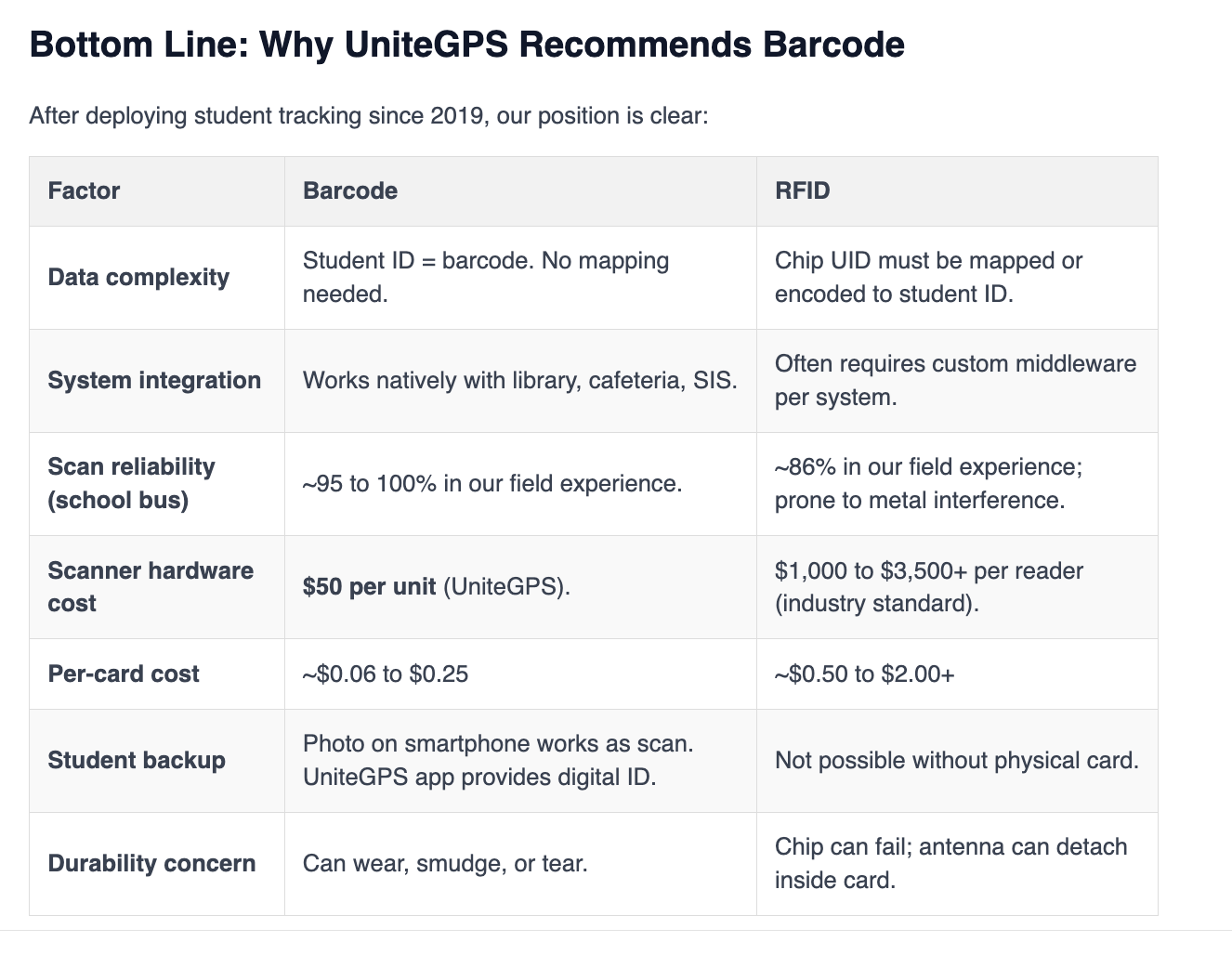
Bottom Line: Why UniteGPS Recommends Barcode
After deploying student tracking since 2019, our position is clear:
| Factor | Barcode | RFID |
|---|---|---|
| Data complexity | Student ID = barcode. No mapping needed. | Chip UID must be mapped or encoded to student ID. |
| System integration | Works natively with library, cafeteria, SIS. | Often requires custom middleware per system. |
| Scan reliability (school bus) | ~95 to 100% in our field experience. | ~86% in our field experience; prone to metal interference. |
| Scanner hardware cost | $50 per unit (UniteGPS). | Tyler RFID reader kit $205 (Allen ISD, 2024). Dedicated industrial RFID readers $1,000 to $3,500+. |
| Per-card cost | ~$0.06 to $0.25 | ~$0.50 to $2.00+ |
| Student backup | Photo on smartphone works as scan. UniteGPS app provides digital ID. | Not possible without physical card. |
| Durability concern | Can wear, smudge, or tear. | Chip can fail; antenna can detach inside card. |
RFID is a powerful technology in the right context: warehouse inventory, high-value asset tracking, and controlled access environments where the infrastructure is carefully engineered. But for the specific, high-volume, high-chaos environment of a K-12 school district, the simplicity, reliability, and cost-effectiveness of barcode scanning is the better fit.
Want to See the Barcode System in Action?
Book a quick 15-minute call and we will walk through your current setup, show you the system live, and calculate your exact savings on hardware, cards, and reprints.
Or call us directly at (207) 591-7777
Competitor Scanning Options
| Competitor (site) | Ridership product | Card technology | Barcode-capable? | Public claim | Ref |
|---|---|---|---|---|---|
| Transfinder (transfinder.com) | Wayfinder + RFID card reader | RFID / NFC primary; barcode/QR via Hardware Suite | Partial | Wayfinder tracks daily ridership; with RFID readers students swipe cards as they board. Dedicated reader supports RFID at 125 kHz and 13.56 MHz; NFC scans faster than an optical (barcode) scanner. 2026 Wayfinder Hardware Suite adds barcode and QR scanning plus PIN-based ID. | 1, 2, 3 |
| Tyler Technologies (tylertech.com) | Tyler Drive (Versatrans / Traversa) | RFID / NFC scan cards | No (not advertised) | Scan-card ridership runs through the Tyler Drive unit or an on-board card scanner and works with either Versatrans or Traversa. Tyler Drive pairs a mobile data terminal with an RFID card reader; students receive RFID scan cards. | 4, 5 |
| Zonar (zonar.com) | Z Pass | Passive RFID (patented) | No | Riders scan a passive RFID card at the Z Pass reader as they board and exit; each scan's date, time and location is captured. | 6 |
| Edulog (edulog.com) | Student Ridership module | RFID | No | Parents are notified when a student swipes an ID card on an RFID card reader boarding and disembarking. | 7 |
| Samsara (samsara.com) | ID Card Reader / Student Tracking | RFID / NFC | No | The ID Card Reader uses RFID; each card carries a unique number that riders tap on and off. Ridership logged via NFC ID card readers or fobs. | 8, 9 |
| SMART tag (smart-tag.net) | SMART tag Ridership | RFID (proprietary reader) | No | A proprietary RFID card reader handles loading and unloading; drivers get a wrong-bus/wrong-stop alert. Students are equipped with RFID cards to confirm the right bus and stop. | 10, 11 |
| BusBoss / Orbit Software (busboss.com) | STUDENTpatrol / ROUTEpatrol | RFID / NFC / Barcode | Yes | STUDENTpatrol uses RFID/NFC/Barcode card readers with tablets or a keypad. ROUTEpatrol tracks ridership with or without cards using NFC or barcode scanners. | 12, 13 |
Competitor Scanning Option References
- https://www.transfinder.com/solutions/Wayfinder
- https://www.transfinder.com/solutions/Hardware_Telematics
- https://stnonline.com/news/transfinder-sweeps-2026-stn-expo-west-innovation-choice-awards/
- https://www.schoolbusfleet.com/articles/rider-tracking-apps-ensure-safety-transparency-peace-of-mind
- https://www.tylertech.com/solutions/k-12-education/student-transportation/student-ridership
- https://www.zonar.com/solutions/z-pass-student-tracking/
- https://www.edulog.com/parent-help/
- https://kb.samsara.com/hc/en-us/articles/360038246191-ID-Cards-for-Student-Transit
- https://www.samsara.com/industries/public-sector/k-12
- https://smart-tag.net/ridership-solution/
- https://smart-tag.net/
- https://www.busboss.com/studentpatrol-gps-tracking
- https://www.busboss.com/routepatrol-tablet-app
Footnote: Publicly available information as of August 15, 2026, gathered from each competitor's website, with refs 3 and 4 sourced to industry press (School Transportation News, School Bus Fleet) where the vendor page confirmed the product but not the card frequency or technology detail.
References and Further Reading
- Pew Research Center — Mobile Fact Sheet (2025). Internet, digital device access among US teens. https://www.pewresearch.org/internet/fact-sheet/mobile/
- Common Sense Media — The Common Sense Census: Media Use by Tweens and Teens (2024). 1 in 4 children have a smartphone by age 8. https://www.k12dive.com/news/half-of-young-children-own-a-cell-phone-or-tablet/741318/
- UCLA / Transform Schools Collaborative — Strengthening K-12 Cellphone Policies (2025). 43% of 8 to 12 year-olds own a cellphone; 88% of 13 to 18 year-olds own a cellphone. https://transformschools.ucla.edu/wp-content/uploads/2025/10/UCLACTSUCCSUCollaborative_K-12CellphonePoliciesBrief_FINALv.3.pdf
- Lowry Solutions — RFID vs Barcode Inventory Tracking (2025). Barcode precision 95 to 98%; RFID 90 to 99%+ with proper implementation. https://lowrysolutions.com/blog/rfid-vs-barcode-which-inventory-tracking-system-is-right-for-your-business/
- CYKEO RFID — RFID Metal Interference (2026). Metal reflects, absorbs, or detunes RF signals causing missed reads. https://www.cykeorfid.com/why-does-rfid-metal-interference-occur-and-how-can-it-be-controlled-in-real-world-deployments/
- CoreRFID — A Guide to RFID Interference (2026). Signal blocking and corruption in commercial deployments. https://corerfid.com/news/rfid-interference/
- SEUIC — RFID Common Troubleshooting Guide (2025). Tag orientation, material interference, and data collision issues. https://www.seuic.us/news-center/product-dynamics/rfid-common-troubleshooting-guide-complete-collection-of-9-major-problem-diagnoses-and-solutions.html
- POSZEO — The Best Barcode System for Retail Shop (2026). Barcode scanning error rate ~1 in 3 million; 99%+ accuracy. https://www.poszeo.com/blog-channel/barcode-system-for-retail-shop/
- FleetOpsClub — Zonar Systems Review (2026). Zonar Z Pass quote-based; 60-bus deployment $200K to $250K over 5 years. https://fleetopsclub.com/software/zonar-systems
- Guardian Route — Tyler Traversa Alternative (2026). Tyler Drive tablet $1,050/unit, mounting kit $290/unit, RFID reader kit $205/unit. https://www.guardianroute.app/compare/tyler-traversa
- CampusIDNews — Texas school district to issue smart tags for bus attendance (2014). SmartTag system roughly $500 per bus plus $1/day Internet and $1 per student ID. https://www.campusidnews.com/texas-school-district-to-issue-smart-tags-for-bus-attendance/
- STN Online — One Powerful Card: Colo. School District Provides Increased Safety and Efficiency (2019). Westminster Public Schools case study with CI Solutions. https://stnonline.com/partner-updates/one-powerful-card-colo-school-district-provides-increased-safety-efficiency/
- CI Solutions — Student ID Card Printing Solutions (2023). K-12 card printing services and systems. https://www.cardintegrators.com/industry-solutions/student-id-card-printing/
- CardCube — RFID vs. Traditional Student ID Cards Explained (2023). Technical breakdown of RFID chip components. https://www.cardcube.net/Blog/834.html
- CardLogix — MIFARE DESFire Definition (2021). Technical explanation of DESFire chip encryption and specifications. https://www.cardlogix.com/glossary/desfire/
- Education Week — Student ID Cards Sport New Digital Features (2010). Student ID system cost framework ($2,000 to $4,000). https://www.edweek.org/leadership/student-id-cards-sport-new-digital-features/2010/01
- ID Card Group — Blank PVC card bulk pricing and printer hardware. https://www.idcardgroup.com/pvc
- BusBoss — Why Student Ridership Verification Fails in Districts (2026). Card loss and damage as primary failure points. https://www.busboss.com/blog/why-student-ridership-verification-fails-in-districts