Between 2015 and 2024, 962 fatal school-bus-related crashes killed 1,069 people nationwide. Among the 204 school-age children who died, 77 were pedestrians struck near a bus, and only 39 were bus occupants, according to NHTSA crash data. That gap says a lot: the biggest danger isn't riding the bus. It's getting on and off it.
For districts, every one of those incidents carries real weight. Liability exposure, angry parent calls, climbing insurance premiums, and drivers who replay a near-miss in their head for weeks afterward.
Here's the reassuring part: school buses remain one of the safest ways to get kids to school - NHTSA reports that children on school transportation account for less than 1% of all traffic fatalities. Most of the remaining risk doesn't come from the vehicle. It comes from driver decisions and district-level processes. This post breaks down practical steps for both.
TL;DR
- Loading and unloading zones carry more day-to-day risk than the ride itself
- Pre-trip inspections, distraction-free driving, and strict stop-arm protocol are the top driver habits
- Districts need training, maintenance oversight, and tracking technology working together, not in isolation
- Rushed inspections and under-prepared substitutes quietly compound risk over a school year
- Safety holds up through daily discipline, not an annual checklist
Practical Safety Tips for School Bus Drivers
Drivers are the front line of student safety. Most preventable incidents trace back to a handful of habits: pre-trip diligence, danger-zone awareness, and defensive driving. Get these right, and you eliminate the majority of avoidable risk before the bus even leaves the lot.
Pre-Trip and Route Preparation
A standardized pre-trip inspection isn't busywork. It's the single habit that catches problems before they become incidents. Every route should start with a check of:
- Brakes and tires
- Mirrors and lights
- Stop-arm function
- Emergency exits and equipment
This matters more than most drivers assume. A GAO review of fatal school-bus crashes from 2000-2014 found that a mechanical defect was cited in less than 1% of cases, while the driver was cited as a contributing factor in 27%. The vehicle usually isn't the problem. Preparation is.
Route familiarity matters just as much. Review your pickup and drop-off list daily, especially if you're covering for a colleague. Wrong-stop errors happen most often when a driver is guessing instead of confirming.
Turn-by-turn navigation tools that show student names and arrival times at each stop have become standard in many districts. They turn an unfamiliar route into a manageable one.
Loading and Unloading Zone Safety
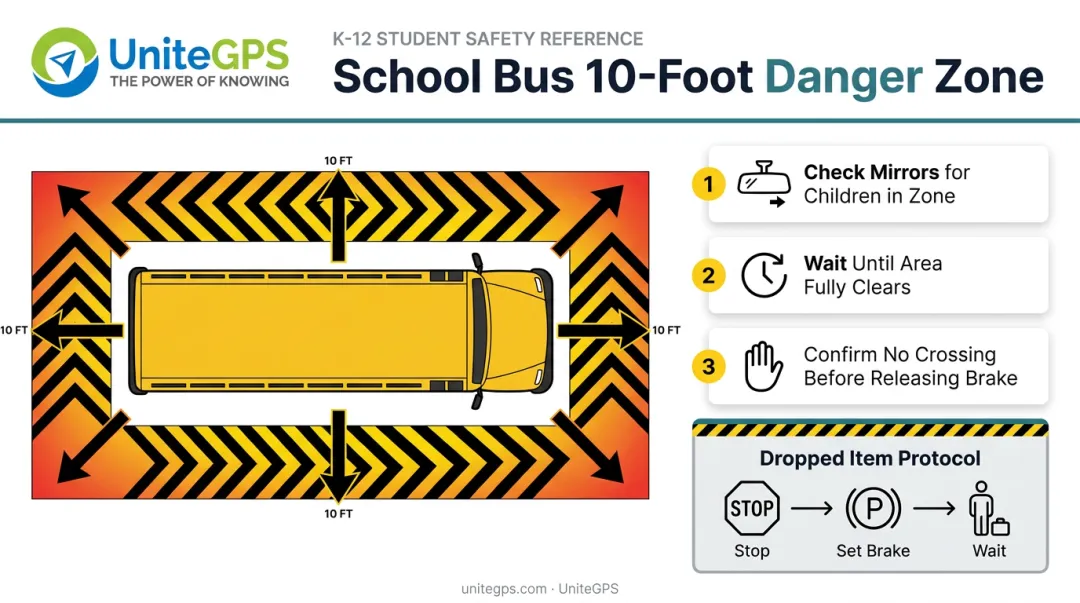
The danger zone extends roughly 10 feet in front, behind, and on either side of the bus. Kids inside that zone are hardest for a driver to see, and that's exactly where most loading-related incidents happen.
Before you move the bus:
- Check front, side, and rear mirrors for any child still in the zone
- Wait until every student has cleared the area completely
- Confirm no one is crossing behind or in front before releasing the brake
Dropped items create a specific risk. A backpack, paper, or phone falling near the bus can send a child ducking back into the danger zone without warning. If that happens, stop immediately, set the parking brake, and wait for the item to be retrieved safely. Don't wave the student to hurry.
Flashing lights and the stop-arm sequence exist for a reason. Activate them early, hold the sequence through the full loading or unloading process, and never move until every student is seated or safely across the road.
On-the-Road Driving Discipline
Phones, radios, and tablets can wait until the bus is parked. Distraction while moving, even for a few seconds, is one of the easiest risks to eliminate entirely.
Pair that habit with safe following distances. In rain, snow, or fog, stopping distances double or triple, so leave extra room.
Railroad crossings deserve their own discipline. Under 49 CFR 392.10, buses must stop within 50 feet of the tracks, but no closer than 15 feet. Look and listen before crossing in a gear that lets you finish the crossing without shifting. No exceptions, no shortcuts.
Practical Safety Tips for School Districts
Districts set the systems, training, and culture that either reinforce or undermine what drivers do behind the wheel. Good driver habits only stick when the district builds the structure around them.
Driver Training, Screening, and Policy
Training requirements vary by state, and the variation is significant. Florida requires 40 hours of preservice training, including 20 classroom hours and 8 behind-the-wheel hours, plus CPR and first aid. Ohio requires at least 15 classroom hours and 12 hours of behind-the-wheel training with a certified instructor.
Whatever your state minimum, treat it as a floor, not a ceiling.
Beyond initial training, districts need:
- Recurrent training covering defensive driving, student management, and emergency response
- Ongoing MVR monitoring to catch violations before they become patterns
- Written, enforced policies for stop-arm use and loading zone procedures, not informal expectations passed driver to driver
Fleet Maintenance and Technology Oversight
NHTSA's guideline for pupil transportation recommends a systematic preventive maintenance program with inspections at least semiannually. It also calls for a daily pre-trip inspection with written reporting of anything that could affect safe operation. That written part is where a lot of districts fall short. A verbal "it's fine" doesn't hold up during a liability review.
Digital inspection tools close that gap. Platforms like UniteGPS's Crosswalk let drivers complete pre- and post-trip inspections on a tablet and attach photos of issues like worn tires or cracked glass. The report goes straight to a mechanic's device or shop screen, so there is no lag between spotting a problem and someone acting on it.
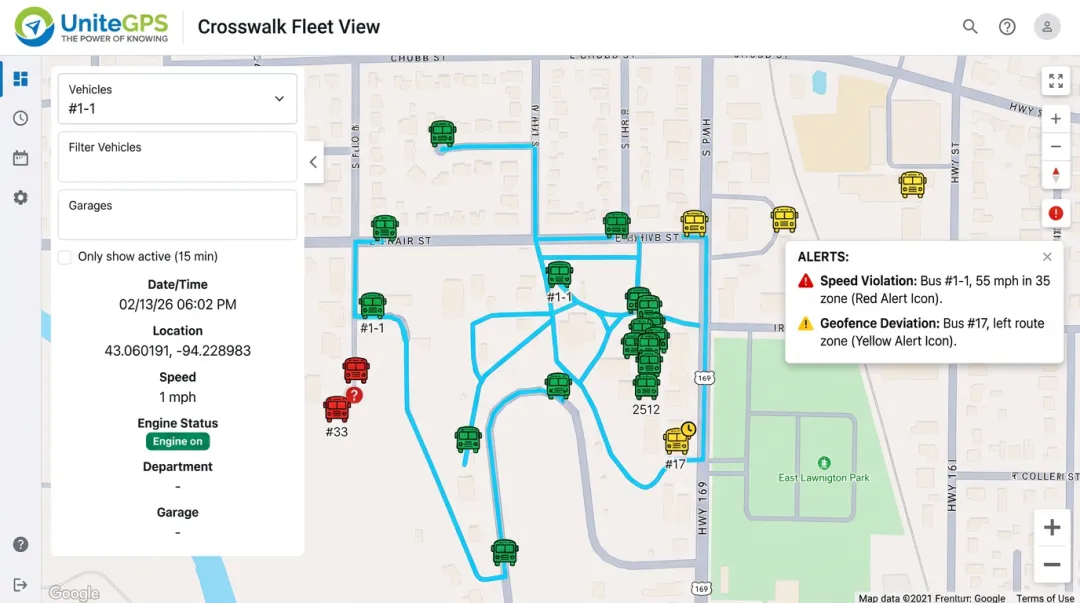
GPS tracking adds another layer of oversight. Crosswalk's Fleet View shows every bus on one map with color-coded status indicators. Dispatchers can spot a delayed or off-route bus at a glance instead of checking vehicles one by one. Speed and geofence alerts flag unsafe driving or unexpected deviations automatically, without anyone watching a screen full-time.
Emergency Preparedness and Communication
NHTSA recommends a supervised, timed evacuation drill at least once each semester. Some states go further. Pennsylvania, for example, requires two drills per year: one in the first week of school and one in March.
Pair those drills with quick driver access to updated medical and emergency contact information for every student on the route.
Communication protocols matter just as much during an actual delay. Districts need a clear chain from driver to dispatch to parents, with no guessing about who sends the update.
How Technology Strengthens School Bus Safety Programs
Real-time GPS tracking gives dispatchers something manual check-ins never could: instant confirmation of whether a bus is on route. Crosswalk's Speed Monitoring tool highlights deviations on a timeline, lets staff filter by route or alert type, and shows exactly when and where something went off script.
That's a very different process from waiting for a parent to call and ask where the bus is.
Other tools close gaps paper logs cannot:
- Tablet scan-on/scan-off ridership records who boarded and exited at each stop
- Turn-by-turn navigation that shows the next stop, expected students, and arrival time
- Parent tools such as Find My Routes so families can check bus location themselves
Ridership tracking matters when a manual headcount misses a student on a crowded route. Timestamped scan data supports safety verification and IEP or Medicaid documentation. Tim Lyons, Director of Transportation at Benton Community School District, put it plainly:
"If a parent calls saying that the bus didn't stop, we can look and see that they were there. It has made a huge difference in our district."
Turn-by-turn navigation helps substitute and unfamiliar drivers in a quieter way. The screen shows the next stop, who should be there, and when they are due—so missed stops become far less likely.
Parent-facing location tools add another layer. When families can check the bus themselves, far fewer "where is the bus?" calls hit the transportation office during a delay.
Common School Bus Safety Mistakes to Avoid
Even well-run districts fall into predictable traps. Three stand out:
Rushing pre-trip inspections. Under time pressure, drivers skip steps. A cracked stop-arm light or soft brake pedal a full inspection would catch goes unnoticed until it becomes a bigger problem.
Sending substitutes out unprepared. A sub who doesn't know the route or the danger zones around specific stops is far more likely to miss a stop or misjudge a loading situation. Route orientation isn't optional just because the assignment is temporary.
Assuming stop-arm compliance is universal. It isn't. During the 2024-2025 school year, drivers surveyed by NASDPTS reported 67,258 illegal passes on a single survey day across 36 states—more than 39.3 million when extrapolated over a 180-day year. Motorists blowing past stopped buses remain one of student transportation's most persistent risks.
Conclusion
School bus safety comes down to two things working together: the discipline of individual drivers and the systems districts build to support them. Neither replaces the other. A perfectly maintained bus doesn't help if the driver skips the danger-zone check, and a diligent driver can't compensate for a district with no training standards or maintenance oversight.
Treat safety as something you reinforce daily through training, maintenance, and the right technology—not a checklist you revisit once a year. When routing, live GPS, and ridership tools support drivers in the moment, districts close the gap between policy and practice.
Frequently Asked Questions
What are the top school bus safety tips?
Pre-trip inspections, danger-zone awareness during loading and unloading, and distraction-free driving cover most of the risk. These three habits, done consistently, prevent the majority of preventable incidents on a route.
What are common safety concerns for school buses?
Loading and unloading zones, illegal passing by motorists, and substitute drivers unfamiliar with their routes are the most frequent concerns raised by transportation directors. All three involve human decisions rather than mechanical failure.
How can school districts improve bus safety without increasing costs?
Enforcing existing written policies, running low-cost recurrent training sessions, and adopting affordable GPS or routing technology all improve safety without a major budget increase. Entry-level routing platforms often start under $200 a month for a full fleet.
What should a school bus driver do during a pre-trip inspection?
Check brakes, mirrors, lights, stop-arm function, and tire condition before every route. Any issue should be reported in writing immediately, not mentioned verbally at the end of the shift.
How does GPS tracking improve school bus safety?
Real-time GPS lets dispatchers verify a bus is on its approved route and flag unexpected deviations or delays as they happen. Administrators and parents also get visibility they didn't have with manual check-ins.
What is the leading cause of school bus-related injuries?
Most fatalities involving school transportation happen outside the vehicle, particularly from illegal passing by motorists and incidents in the loading or unloading zone. Riding the bus itself remains statistically safer than the walk to and from it.