Every school morning, thousands of buses pull up to curbs and crosswalks across the country, and the biggest risks to students rarely happen inside the vehicle. Illegal stop-arm passing incidents keep transportation directors up at night, parents now expect to track their child's bus the way they'd track a food delivery, and state reporting requirements keep tightening.
Districts often treat "school bus safety" as a line item: a policy binder, a checkbox for the state auditor. But the real payoff shows up in daily operations. Fewer near-misses at the curb. Faster answers when a parent calls asking where their child is. Less time spent second-guessing whether a bus actually stopped where it should have.
This article breaks down what actually makes school bus safety programs work in practice, not just what they promise in a sales pitch.
Key Takeaways
- School buses are among the safest ways to reach school, but real risk lives at the loading zone and roadway
- Effective programs combine three layers: ridership tracking, stop-arm enforcement, and driver/vehicle safety systems
- Districts without structured programs see more parent complaints, slower incident response, and rising liability exposure
- The right technology partner turns scattered data into a program districts can actually manage
What Is a School Bus Safety Program
A school bus safety program combines technology, training, and policy into one coordinated system. Together, these elements protect students before they board, while they ride, and after they step off the bus.
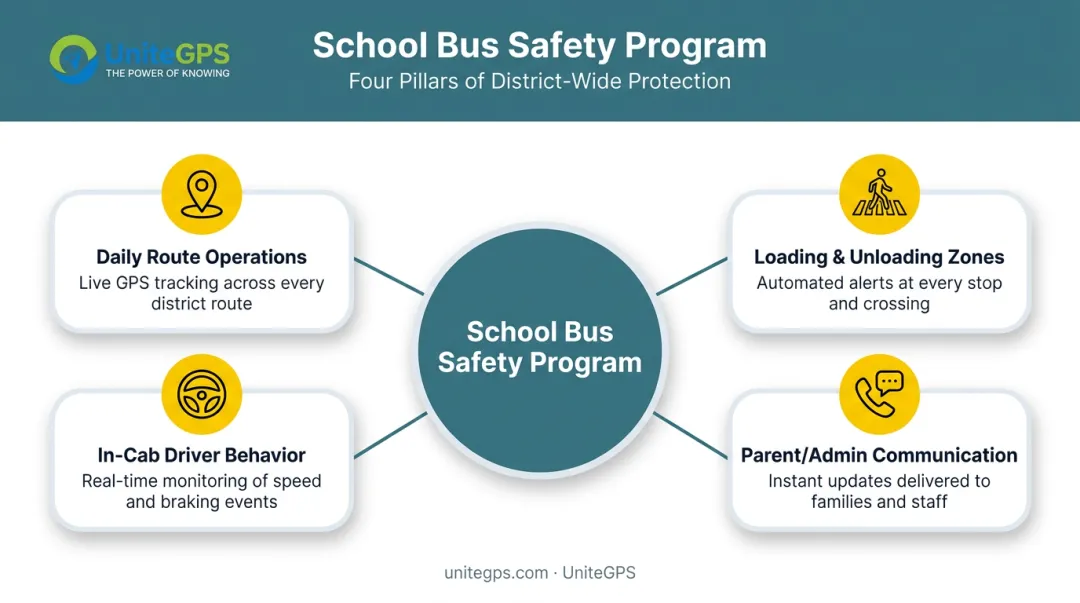
In practice, that system touches four areas:
- Daily route operations, including GPS tracking and on-time performance
- Loading and unloading zones, where most transportation-related student injuries happen
- In-cab driver behavior, from stop-arm compliance to defensive driving habits
- Communication with parents and administrators, especially during delays or emergencies
Building these pieces is only part of the job; what matters is how districts use them. Compliance alone isn't the end goal.
Programs built only to satisfy an auditor tend to produce paperwork instead of safer outcomes. Programs built to reduce injuries and build accountability produce both: districts that can prove what happened on any given route, on any given day, and use that proof to make real changes.
Key Advantages of School Bus Safety Programs
The advantages below aren't abstract safety talking points. They tie directly to numbers districts already track: violation counts, ridership accuracy, response time, and parent complaint volume. If a safety program can't move at least one of these metrics, it isn't adding operational value, no matter how it's marketed.
Real-Time GPS Tracking and Student Ridership Accountability
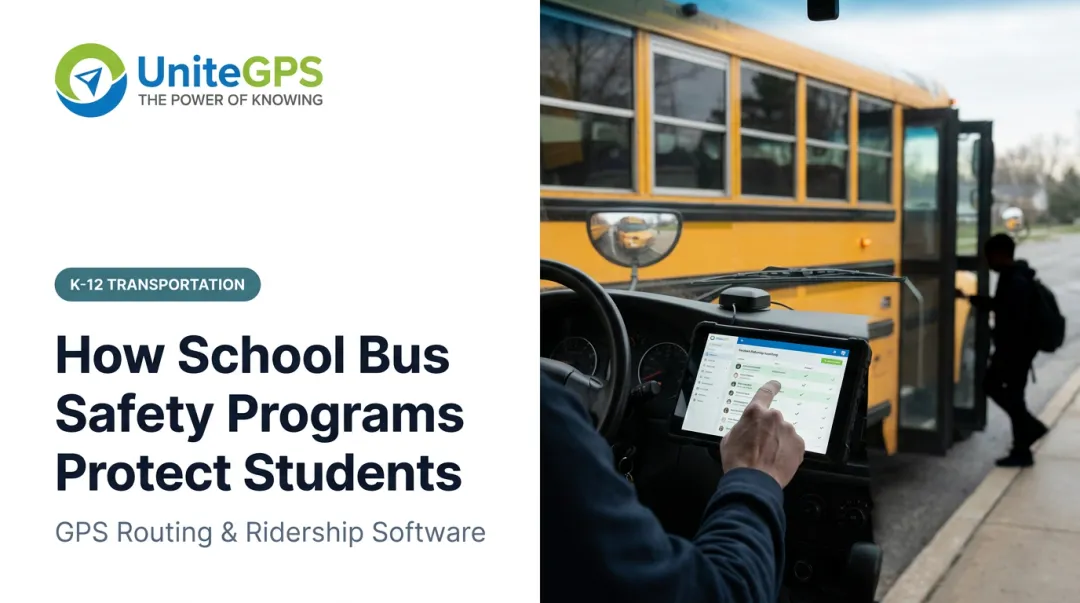
GPS-enabled tracking paired with tablet-based ridership scanning lets districts confirm, with a timestamp, exactly which students boarded, rode, and exited each bus. That replaces the paper clipboard and the driver's memory, which is where most ridership gaps used to start.
The real-world impact shows up fastest during a crisis. A dispatcher can pull up a single bus's location in seconds instead of radioing every driver on the route. Parents get an accurate arrival estimate instead of guessing at a stop in the rain, wondering if the bus already came and went.
Why this matters: federal crash data makes the case for where the actual danger sits. Of 204 school-age children killed in school-transportation-related crashes between 2014 and 2023, 77 were pedestrians and 39 were occupants of the bus itself, according to NHTSA's crash data on school-transportation-related traffic crashes.
The risk concentrates outside the vehicle, at the curb and the crosswalk, not inside it. That's exactly where ridership visibility and accurate stop timing do the most good.
Ridership tracking also closes the "which bus, which student" gap that used to slow down emergency response. When a parent calls asking why their child wasn't dropped off, transportation staff can check scan records instead of relying on a driver's recollection from three routes ago.
KPIs this advantage moves:
- Ridership accuracy rate
- Parent call volume to the transportation office
- Incident response time
- Route completion verification
When it matters most:
- Severe weather delays, when ETAs shift by the hour
- Special education transport, where individualized pickup and drop-off details carry higher stakes
- District-wide emergencies, when knowing a student's exact bus location isn't optional
Platforms like UniteGPS's Crosswalk system were built around this exact need. The system updates bus positions every five seconds and lets staff look up a specific student's assigned bus, current location, and expected stop time through a feature called Find My Routes, replacing the paper roster.
For districts running the tablet suite, barcode scan-on and scan-off records add a second layer: proof of who actually boarded, not just where the bus is.
Stop-Arm Enforcement and Illegal Passing Prevention
Stop-arm cameras and AI-based violation detection target the leading cause of student injury and death in school transportation: vehicles illegally passing a stopped bus. These systems capture license plates automatically, generate citations without an officer present, and create a documented deterrent that a warning letter never could.
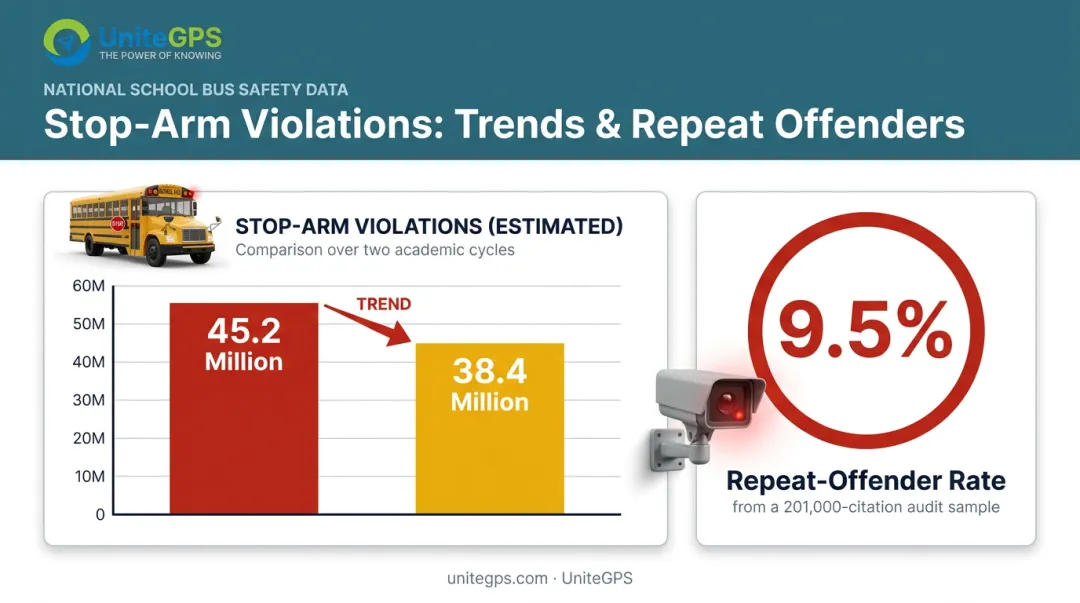
Why this matters: the scale is larger than most districts assume. The 2026 NASDPTS national survey estimated 38.4 million illegal passing incidents annually, based on a one-day count from 101,334 drivers across 39 states and DC, according to NASDPTS's national stop-arm violation data.
That figure has declined from 45.2 million two years earlier, but it still represents millions of moments where a stopped bus, arm extended, wasn't enough to stop traffic.
Camera programs also show low repeat-offender rates once citations start arriving. A Suffolk County, New York audit found that of more than 201,000 citations mailed, roughly 9.5% involved repeat offenders. That's not proof that total violations always drop district-wide, but it does show that once a driver gets caught on camera, they're far less likely to do it again on the same route.
KPIs this advantage moves:
- Violation counts per route
- Repeat-offender rate
- Citation-to-conviction rate
- Near-miss reports from drivers and staff
When it matters most:
- High-speed roads where an approaching driver has less time to react to a stopped bus
- Routes that require students to cross a roadway to reach their stop
- Districts operating in high-traffic-density areas, where visibility and following distance are already compromised
Driver Training, Vehicle Safety Systems, and Route Risk Assessment
Compartmentalization, seat belts, collision avoidance systems, and structured driver training make up the vehicle- and behavior-level layer of protection. On the ground, this looks like annual route and stop hazard reviews, refresher training modules for drivers, and buses equipped with automatic emergency braking or fire suppression systems.
Why this matters: compartmentalization, the high-backed, energy-absorbing seating that's been standard on buses for decades, works well in many crashes but doesn't prevent every injury, particularly in rollovers, side impacts, or crashes with severe intrusion.
The National Transportation Safety Board's 2025 investigation into a Leander ISD crash found that properly worn lap and shoulder belts reduced injury severity in the area of maximum intrusion. The board reiterated its recommendation for lap/shoulder belts on all new large school buses, according to NTSB's crash investigation report.
Route reassessment matters just as much as equipment. Ohio requires districts to audit routes, stops, and pickup/drop-off sites at least annually. Virginia requires the same cadence, plus a reassessment whenever conditions change.
Neither state waits for an incident to force the review. Districts that pair these reviews with tablet-based turn-by-turn navigation also cut down on a quieter risk: substitute drivers guessing at unfamiliar stops mid-route.
KPIs this advantage moves:
- Crash severity rate
- Driver training completion rate
- Number of routes flagged for hazard remediation
When it matters most:
- Purchasing new bus fleets, where belt and safety system specs get locked in for a decade or more
- Onboarding new drivers or substitutes, who need refresher training before their first solo run
- Routes with river crossings, rail crossings, or high-speed roads
What Happens When Safety Programs Are Missing or Ignored
When districts treat school bus safety as reactive rather than structured, the same patterns show up almost every time.
- Inconsistent enforcement: Without automated violation detection, stop-arm offenders on quiet routes go unchecked simply because no one was there to see it
- Rising parent call volume: Without ridership and location visibility, every "where is my child" question becomes a phone call, and every disputed pickup becomes a he-said-she-said conversation
- Reactive incident response: A near-miss at an unmarked rail crossing or blind turn often gets addressed only after it happens, so the fix always arrives one incident too late
- Higher liability and insurance costs: Unresolved safety gaps compound over time, and insurers weigh claims history, exposure, training, and maintenance together at renewal
- Oversight that doesn't scale: Adding routes, buses, or substitute drivers without reliable tracking spreads oversight thinner right when it needs to be strongest
None of these problems announce themselves immediately. They show up as a slow accumulation of complaints and near-misses, until a single serious incident forces the district to explain why the gaps were never addressed.
How to Get the Most Value from a School Bus Safety Program
A safety program only delivers full value when technology, training, and enforcement get applied consistently across every route, not just the ones with the most complaints or the worst crash history.
Three practices separate districts that get real value from those that just own the tools:
- Review outcomes on a regular cadence. Track violation data, ridership accuracy, and response times monthly or quarterly, not just after an incident forces a look.
- Act on what the data shows. Insights sitting in a dashboard don't help anyone. Adjusting a route, retraining a driver, or escalating a repeat stop-arm violator to law enforcement is what turns data into safer outcomes.
- Unify the tools instead of stacking them. Districts running separate systems for GPS, ridership, and route planning end up with fragmented data and manual entry that undermines the whole point of tracking anything in the first place.
That third point is where a lot of districts lose value without realizing it. A GPS system that doesn't talk to the ridership scanner creates gaps. So does a route planner that requires re-entering the same student data every semester. These are exactly the kind of gaps a safety program is supposed to close.
A platform like UniteGPS's Crosswalk system addresses this by unifying GPS tracking, ridership data, and route planning into one system, so districts aren't stitching together spreadsheets, standalone trackers, and manual rosters.
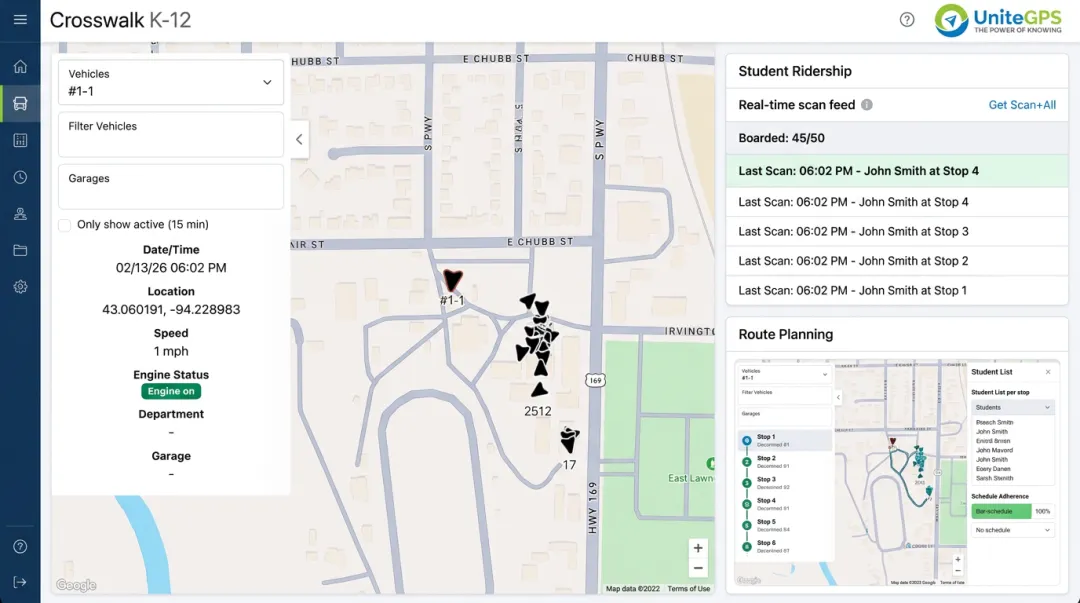
When Tim Lyons, Director of Transportation at Benton Community School District, described switching to Crosswalk, he put it simply: "If a parent calls saying that the bus didn't stop, we can look and see that they were there." That's the kind of proof a fragmented system can't produce on demand.
Conclusion
Effective school bus safety depends on three things working in sync: visibility into what's happening on every route, fast answers when a parent or administrator needs one, and consistent data across tracking, enforcement, and training. No single tool covers all three on its own. Platforms like UniteGPS's Crosswalk K-12 combine routing, GPS tracking, and ridership data specifically to close that gap.
The payoff builds over time. Better ridership and route data help transportation directors flag stops that need a second look, identify drivers due for refresher training, and spot routes overdue for a hazard review. Fewer incidents follow, and with them comes the kind of parent trust no compliance checklist can manufacture.
That trust isn't something a district earns once and files away. School bus safety works best as an ongoing practice, refined every semester as routes change, drivers turn over, and new hazards show up on the map.
Frequently Asked Questions
What is the school bus safety program in my state?
Programs vary by state but generally combine driver certification requirements, stop-arm violation laws, and route safety standards set by the state department of education or transportation. Check your state's pupil transportation office for specifics.
What are the most common school bus safety issues?
The most common issues are illegal passing of stopped buses, inconsistent seat belt or restraint use, and the risks students face while crossing a roadway to reach their stop. Most incidents cluster around the loading and unloading zone rather than inside the moving bus.
How do school bus safety programs protect students outside the bus?
Stop-arm cameras, crossing-guard training, minimized roadway-crossing stops, and annual route hazard reviews all target the loading and unloading zone, since that's where most transportation-related student injuries actually happen.
What technology is used in modern school bus safety programs?
Districts typically deploy GPS tracking, RFID or barcode ridership scanning, AI-powered stop-arm cameras, dashcams with driver behavior alerts, and collision avoidance systems. Most programs combine several of these rather than relying on just one.
Are school buses safer than cars?
Yes. School buses remain among the statistically safest vehicles on the road, largely due to compartmentalized seating along with professional driver training and certification requirements that private vehicle drivers aren't held to.
Who enforces school bus stop-arm laws?
Local law enforcement typically issues citations, often based on video evidence from stop-arm cameras rather than an officer witnessing the violation directly. Penalties and civil fines vary by state law.