It's 6:45 AM and the transportation office phone is already ringing off the hook. A parent wants to know why the bus hasn't shown up. The dispatcher has no way to check, because the only tracking tool is a driver's cell phone and a hope that they answer.
Meanwhile, the transportation director is toggling between a routing spreadsheet, a paper maintenance log, and a separate system for student rosters that hasn't synced since last Tuesday.
This is the daily reality for a lot of districts. School bus fleets have gotten far more complex — GPS routing, ridership tracking, compliance documentation, driver shortages — yet many transportation offices are still running them on tools built for a much simpler era.
This guide breaks down where the real headaches come from and the modern, integrated approach that districts nationwide are using to eliminate them.
Key Takeaways
- Most fleet headaches trace back to five recurring, fixable problems, not staffing gaps
- Consolidating routing, GPS, ridership, and SIS data into one platform cuts manual work and errors
- Real-time visibility for parents directly reduces "where's the bus" calls to the front office
- Vendor stability and trial periods matter as much as feature lists when choosing software
What Does "School Bus Fleet" Really Mean Today?
A school bus fleet used to mean one thing: the vehicles parked in the lot overnight. That definition doesn't hold up anymore.
Today, a fleet is the full system a district relies on to move students safely: vehicles, drivers, routes, and the technology layer connecting all of it. GPS tracking, routing engines, ridership tools, and student information system (SIS) integrations now directly determine how well a fleet actually performs.
Fleet managers juggle several moving parts at once:
- Vehicles — availability, maintenance schedules, and readiness
- Routes — stop assignments, timing, and constant address changes
- Drivers — regular staff and substitutes who need clear guidance
- Compliance documentation — inspections, Medicaid billing, IEP transportation records
- Communication — keeping parents and administrators informed without flooding the office with calls
That last point is where most daily friction starts. When any of these pieces slip, the headaches stack up fast.
The Real Headaches Behind Fleet Management
Most fleet frustration isn't a staffing problem. It's a process problem — the same handful of avoidable issues showing up in district after district.
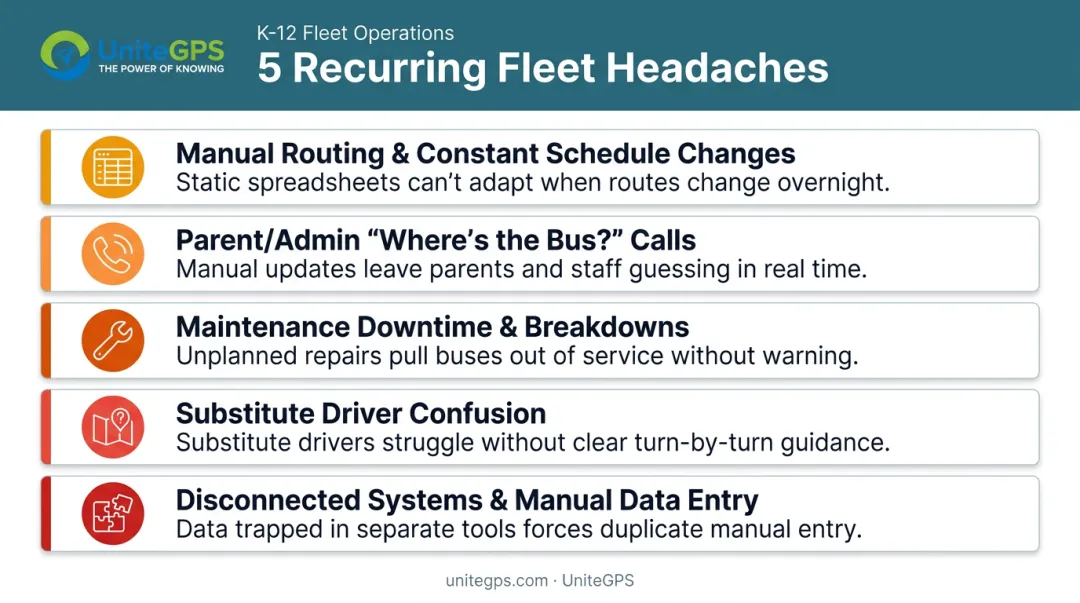
Manual Routing and Constant Schedule Changes
Student transportation data changes constantly. New addresses, revised school schedules, roster updates — industry reporting confirms that this information "can change daily," which means hand-built routes break down just as often.
When routes live in a spreadsheet, every change means manual rework. Staff redo stop sequences by hand, increasing the odds a stop gets missed entirely.
Parent and Admin Calls About "Where's the Bus?"
Without real-time visibility, the transportation office becomes a call center. Research on routing data shows that giving parents live arrival information sharply reduces those calls. Staff get hours back for actual operations instead of the phone.
Maintenance Downtime and Breakdowns
Reactive maintenance (fixing things only after they break) creates a predictable cascade:
- Last-minute vehicle swaps disrupt planned routes
- Missed pickups happen when no backup bus is ready
- Repair costs climb over time compared to scheduled servicing
Substitute Driver Confusion
A substitute on an unfamiliar route without turn-by-turn guidance is more likely to miss a stop or run long. Missed stops are a safety issue, not just a scheduling inconvenience.
Disconnected Systems and Manual Data Entry
Districts frequently run separate systems for routing, SIS data, and Medicaid billing. Procurement records from Jefferson County Public Schools explicitly required routing software to update bus assignments directly inside Infinite Campus. That requirement exists because manual re-entry wastes staff hours and introduces errors that hit both safety and reimbursement accuracy.
Best Practices for a Headache-Free Fleet
You can fix most of these problems without adding staff by consolidating fragmented tools into one connected platform.
Centralize Routing and GPS Tracking in One Platform
When route planning and live GPS tracking share a single system, managers can see vehicle location, adjust for delays, and dispatch a replacement bus in real time instead of guessing. That combined approach is what UniteGPS built Crosswalk around, based on conversations with transportation directors who needed operational tools before parent-facing features.
Sync With Your Student Information System
Automatic SIS synchronization with platforms like PowerSchool, Skyward, or Infinite Campus eliminates duplicate manual entry. Rosters and routes stay current district-wide without anyone re-typing a single address.
Track Ridership With Tablets for Safety and Accountability
Tablet-based ridership tracking confirms exactly which students boarded and disembarked, and when. That creates:
- Documented proof of safe transport for administrators
- Real-time confirmation for parents when a child boards or arrives
- A defensible audit trail for IEP and Medicaid documentation
Equip Drivers (Including Substitutes) With Turn-By-Turn Navigation
In-cab turn-by-turn directions, complete with audible guidance and student information at every stop, let any driver run an unfamiliar route confidently. A substitute logging in for the first time gets the exact same navigation and stop data as the regular driver, without needing to call dispatch for help.
Get Support That Doesn't Leave You Waiting
Route changes and system issues don't wait for a support ticket queue to open up. Live, unlimited support from specialists who understand K-12 transportation (not generic help desk agents) directly reduces operational stress during time-sensitive moments.
What to Look for When Choosing Fleet Management Technology
Not every platform is built the same way. The wrong choice can create new headaches instead of solving old ones.
Integration Capabilities
A platform should connect with the systems you already use, not force manual data transfer. Look for:
- SIS connectivity so student and enrollment data stays in sync
- GTFS feed support if you also run transit routes
- Medicaid billing documentation built into the workflow
Vendor Stability and Long-Term Partnership
Private equity-backed software vendors have a track record of changing pricing, support quality, or product direction after an acquisition.
UniteGPS has taken the opposite path: bootstrapped since 2014, founder-led, and profitable without outside investment pressure. Product decisions stay focused on what districts actually need, not what investors want to see next quarter.
Trial Periods and Onboarding Support
A no-risk trial period lets your team validate a platform before committing budget. UniteGPS offers a 90-day free trial with no credit card required, during which the team builds your routes for you and handles SIS integration setup.
Data Security and Compliance
FERPA compliance isn't optional when a platform handles ridership or student location data. Under FERPA regulations, education records—including route, stop, and ridership data tied to a specific student—require strict handling.
Any vendor should also apply strong encryption, role-based access controls, and clear data ownership terms that keep districts in full control of their information.
Emerging Trends Shaping School Bus Fleets
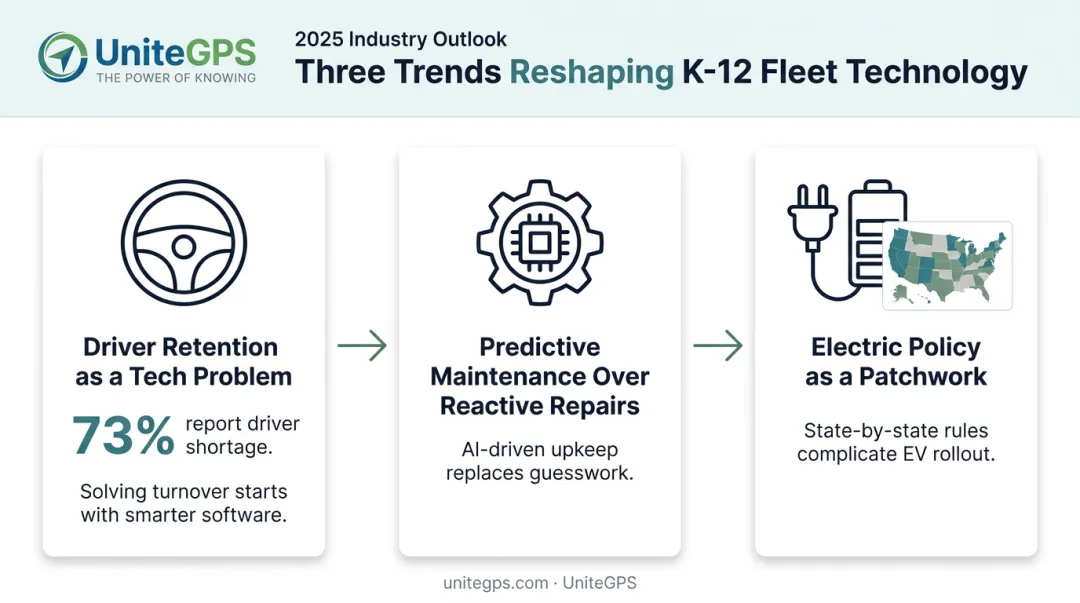
Three shifts are reshaping how districts run buses day to day:
- Driver retention as a tech problem. A 2025 industry survey of private school-bus contractors found that 73% reported a mild-to-moderate driver shortage. Simpler navigation and less admin work help districts keep the drivers they have.
- Predictive maintenance over reactive repairs. AI-enabled diagnostics are moving fleets from breakdown fixes toward data-based scheduled service, cutting the unplanned downtime that disrupts routes.
- Electric policy as a patchwork. Federal and state programs differ on timelines and funding, so many districts extend diesel lifespans and plan phased transitions instead of a full conversion rush.
Districts that treat these trends as operational priorities—not side projects—avoid the worst of the headaches that follow.
Frequently Asked Questions
What does "school bus fleet" mean?
A school bus fleet is the complete system a district uses to transport students: the vehicles, drivers, routes, and the technology (GPS, routing, ridership tools) that keeps them all running together.
What is the most popular school bus brand?
Blue Bird, Thomas Built Buses, and IC Bus are the three leading manufacturers in the U.S. market. Fleet management software works across all major brands, so your choice of software isn't tied to your vehicle manufacturer.
How much does school bus fleet management software cost?
Pricing depends on fleet size, feature set, and whether you need GPS hardware or tablets. A free trial is the practical way to get a quote matched to your district instead of relying on generic industry averages.
How can GPS tracking reduce parent calls to the transportation office?
Real-time visibility through a parent app lets families check their child's bus location themselves. That self-service option cuts inbound "where's the bus" calls to your front office.
What is the difference between fleet management software and basic GPS tracking?
Basic GPS tracking shows only vehicle location. Full fleet management software adds routing, ridership tracking, SIS integration, and reporting on top of that location data.
How long does it take to implement a new school bus fleet management system?
Timelines depend on district size and how ready your existing data is. Platforms that pair a trial period with live onboarding and route-building support usually get districts running faster.