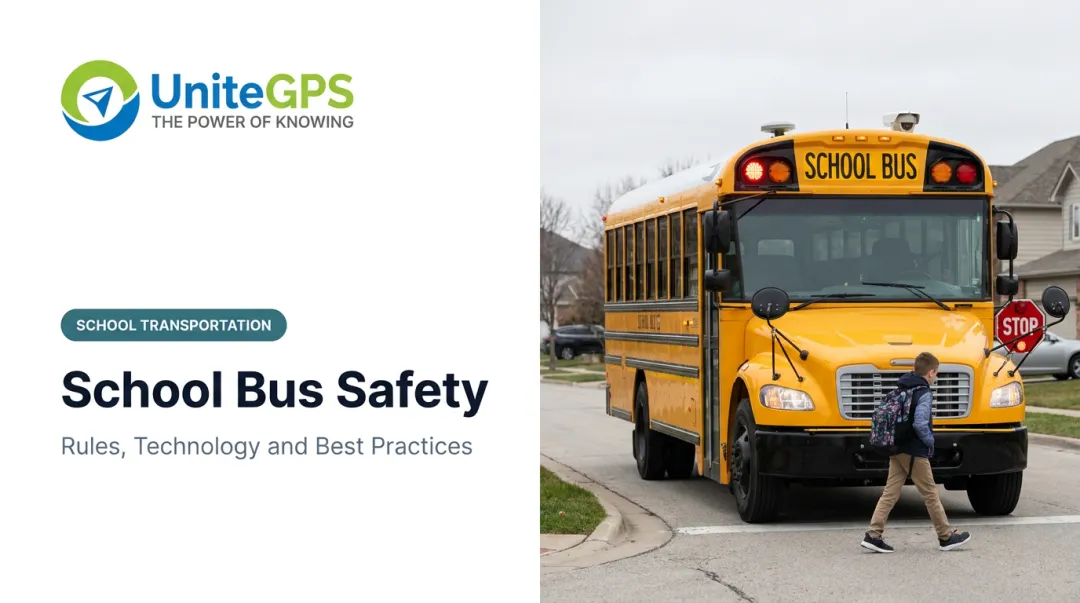
NHTSA notes that 26 million children ride school buses every day in the US, according to the agency's driver-service curriculum. Behind that number sits a daily balancing act: safety compliance, operational efficiency, and parent communication, all managed with limited staff and often aging fleets.
This guide breaks down the regulations districts must track, the technology reshaping fleet operations, and practical steps for building a safer, smarter bus program.
Key Takeaways
- Overlapping federal, state, and district rules demand continuous compliance tracking—not a one-time check
- GPS tracking, ridership verification, and route optimization are now baseline fleet requirements
- Documented, tech-supported safety programs reduce incidents, parent complaints, and admin workload
- Inspection and credential gaps create real liability exposure during audits or after incidents
Why School Bus Fleet Management and Safety Go Hand in Hand
Fleet management and safety compliance aren't separate departments; they're the same system viewed from different angles. Routing, maintenance schedules, and GPS tracking are the operational backbone. Inspections, driver conduct, and credential monitoring are the safety backbone. Weaken one, and the other suffers.
When both sides hold, the data shows it. NHTSA crash research found 0.2 school-bus fatalities per 100 million vehicle-miles, compared to 1.5 for passenger cars (a 2002 comparison that still shapes how the industry thinks about bus safety).
More recent NHTSA data (2014-2023) counted 1,079 deaths in 971 school-bus-related crashes, with 70% of those being occupants of other vehicles, not the bus itself.
That said, underinvestment still carries real costs:
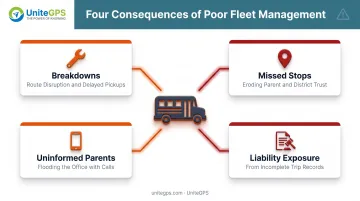
- Breakdowns from missed maintenance windows disrupt routes and instructional time
- Missed stops erode trust and generate complaint calls
- Uninformed parents flood transportation offices with status inquiries
- Liability exposure grows when inspection or credential records are incomplete
None of this is theoretical. A June 2026 Arizona Auditor General report on Tombstone USD found 8 of 31 buses pulled from service in one fiscal year, with maintenance records missing for roughly half the reported fleet. That's the kind of documentation gap that turns a routine audit into a crisis.
Understanding School Bus Laws and Safety Regulations in the US
The Federal Baseline
NHTSA's Federal Motor Vehicle Safety Standards (FMVSS) govern the manufacture and sale of new school buses — not how districts operate them day to day. A school bus, by NHTSA's definition, carries 11 or more people and must include features like stop arms and FMVSS 222's energy-absorbing seating compartments.
Driver credentials fall under FMCSA rules:
- CDL with P and S endorsements required for transporting pre-K-12 students to and from school or school events
- Medical certificates renewed every 24 months (12 months for certain diabetes or vision cases)
- Motor vehicle record (MVR) checks at least annually for covered drivers, with a full 10-year license history pulled at hiring
Ordinary school-bus operations are largely exempt from most FMCSRs except a specific list of provisions. States fill in the gaps, often with stricter rules than federal law requires.
Inspection Requirements
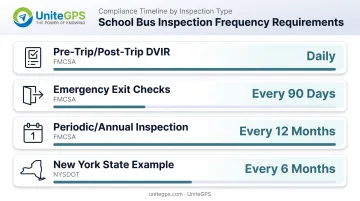
| Inspection Type | Frequency | Governing Authority |
|---|---|---|
| Pre-trip/post-trip DVIR | Daily | NHTSA guidance / state adoption |
| Emergency exit checks | Every 90 days | 49 CFR 396.3 (where applicable) |
| Periodic/annual inspection | At least every 12 months | 49 CFR 396.17 |
| State example (New York) | Every 6 months | NYSDOT |
State Variations Districts Must Track
- Stop-arm camera laws: at least 30 states authorize them as of late 2025
- Seat belt mandates: differ sharply by state—fleet policies must match the rules where each bus operates
- Inspection cadence: some states exceed the federal 12-month minimum (New York, for example, requires checks every 6 months)
Stop-arm laws exist because illegal passing is still common. A 2026 NASDPTS survey projected more than 38.4 million illegal stop-arm passings nationwide for the school year—a slight improvement year over year, but still a figure that leaves districts heavily exposed.
Documentation gaps compound the risk. A 2017 NYC Comptroller audit found processing deficiencies in nearly a quarter of sampled license-suspension notifications, some handled a full week late. When credential tracking slips, liability follows.
Modern Technology Powering Fleet Management and Safety
Real-Time GPS as the Foundation
Live GPS tracking gives dispatchers and parents visibility into where a bus actually is, not where it's scheduled to be. Route deviation alerts flag problems before they become complaints. **68% of surveyed public-school districts now use some combination of rider tracking and parent apps**, according to a 2025 School Bus Fleet district survey — a sign this category has moved from novelty to expectation.
Ridership Verification
Tablet or card-based scanning creates a timestamped record of exactly which student boarded which bus, and when. This isn't just a safety feature. It also supports Medicaid billing documentation for special-education transportation, replacing manual attendance sheets with scan-verified, audit-ready records.
SIS Synchronization
Manual roster entry is a recurring failure point. Automated SIS sync pulls enrollment, address, and school-assignment data directly into routing software, eliminating duplicate entry and reducing errors when students transfer or move mid-year.
Driver-Assist Navigation
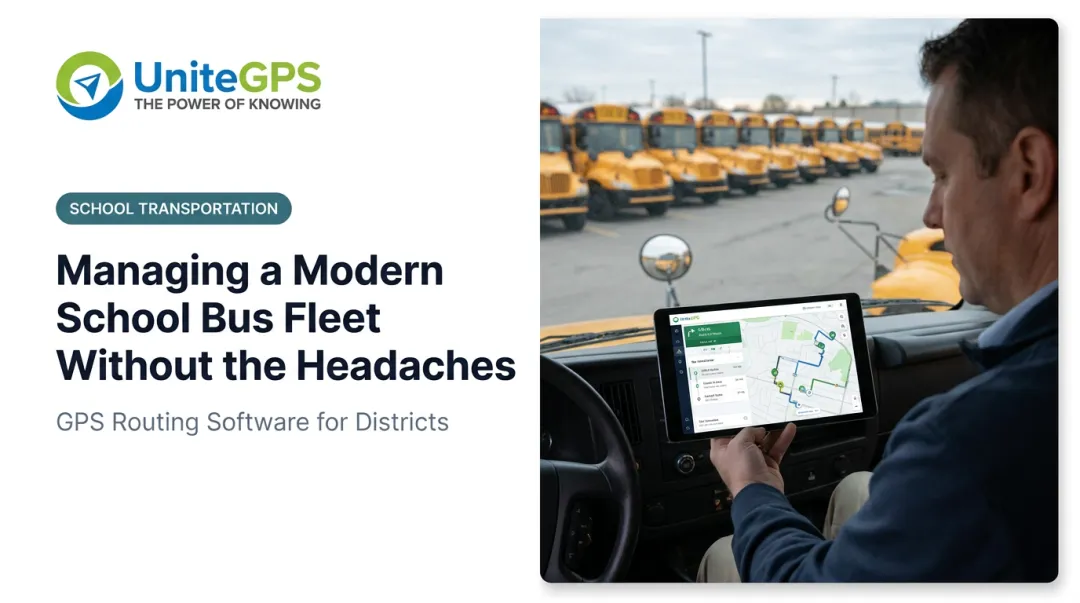
Turn-by-turn tools matter most on the days routes go sideways, usually when a substitute driver is covering someone else's route. School-bus-specific navigation shows the full stop order, student names at each stop, and audible directions, cutting reliance on paper maps or another driver's memory.
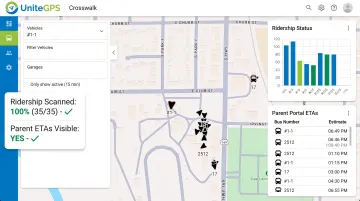
These tools work best when they share one system instead of living in separate products. UniteGPS's Crosswalk platform combines them for K-12 transportation:
- Live GPS updates every 5 seconds
- Ridership scanning on tablet or card
- SIS sync with PowerSchool, Skyward, and Infinite Campus
- Parent-facing ETA visibility
Everything runs in a single environment, so dispatch, drivers, and families work from the same data.
Emerging Tools Districts Are Watching
A 2026 industry survey put AI-based route optimization and predictive maintenance alerts among top planned investments, though national adoption data is still thin. Stop-arm cameras are also gaining regulatory traction across states.
Best Practices Checklist for Daily Fleet Safety
Small daily habits keep minor defects from becoming roadside failures. Use this checklist to tighten inspections, credentials, and parent updates.
- Digitize pre-trip and post-trip inspections: Paper forms get lost or filled out incompletely. Digital logs with photo attachments (cracked glass, worn tires) send issues straight to maintenance.
- Automate credential and maintenance alerts: Track CDL endorsement renewals, medical certificate expirations, and service milestones before they lapse.
- Set a parent communication protocol: Real-time delay notifications cut the "where's the bus" calls that flood the transportation office.
Choosing the Right Fleet Management Software for Your District
When evaluating vendors, prioritize:
- GPS accuracy and update frequency
- SIS integration with your existing enrollment system
- Ridership tracking capability, especially if you bill Medicaid for IEP transportation
- Ease of use for both drivers and dispatchers
- Support responsiveness: a queue-based ticket system slows down urgent issues
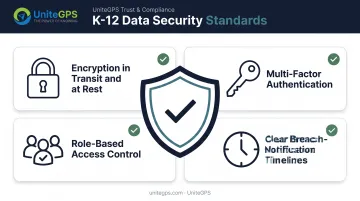
Data security deserves particular attention. These platforms handle student names, addresses, and route assignments, so FERPA compliance isn't optional. Look for:
- Encryption in transit and at rest
- Multi-factor authentication
- Role-based access control
- Clear breach-notification timelines
Vendor stability matters just as much. Districts should favor companies with a track record of long-term partnership over platforms backed by private equity and built for rapid scaling and exit. Those incentives don't always align with a district's decade-long transportation needs.
UniteGPS offers a 90-day free trial with no credit card required, during which its team builds the district's initial routes and configures SIS synchronization. Support comes through unlimited live access to K-12 transportation specialists, without a ticketing queue. That combination makes it a low-risk way to move off spreadsheets or basic routing tools.
Frequently Asked Questions
What is the best software for tracking school buses?
The right fit depends on district size and needs. Strong platforms combine real-time GPS, ridership tracking, and SIS integration. UniteGPS is built for K-12 districts and prices by fleet size across routing, GPS, and tablet tiers.
What are the laws regarding school buses in the USA?
Federal NHTSA and FMCSA rules set baseline vehicle design and driver credential standards. States then add their own requirements around stop-arm cameras, seat belts, and inspection frequency.
What are the latest technologies used in school buses?
GPS tracking, ridership verification tablets, stop-arm cameras, and AI-based route optimization are the leading categories districts are adopting or evaluating.
What are the system requirements for bus apps?
A smartphone or tablet with GPS and data connectivity, a compatible OS version, and reliable cellular coverage along the bus routes.
How often should school buses be inspected for safety compliance?
Daily pre-trip and post-trip inspections are required, plus emergency exit checks every 90 days where federal rules apply. Annual state DOT inspections are the minimum; some states, like New York, inspect every 6 months.
How can districts reduce parent complaints about bus delays?
Real-time tracking apps that show live ETAs reduce calls to the transportation office, since parents can check bus location themselves instead of calling to ask.