Introduction
It's 6:45 a.m., and a mother stands at the curb with her son, breath fogging in the cold, watching for a bus that might show up in five minutes or fifteen. She has no way to know which.
That exact scene, repeated at thousands of stops every morning, is what pushed one frustrated Maine parent to build the first version of a GPS tracking platform for school buses back in 2014.
GPS tracking often gets pitched as a convenience feature, something that saves families a few minutes of guessing. Its real value shows up in the moments that matter most.
A student steps off the curb. A dispatcher needs an exact location during an emergency. A district has to confirm which driver was speeding through a school zone.
This article breaks down the specific ways GPS technology makes student transportation measurably safer, not just more convenient.
Key Takeaways
- Real-time GPS shortens stop wait times so students spend fewer minutes alone at the curb
- Ridership tracking logs every board and deboard, flagging wrong stops and missing students fast
- Driver behavior alerts catch speeding and route deviations before they become incidents
- Without GPS data, districts respond slower in emergencies and lack an audit trail afterward
- Purpose-built K-12 platforms beat generic fleet tools on parent alerts and student-specific safety features
What Is GPS for School Buses (Brief Context)
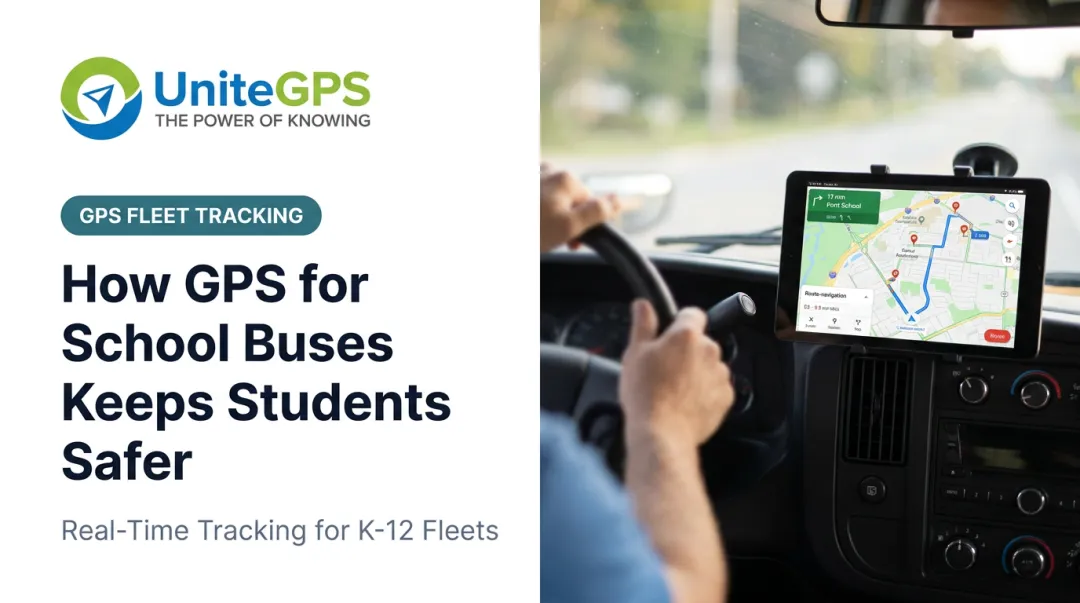
GPS for school buses works through a small satellite receiver installed on each vehicle. It transmits real-time location data to a secure platform that dispatchers, school staff, and parents can access from a computer or phone.
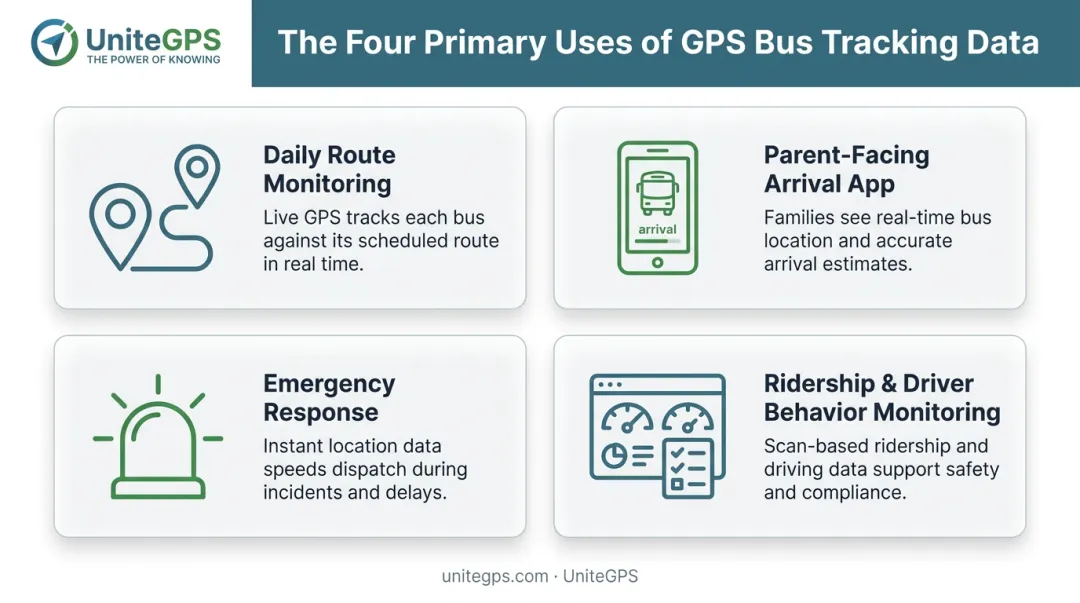
Districts typically use this location data for four things:
- Daily route monitoring, so dispatchers can see where every bus is at any moment
- Parent-facing apps showing live bus location and arrival estimates
- Emergency response, giving staff an exact vehicle location instantly
- Ridership tracking and driver behavior monitoring, layered on top of raw GPS data
Adoption has moved fast over the past few years, with ridership tracking and parent apps now common features rather than the exception.
What matters is the visibility districts and families need to prevent incidents before they happen, and to respond fast when something does go wrong.
Key Ways GPS Tracking Keeps Students Safer
The sections below aren't about efficiency claims. Each one ties to a specific safety mechanism GPS enables, and a measurable outcome districts and parents actually care about.
Reduces Time Students Are Exposed at Unpredictable Stops
Without GPS, families rely on a printed schedule that assumes perfect traffic, perfect weather, and a driver who never runs behind. Real mornings don't work that way. A fender-bender two miles up the route, a snow squall, a construction detour — any of these pushes a bus 10 or 15 minutes off schedule, and nobody at the stop knows it.
Real-time GPS with predictive arrival times changes that. Parents can check an app and time their walk to the stop within a few minutes of the bus actually showing up, instead of standing outside for a fixed 20-minute window just in case.
Why less waiting time matters for safety:
- Every extra minute at an unsupervised curb or roadside adds exposure to passing traffic, extreme weather, and unfamiliar adults
- A Kansas State Department of Education 2024-25 loading/unloading survey recorded six pupil fatalities at bus stops nationwide, including victims as young as five
- All six of those incidents involved the school bus itself, not a passing vehicle, which points to how much risk concentrates in the boarding and deboarding window rather than during the ride
Shorter, more predictable wait times also change the relationship between families and the transportation office. Parents who trust the arrival estimate stop calling to ask "where's the bus?" — which frees up dispatchers to handle actual problems instead of routine status checks.
KPIs this affects: on-time performance, average stop-wait duration, parent call volume.
When this matters most:
- Winter climates, where extra minutes outside carry real health risk
- Rural routes with long distances between stops and no shelter
- Districts with a history of inconsistent on-time performance
Creates Verified Boarding and Deboarding Accountability
GPS shows where a bus is. It doesn't show who's on it. That distinction matters enormously when something goes wrong, and it's the reason ridership tracking exists as a separate layer on top of raw location data.
Tablet or card-based ridership systems solve this by having each student scan an ID or barcode when boarding and exiting. Every scan gets a timestamp and a location tag, creating an auditable record of exactly which students were on which bus, at which stop, at what time.
Why this closes a real safety gap:
- Without a boarding record, a student dropped at the wrong stop can go unnoticed until a parent calls asking where their child is
- School Bus Fleet documented a 2019 case where a 5-year-old special-needs student was dropped at the wrong NYC school, about half a mile from her stop
- Ridership systems remove the guesswork. If a parent calls saying the bus never stopped, staff can pull the record and confirm exactly what happened
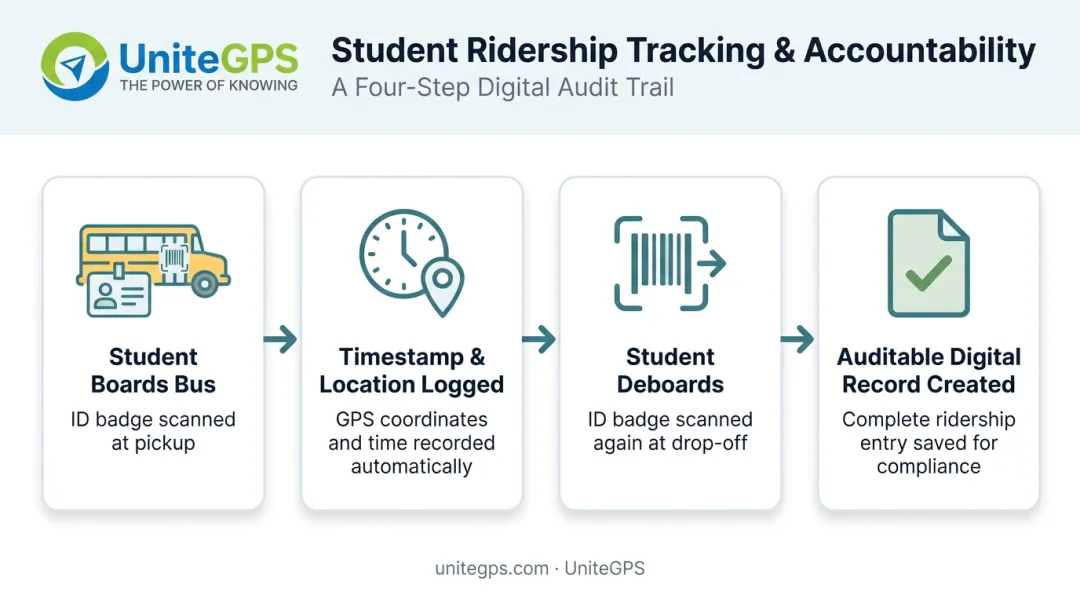
This is the gap UniteGPS's early district partners flagged as more urgent than location tracking alone. When the company rolled out tablet-based ridership tracking on every route in 2019, it was because transportation directors needed to know who was on the bus, not just where the bus was.
Tim Lyons, Director of Transportation at Benton Community School District, put it simply: "If a parent calls saying that the bus didn't stop, we can look and see that they were there."
KPIs this affects: incident response time, ridership accuracy, audit and compliance readiness.
When this matters most:
- Large districts running dozens of stops and transfers per route
- Special education transport, where a missed pickup or drop-off carries outsized risk
- Any emergency requiring an immediate accounting of which students were on a specific bus
Improves Driver Behavior and Route Compliance
Manual oversight can't catch a driver going 15 mph over the limit on a rural stretch, or quietly reversing a route without telling dispatch. GPS data can, and it does it continuously rather than after a complaint gets filed.
Modern platforms turn raw location data into automated alerts for supervisors: speeding events, unauthorized route deviations, and geofence breaches, all flagged in near real time. UniteGPS's platform, for example, updates vehicle positions every five seconds and lets supervisors filter and review deviation events with a timeline slider, building a documented record of what happened and why.
Why behavior monitoring is a direct risk-reduction tool:
- An NTSB investigation of a 2016 Chattanooga crash found the driver hit roughly 52 mph in a 30 mph curve, killing six students and injuring 26
- The bus had GPS installed, but the district wasn't monitoring route adherence; records later showed the driver had reversed the route days earlier unnoticed
- Six students had complained about the driver's erratic behavior five days before the crash, and no one removed him from the route
GPS data only creates safety value when someone is actively watching it and acting on it. Districts that review speeding and deviation alerts weekly can coach an at-risk driver before a pattern becomes a headline, instead of reconstructing what happened after the fact.
KPIs this affects: speeding incidents, route deviation frequency, crash and near-miss rate.
When this matters most:
- Substitute or new drivers unfamiliar with a route
- High-traffic urban corridors with tight margins for error
- Districts already under public scrutiny after a prior incident
What Happens When GPS Tracking Is Missing or Ignored
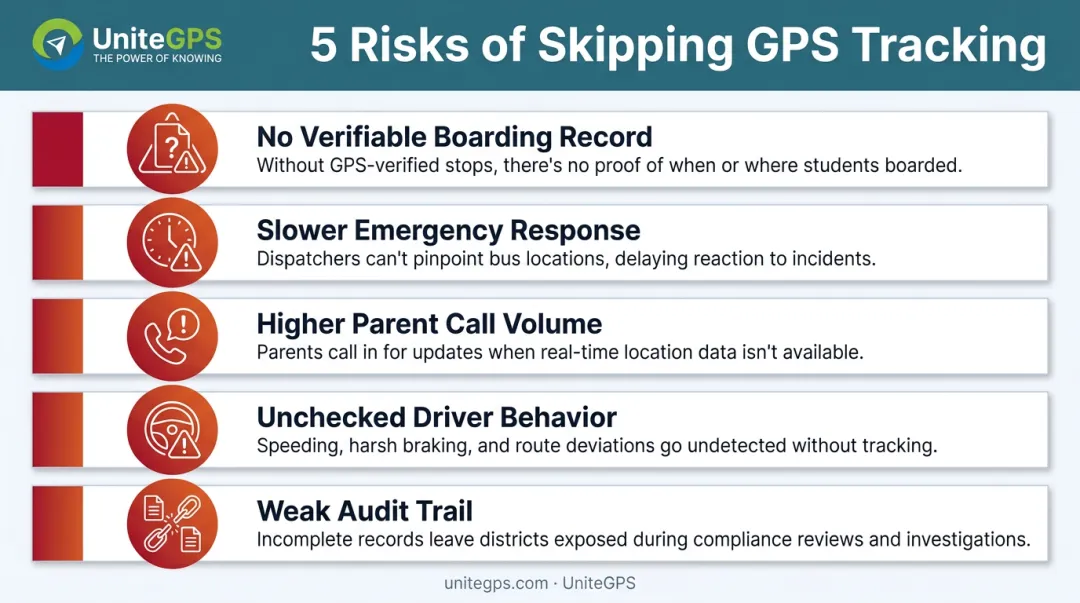
Districts still relying on manual tracking or a basic dot-on-a-map tool tend to run into the same problems, over and over.
- No verifiable boarding record. If a student's whereabouts come into question, there's no data trail to confirm who was on which bus — a real liability gap during an incident investigation.
- Slower emergency response. Dispatchers without live location data can't tell responders exactly where a bus is; they're working from a schedule, not a fact.
- Higher parent call volume. Vague or inconsistent arrival information means more calls, less trust, and a transportation office spending hours on status checks.
- Unchecked driver behavior. Speeding and route deviations go unnoticed until a complaint or a crash forces a review, as the Chattanooga case above illustrates.
- Weak audit trail. Reconstructing what happened after an incident becomes guesswork, which complicates insurance claims and district accountability.
A district without GPS isn't guaranteed a bad outcome. But the tools to prevent, catch, and respond to problems simply aren't there when something goes wrong.
How to Get the Most Value from GPS Tracking
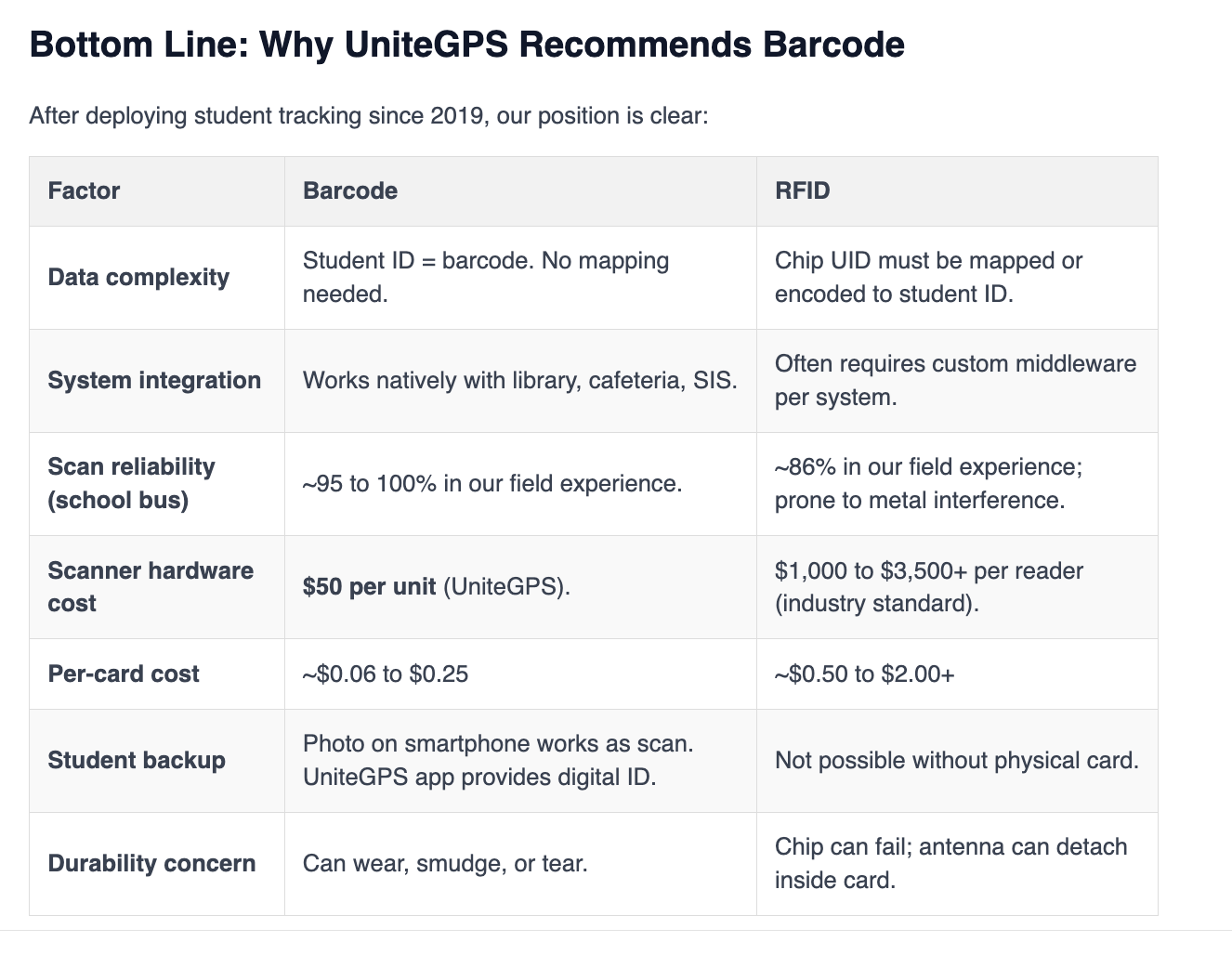
GPS location data by itself answers one question: where's the bus right now? That's useful, but it isn't the same as student safety. Platforms that improve safety pair GPS with ridership tracking, parent apps, and school-level dashboards: the tools that confirm a child boarded, exited, and arrived where they were supposed to.
That's also why generic commercial fleet software tends to fall short for K-12 districts. A delivery fleet doesn't need FERPA-compliant data handling, boarding confirmation workflows, or a way for a school secretary to check which bus a specific student rides.
| What to look for | Generic fleet GPS | K-12-built platform |
|---|---|---|
| Student boarding confirmation | Not available | Scan-based ridership tracking |
| FERPA-compliant data handling | Rarely built-in | Standard requirement |
| Parent-facing arrival app | Not applicable | Core feature |
| School-level visibility | Not applicable | Zone maps, roster sync |
When vetting a provider, the technology matters, but so do the terms around it:
- Trial length and cost — insist on a real trial, not a rushed demo. UniteGPS offers 90 days free, no credit card, with routes built at no cost
- Support responsiveness — a 6 a.m. routing issue can't sit in a ticket queue; look for unlimited live support from K-12 specialists
- Data privacy compliance — confirm the vendor acts as a school official under FERPA, with a signed data processing agreement and clear ownership terms
Conclusion
The real safety value of GPS comes from three mechanisms working together: less time exposed at unpredictable stops, a verified record of who boarded and exited, and oversight that catches risky driver behavior before it becomes a crash.
None of these benefits appear the day a GPS unit gets installed. They compound over months, as districts act on the data — coaching drivers, correcting stop times, closing gaps in ridership records — rather than just collecting numbers on a dashboard.
That's the mindset UniteGPS has built its platform around for more than a decade: GPS-based transportation technology as an ongoing safety practice, shaped by feedback from the districts using it every day—not a one-time install you set up and forget. If your district is weighing GPS for student safety, start by mapping which of these three mechanisms you need most, then evaluate platforms against that standard.
Frequently Asked Questions
Can you use GPS on a school bus?
Yes. GPS units are commonly installed on school buses nationwide, and some cities and districts now require them by policy or law for safety and accountability.
What is the best GPS app for school bus drivers?
The best options combine bus-specific turn-by-turn navigation, built around pre-approved routes, with direct dispatcher connectivity. Purpose-built K-12 platforms typically outperform generic consumer navigation apps designed for cars.
What is the best tracker for kids on a school bus?
A standalone personal tracker isn't ideal. A district-wide ridership tracking system integrated with GPS verifies boarding and deboarding for every student automatically, without relying on individual devices.
Do all school buses have GPS trackers?
Not universally. GPS isn't federally mandated, but adoption has grown fast. Some cities, like New York, require it on contracted routes, and most districts now adopt it voluntarily for safety and efficiency.
How does GPS tracking improve student safety on school buses?
It shortens the time kids wait at unpredictable stops, creates a verified boarding and deboarding record, and flags risky driver behavior like speeding before it turns into an incident.
Can parents see their child's bus location in real time?
Yes, most modern platforms include a parent app showing live location and arrival estimates. Platforms with ridership tracking can also confirm the exact moment a child boarded or exited.