Introduction
School transportation budgets are under real strain. A 2021 national survey of transportation professionals found that 91% of respondents altered elementary school service because of workforce shortages, with similar disruptions at middle and high school levels.
Labor is the largest lever. Ohio’s FY2020 cost analysis showed labor at 58% of per-bus operating expenses, and driver wages alone at 37%. For most districts, workforce and day-to-day efficiency decide whether costs climb or fall.
That pressure comes from three places: system design choices, how daily operations run, and external cost drivers districts cannot fully control. This guide covers cost-reduction strategies across all three—focused on durable savings that protect service quality instead of cuts that hurt students.
TL;DR
- Transportation costs build quietly across fuel, labor, maintenance, and admin—not one budget line
- Biggest cost drivers: inefficient routes, manual processes, reactive maintenance, and empty seats
- Savings require action at three levels: technology/policy, daily operations, and driver retention
- Lasting cuts come from data and integrated platforms, not service reductions that spark backlash
How Costs Around School Transportation Typically Build Up
Transportation budgets rarely fail because of one large expense. Instead, costs compound gradually across multiple operational areas until they grow large enough to trigger a budget crisis.
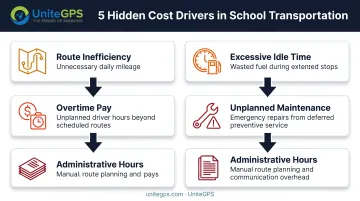
Those costs typically hide in:
- Route inefficiency that adds unnecessary daily mileage across dozens of buses
- Excessive idle time that wastes fuel without transporting students
- Overtime pay for drivers covering poorly planned routes or filling staffing gaps
- Unplanned maintenance from overused vehicles breaking down unexpectedly
- Administrative hours spent on manual scheduling, payroll processing, and answering parent calls
Many districts operate with static routes unchanged for years, never conducting systematic analysis until a budget crisis forces it. By then, inefficient patterns have become embedded in operations, and each year of delay makes them harder—and costlier—to unwind.
Key Cost Drivers for School Transportation
Route Inefficiency
Static routes are the foundational cost driver in most districts. Routes built years ago pick up extra mileage, redundant stops, and poor bell-time coordination—and that combination puts more vehicles in service than the district needs.
When ridership is not checked against the plan on a regular basis, full-size buses still roll on routes that consistently carry light loads.
Boston Public Schools' joint optimization of routes and bell times produced $5 million in annual savings by eliminating 50 buses—an 8% fleet reduction—without reducing service quality. Districts that treat routing and bell times as one system can cut fleet size without cutting service.
Route waste is only part of the bill. Day-to-day administration often inflates labor cost just as much.
Manual Administrative Processes
Manual work drives up labor costs through tasks modern systems can automate:
- Paper-based driver communication requiring physical distribution
- Spreadsheet-dependent route planning vulnerable to errors
- Manual payroll processing and timesheet entry
- Day-of firefighting instead of planned dispatch and coverage workflows
Those hours are salary dollars that could go to direct student services instead.
Inadequate Operational Visibility
Even with leaner routes and less paperwork, directors still overspend when they lack live data on vehicle location, actual ridership, driver availability, and maintenance needs. Without that picture, every decision defaults to reaction—and reaction costs more than a planned response.
Parent calls asking "Where's the bus?" that staff cannot answer waste office time and erode trust. The same gap shows up when a district cannot confirm a missed stop: disputes drag on, and real operational problems stay hidden.
Cost-Reduction Strategies for School Transportation
Effective cost reduction requires strategic intervention at three distinct levels: foundational decisions about systems and processes, daily management practices, and the broader context influencing transportation costs.
Strategies That Reduce Costs by Changing Decisions
Select Integrated Technology Platforms
Choose route optimization and GPS tracking technology that integrates with student information systems rather than requiring separate platforms. Integration eliminates manual data entry, provides real-time visibility into fleet operations, and automates route efficiency analysis.
When evaluating solutions, prioritize:
- Affordable upgrade paths from basic routing to full GPS and ridership tracking
- Transparent pricing without hidden implementation costs
- Customer-driven development shaped by real district feedback
- SIS integration that syncs enrollment data automatically
UniteGPS's Crosswalk platform covers this stack with tiered pricing from $49/month for 1-5 buses (Routing Essentials), $25/bus/month for GPS tracking with included hardware, and $39/bus/month for complete ridership management. The 90-day free trial includes route building by the UniteGPS team, with no credit card required.
Redesign Transportation Policies
Balance cost efficiency with service quality through policy changes:
- Walking distance standards appropriate for different grade levels (NYC uses bands of <0.5 mile, 0.5-<1 mile, 1-<1.5 miles, and ≥1.5 miles, with eligibility varying by grade)
- Coordinated bell times across schools to enable vehicle sharing between multiple runs
- Eligibility criteria that serve genuinely transportation-dependent students rather than defaulting to universal service
Aubrey ISD's 2025 bell schedule redesign moved seven campuses from two to three tiers, projecting elimination of 4-6 routes with estimated savings of $150,000 per eliminated route. While these remain projections rather than realized savings, they demonstrate the scale of potential impact from policy adjustments.
Right-Size Vehicle Deployment
Analyze actual ridership data rather than assumed capacity needs. Match vehicle size to route requirements and eliminate the practice of dispatching full-size buses for routes with consistently low student counts.
Edwardsville District 7's ridership review identified approximately 730 assigned stops that went unused, leading to plans to remove three routes while maintaining existing ride-time limits. This example shows how tracking actual usage reveals consolidation opportunities invisible in enrollment-based planning.
Establish Proactive Maintenance Schedules
Base maintenance on actual vehicle usage data and manufacturer recommendations rather than arbitrary calendar intervals. Arizona's 2026 Tombstone USD audit found inadequate maintenance documentation resulted in state inspectors removing 8 of 31 buses in FY2024 and 6 in FY2025, with additional buses requiring major defect repairs during inspection.
Proactive maintenance prevents expensive emergency repairs, extends vehicle service life, and avoids the operational disruption of losing buses to compliance failures. The EPA emphasizes that well-maintained vehicles also operate more fuel-efficiently.
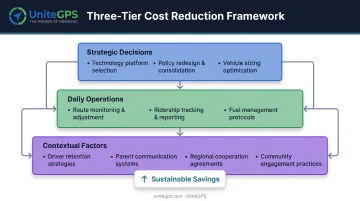
Strategies That Reduce Costs by Changing How Operations Are Managed
Implement Real-Time Route Monitoring
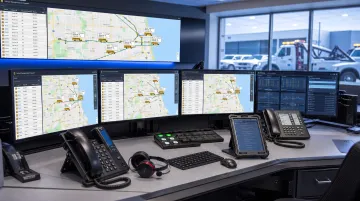
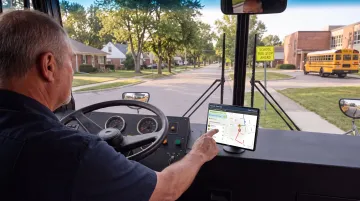
Provide drivers with turn-by-turn navigation tools and give dispatchers continuous visibility into whether buses follow optimized paths or add unnecessary miles through inefficient navigation. GPS tracking updating every few seconds allows transportation staff to compare planned versus actual routes and identify deviation patterns.
This visibility particularly helps substitute drivers who may be unfamiliar with routes, reducing the likelihood they'll get lost and add unplanned mileage.
Track Actual Student Ridership
Replace assumed ridership based on enrollment rosters with verified boarding data. Timestamped ridership records identify:
- Ghost riders assigned but not actually using service
- Underutilized stops where scheduled service consistently runs empty
- Consolidation opportunities where multiple nearby stops serve very few students
- Routes dispatched unnecessarily where participation doesn't justify the vehicle
Minimize Fuel Waste Through Idle Time Monitoring
Identify excessive engine idling, inefficient driving patterns, and opportunities for fuel conservation training. GPS-based idle alerts notify staff when vehicles sit running unnecessarily, creating concrete coaching opportunities with specific drivers.
Cutting idle time lowers fuel spend immediately and does not change routes or service levels.
Automate Administrative Processes
Reduce labor costs through systems that:
- Automatically recalculate arrival times when stops change
- Sync student data from SIS platforms to eliminate manual roster updates
- Process route assignments and changes without spreadsheet management
- Enable digital vehicle inspections instead of paper forms
These automations free transportation staff to focus on strategic planning rather than repetitive data entry.
Strategies That Reduce Costs by Changing the Context Around Transportation
Reduce Driver Turnover
Driver shortages create cascading costs. Education Week reported in 2024 that 60% of surveyed school leaders cut routes because of driver shortages. EPI found in 2025 that school bus drivers saw 4.2% real hourly wage growth the prior year, a clear sign of wage pressure in a tight labor market.
Retention strategies include:
- Competitive pay and benefits
- Consistent schedules enabled by optimized routes
- Operational tools that make drivers' jobs easier
- Clear communication and professional support
Recruiting and training replacement drivers costs significantly more than retaining experienced staff, making retention investments financially sound even when they require upfront expenditure.
Reduce Parent Call Volume
Provide families with real-time bus location visibility and automated arrival notifications. This shifts the most common parent question—"Where's the bus?"—from a phone call requiring staff time to self-service information access.
Seattle Public Schools reports its highest call volume occurs 7-10 a.m. and 2-5 p.m.—exactly when buses operate. Real-time tracking systems reduce this workload, allowing transportation office staff to focus on planning rather than answering repetitive location inquiries.
Explore Regional Cooperation
Consider route sharing with neighboring districts for specialized transportation needs like special education services, out-of-district placements, and vocational programs. Individual district routes for these services often operate inefficiently at partial capacity, while coordinated regional service can achieve better utilization.
Regional cooperation requires careful planning and formal agreements but can reduce per-student costs for low-volume specialized routes.
Document Transportation for Medicaid Reimbursement
Capture revenue that offsets transportation costs by properly documenting services for eligible students. Missouri's Medicaid program may reimburse school districts for transportation when a child receives an IEP direct service and needs specialized transportation.
Requirements typically include:
- Trip logging for each service
- Student eligibility tracking
- Billing documentation showing service delivery
- Mileage categorization (regular route vs. specialized service)
Manual systems often miss documentation opportunities, leaving reimbursement revenue uncaptured. Integrated platforms with ridership tracking and IEP documentation features make systematic capture feasible without adding administrative burden.
Conclusion
Sustainable transportation cost reduction comes from operational improvement, not service cuts that harm students or create community backlash. The strongest results pair foundational decisions—integrated technology platforms and evidence-based policies—with daily management that eliminates waste and raises efficiency.
Districts that treat cost reduction as an operations problem, not a one-time budget cut, lock in lasting savings while holding or improving service quality. Put the strategies in this guide to work across the three places costs build up: upfront system and policy decisions, daily operational management, and the broader context that shapes transportation efficiency.
Frequently Asked Questions
How can schools cut transportation costs?
Combine route optimization, integrated tech, and real-time visibility to cut mileage, admin labor, and operational waste. Prioritize efficiency gains over service cuts that limit student access.
What is the biggest expense in school transportation?
Labor costs represent 58% of per-bus operating expenses according to Ohio's FY2020 analysis, with driver wages alone accounting for 36.96%. This makes route efficiency and workforce optimization the highest-impact areas for cost reduction, as efficient routes require fewer driver hours and vehicles.
How much can route optimization software reduce transportation costs?
Boston Public Schools eliminated 50 buses (8% of its fleet) and achieved $5 million in annual savings through joint route and bell-time optimization. Results vary by district, but systematic optimization often uncovers consolidation opportunities manual planning misses.
What are hidden costs in school transportation?
Overlooked costs include manual payroll and scheduling labor, overtime from poor routing, reactive maintenance, and staff time on repetitive parent calls. They build gradually instead of showing up as clear line items.
How do driver shortages impact transportation budgets?
Shortages drive overtime, higher starting wages, and costlier contracted coverage when internal staffing falls short. The 4.2% real wage growth school bus drivers saw recently reflects that pressure.
Can small school districts afford transportation management software?
Modern platforms offer scalable pricing based on fleet size, with options starting at $49/month for 1-5 buses. Many include free trials, and entry-level plans often pay for themselves within the first year through fuel and labor savings—even for small fleets.