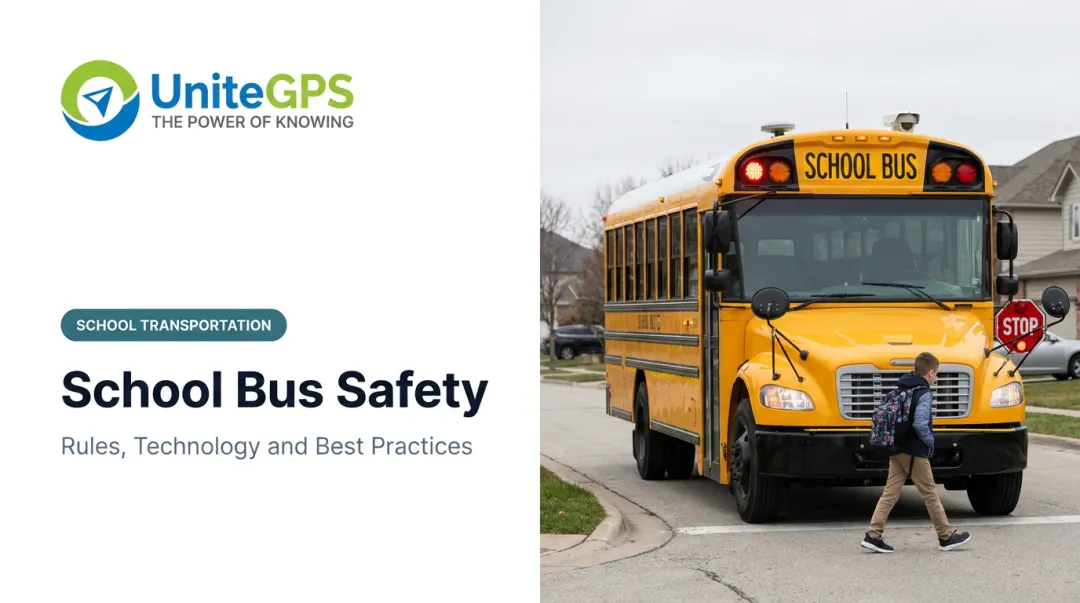
Nearly 500,000 school buses carry more than 25 million students to and from school every single day in the US. The National Transportation Safety Board classifies these vehicles as among the safest on the road, and the numbers back that up: NHTSA's benchmark data shows school-bus occupants die at a rate of just 0.2 per 100 million vehicle miles, compared with 1.5 for passenger car occupants, according to the NTSB's school bus safety overview.
But that safety record hides a real problem. Between 2012 and 2021, 206 school-age children died in school-transportation-related crashes, and 78 of them were pedestrians struck near the bus itself, not passengers injured in a collision.
True school bus safety rests on three pillars: enforced traffic laws, advancing onboard technology, and consistent habits from drivers, students, and parents. This guide covers all three.
Key Takeaways
- School buses are the safest way to school, but most injuries happen outside, in the danger zone
- Illegal passing persists nationwide despite stop-arm laws, fueling rapid growth in camera enforcement
- Collision avoidance systems, stop-arm cameras, and GPS tracking close gaps that rules alone can't fix
- Simple daily habits at the bus stop prevent most student injuries
- Safety is a shared responsibility across drivers, parents, students, and transportation departments
School Bus Safety Rules and Laws Every Motorist and Parent Should Know
Law compliance is the first line of defense. These rules exist because most child injuries happen while crossing the road near a bus, not during a crash. Understanding exactly when traffic must stop, and where penalties apply, matters as much for parents as it does for drivers.
The Stop-Arm Law: What Every Driver Must Do
Every state requires traffic to stop when a school bus flashes its red lights and extends its stop arm. From behind, the rule is universal. But requirements for opposing traffic shift depending on road design, according to NHTSA's guidance on illegal passing.
Georgia's roadway rules illustrate the pattern most states follow:
| Roadway Type | Who Must Stop? |
|---|---|
| Two lanes | Both directions |
| Four+ lanes, no physical median | Both directions |
| Four+ lanes, physical median | Only traffic following the bus |
That distinction trips up plenty of drivers. Despite uniform rear-approach laws, illegal passing stays stubbornly common. NASDPTS's most recent one-day survey found 101,334 bus drivers across 39 states reported 56,024 illegal passes in a single day, projecting more than 38.4 million violations over the school year.
Penalties and Enforcement Trends
States have started responding with tougher penalties. Indiana passed Senate Enrolled Act 2 in 2019 after a Rochester-area crash killed three siblings crossing to their bus.
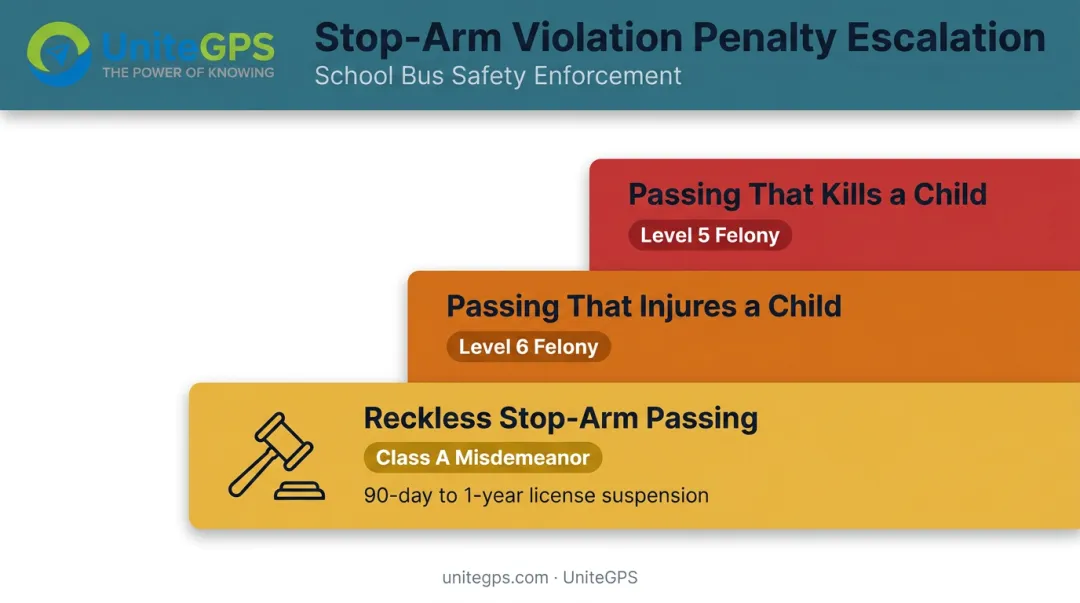
The law reclassified stop-arm violations based on severity:
- Reckless stop-arm passing: upgraded from a Class B to a Class A misdemeanor
- Passing that injures a child: Level 6 felony
- Passing that kills a child: Level 5 felony
Courts can also suspend a driver's license for 90 days on a first offense and a full year on repeat violations.
Camera enforcement is filling the gaps that traffic stops can't. NTSB recommendation H-20-12, issued after the Rochester investigation, calls on states to let stop-arm cameras document violations and support citations. At least 30 states had passed stop-arm-camera laws by October 2025.
Seat Belts and Compartmentalization Requirements
Large school buses have relied on compartmentalization since 1977, meaning closely spaced seats with high, padded, energy-absorbing backs that cushion kids without requiring them to do anything. It's passive protection by design.
But it's not complete protection. NTSB has found compartmentalization can fail in rollovers, side impacts, and crashes where pre-impact motion throws a student out of their seating compartment.
That's why NTSB recommendation H-18-10 asks states to require lap-shoulder belts at every seating position on new large buses. Properly worn lap-shoulder belts provide the highest protection across frontal, side, rear, and rollover crashes.
School Bus Safety Technology: How Innovation Is Closing the Gaps Rules Alone Can't
Laws set expectations. Technology is what actually prevents violations and limits damage when human error happens anyway, which is why it's the fastest-growing area of school bus safety investment right now.
Stop-Arm Cameras and Automated Enforcement
Stop-arm camera systems photograph license plates of vehicles that pass illegally, turning enforcement from something an officer has to witness firsthand into something automatic and documented.
Two districts illustrate the impact:
- Montgomery County, Maryland launched with 25 cameras in January 2014, recorded roughly 4,800 violators by August 2016, and equipped its entire fleet by 2019.
- Monroe County, New York reports that 94% of first-time offenders never receive a second ticket, and 95% don't contest the citation after seeing the video evidence.
Collision Avoidance and Automatic Emergency Braking
Collision avoidance systems use sensors to detect pedestrians and obstacles around the bus, then apply automatic emergency braking if the driver doesn't react in time.
NTSB recommendation H-18-19 calls for this technology as standard equipment on all newly manufactured school buses, following investigations that found its absence contributed to crash severity in at least one fatal case. This remains a safety recommendation rather than a federal mandate, so adoption still varies by manufacturer and district.
Real-Time GPS Tracking and Ridership Monitoring
GPS tracking apps give parents live visibility into where the bus is and when it'll arrive. This cuts down on kids waiting unnecessarily at unsafe curbside spots and reduces calls flooding into transportation offices.
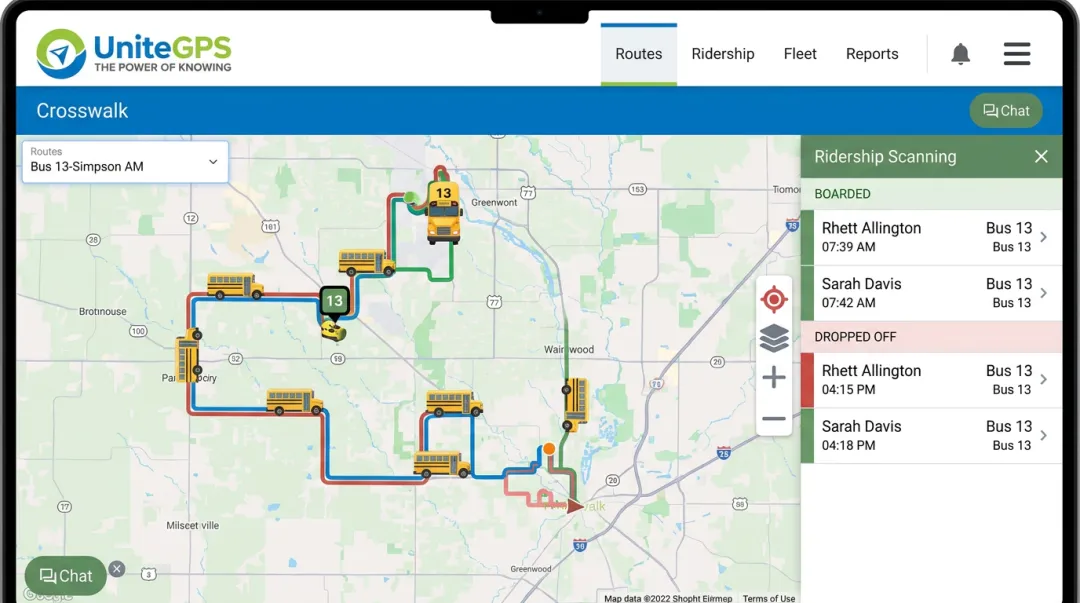
Tablet-based ridership tracking takes it further, scanning students on and off the bus to confirm every child boarded and exited where they should have. It closes an accountability gap that manual headcounts routinely miss.
This is the space where UniteGPS's Crosswalk platform operates. It combines real-time GPS tracking, card swipe-based ridership scanning, and route optimization built specifically for K-12 districts, with FERPA-compliant data handling and direct integration into student information systems like PowerSchool and Skyward. More than 100 districts nationwide use it.
Tim Lyons, Director of Transportation at Benton Community School District, put it this way:
"If a parent calls saying that the bus didn't stop, we can look and see that they were there. It has made a huge difference in our district."
That's the practical value of pairing GPS data with ridership scans: disputes get resolved with timestamps instead of guesswork.
Best Practices for Students and Parents at the Bus Stop
Most bus-related injuries happen outside the vehicle, which makes stop-side habits some of the most effective safety practices available.
For students:
- Stand 10 feet back from the curb, or five giant steps, while waiting
- Wait for the bus to fully stop and the driver's signal before approaching
- Make eye contact with the driver before crossing in front of the bus
- Never walk behind the bus, and never chase a dropped item without telling the driver first
For parents:
- Walk young children to the stop rather than sending them alone
- Arrive at least 5 minutes early so there's no rush at the curb
- Make sure kids know their driver's name and bus number for safety and quick recognition
- Use a GPS tracking app, if the district offers one, to time departure from home instead of guessing
The same discipline should carry onto the bus itself. Once aboard, students should stay seated, keep the aisle clear, avoid distracting the driver, and never put heads or arms out the window. These small habits address a large share of preventable incidents.
Best Practices for Bus Drivers On the Road
Drivers carry the heaviest share of responsibility once the bus is moving, and that responsibility extends well beyond just following speed limits.
Vigilance matters most near stops. Drivers should:
- Scan continuously for children approaching from either side
- Slow down through school zones during pickup and drop-off times
- Maintain extra following distance to account for the bus's blind spots, often called the "danger zone," which extend around its front, back, and sides
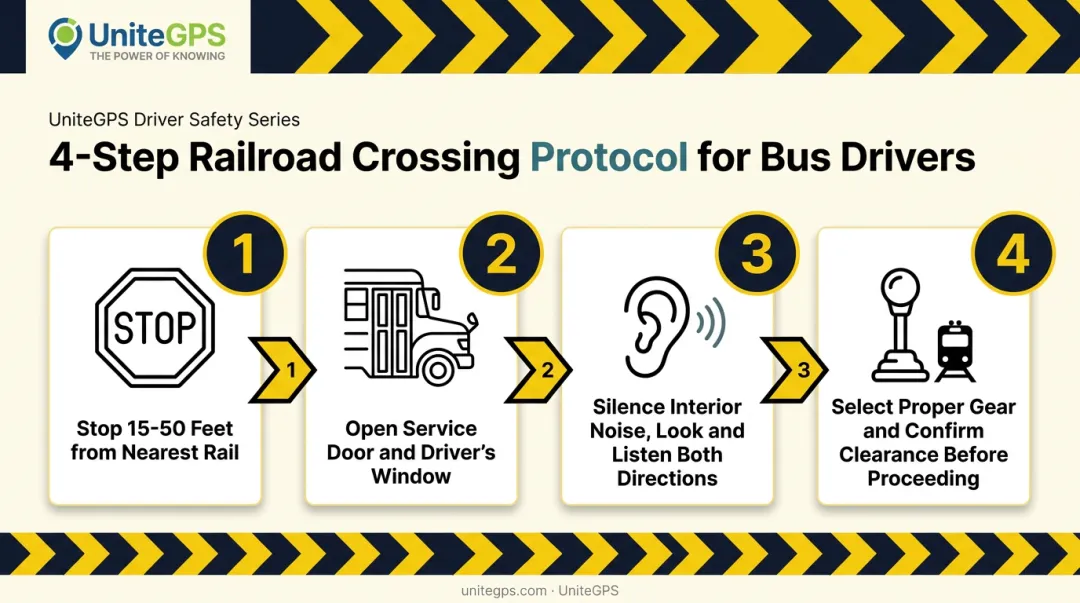
Railroad crossings demand a specific protocol:
- Stop 15 to 50 feet from the nearest rail
- Open the service door and driver's window
- Silence interior noise and look and listen in both directions
- Select a gear that allows crossing without shifting, and confirm space beyond the tracks before proceeding
If a bus stalls on the tracks or in another hazard zone, evacuation should happen immediately. Students and the driver should move away from the tracks at a 45-degree angle, in the direction the train is approaching from, which reduces exposure to debris thrown forward by the impact.
Common School Bus Safety Mistakes to Avoid
Even well-intentioned districts and drivers fall into predictable traps:
- Assuming flashing lights or compartmentalization guarantee safety. Both depend on human behavior: drivers must actually stop, and kids must stay seated.
- Misjudging divided-highway exceptions. On physically divided highways, many states only require trailing traffic to stop, not both directions — a common cause of illegal passes.
- Relying solely on manual headcounts. Paper rosters miss mid-route transfers on packed routes. Ridership scanning systems like UniteGPS's close that gap, confirming exactly who boarded and departed.
Frequently Asked Questions
Is the school bus the safest vehicle in America?
Yes. NHTSA's benchmark data shows school-bus occupants face roughly 0.2 fatalities per 100 million vehicle miles, compared with 1.5 for passenger car occupants, largely due to size, design, and compartmentalization.
What is the safest spot on a school bus?
No NHTSA or NTSB source designates one universal safest seat. Injury patterns depend on impact location, rollover dynamics, and belt use, not a fixed row or side of the bus.
Is it illegal to pass a stopped school bus in every state?
Yes, from behind, when red lights are flashing and the stop arm is extended. Opposite-direction rules vary on physically divided highways, where only trailing traffic may need to stop.
What is compartmentalization on a school bus?
It's a passive protection system using closely spaced, high-backed, padded seats that cushion occupants without seat belts. NTSB findings show it can fail during rollovers, side impacts, or crashes involving significant pre-impact motion.
How can parents track their child's school bus in real time?
Many districts now offer GPS tracking apps, such as UniteGPS's Crosswalk platform, giving parents live bus location and arrival estimates so kids aren't waiting outside longer than necessary.
What should students do if a school bus doesn't stop at a railroad crossing?
If the bus stalls on the tracks, students should evacuate immediately and move away at a 45-degree angle in the direction the train is approaching from, reducing exposure to flying debris.