Every school morning, families across the country stand at the curb trusting that a big yellow bus will show up on time. More than 20.3 million public K-12 students ride a school bus daily, according to School Bus Fleet's 2024-25 state-by-state compilation. That's a massive logistics operation running on tight budgets and thin staffing.
Transportation directors are under real pressure. Driver shortages, climbing fuel costs, and shrinking budgets mean districts need to do more with less. Routing software has moved from "nice to have" to essential infrastructure for keeping buses running safely and on schedule.
This article breaks down the top school bus routing platforms on the market, how to evaluate them, and what actually separates a good system from a great one.
Key Takeaways
- Automated routing replaces manual spreadsheet planning, saving teams hours every week.
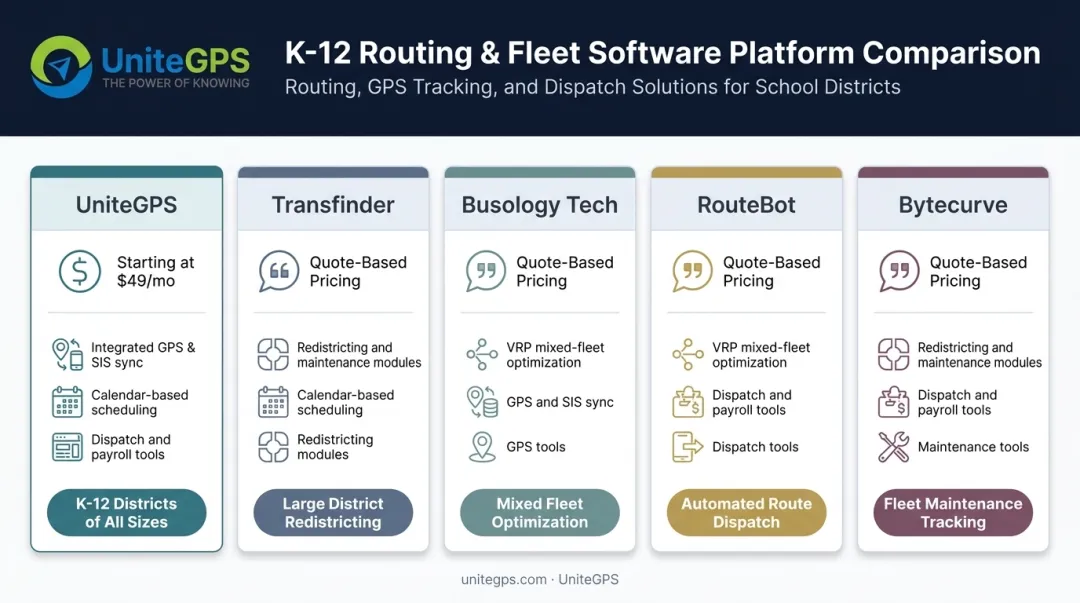
- Top platforms include UniteGPS, Transfinder, Busology Tech, RouteBot, and Bytecurve, each with distinct strengths.
- The right choice depends on district size, existing tech stack, budget, and support needs.
- Look for no-cost trials or demos before committing to a switch
Overview of School Bus Routing Software in K-12 Transportation
School bus routing software automates the tasks transportation departments used to handle with maps, spreadsheets, and sticky notes. It generates optimized routes and stop sequences, tracks buses via GPS, and logs which students actually boarded which bus.
With over 20 million students riding daily, even small routing inefficiencies compound fast across thousands of districts nationwide.
Two pressures are pushing districts toward this technology this year:
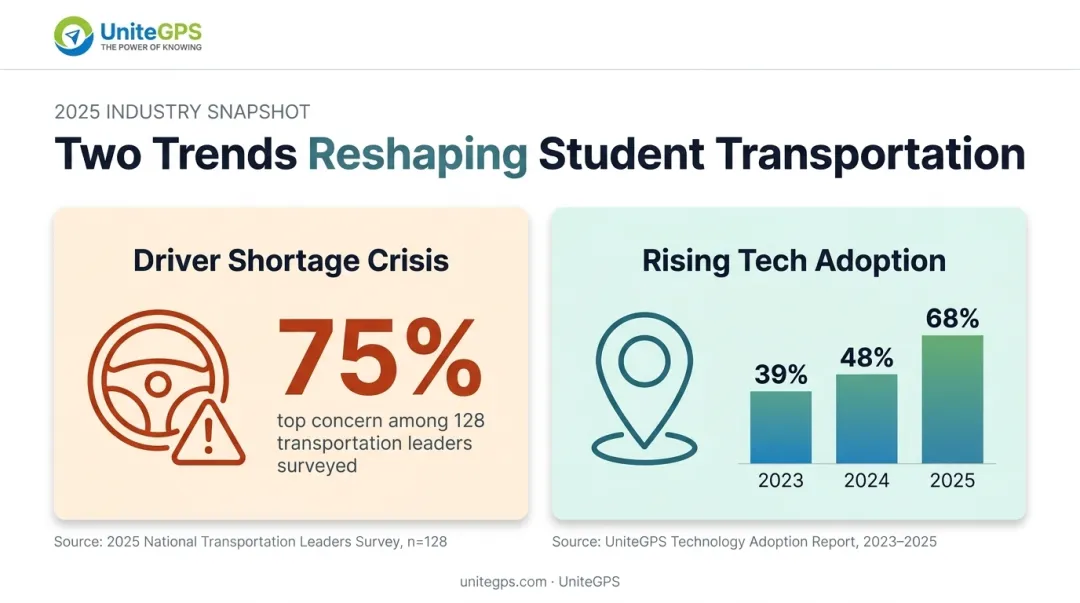
- Driver shortages: A 2026 Zonar/School Transportation News survey of 128 transportation leaders found 75% named driver availability as their top concern heading into fall.
- Tech adoption is climbing fast: School Bus Fleet's 2025 district survey found 68% of districts used rider-tracking or parent apps in 2025, up from 48% in 2024 and just 39% in 2023.
The providers below represent very different approaches, from decades-old enterprise suites to newer, optimization-first platforms built around a single problem.
Top School Bus Routing Software Solutions for K-12 Districts
Before comparing platforms, it helps to know what actually separates them. We evaluated each provider on five criteria:
- Route optimization technology: true algorithmic optimization versus simple map visualization
- Integration capability: SIS syncing, GTFS support, GPS hardware compatibility
- Safety and ridership features: real-time tracking and boarding verification
- Customer support model: live support versus ticket queues
- Pricing transparency: clear costs versus opaque enterprise quotes
UniteGPS (Crosswalk Platform)
UniteGPS was founded in 2014 after co-founder Chris Bunnell watched his own kids wait outside in a Maine winter with no idea when their bus would actually arrive. He teamed up with Steve C. Lanning and Steven J. Lanning, colleagues from a prior federal data project, to build something better. Today Crosswalk K-12 serves 100+ districts nationwide, and the company has remained fully bootstrapped since day one, without a dollar of outside investment.
What sets it apart is the integration: routing, GPS tracking, student ridership tracking, and SIS syncing all live in one platform, built feature-by-feature from direct conversations with transportation directors rather than an investor roadmap.
| Pricing | Tiered by fleet size, starting at $49/month for 1-5 buses; 90-day free trial, no credit card required |
| Key Features | Route optimization, real-time GPS tracking, ridership scanning, SIS data sync, driver navigation, unlimited live support |
| Best For | K-12 districts and small-to-medium transit agencies wanting an affordable, integrated platform with a long-term support partner |
Tim Lyons, Director of Transportation at Benton Community School District, put it this way: "Since we began using Crosswalk K-12, it has been a game changer for us... if a parent calls saying that the bus didn't stop, we can look and see that they were there."
Transfinder (Routefinder PLUS)
Transfinder has been in this space since 1988, headquartered in Schenectady, New York. It's one of the oldest names in school routing, with a large install base and a wide ecosystem of add-on modules.
Its differentiator is breadth across the platform.
Districts get routing, redistricting, GPS, and maintenance tools all under one vendor umbrella.
| Pricing | Enterprise/quote-based, tailored to district size and modules selected |
| Key Features | Route optimization, Attendance ZonePlanning/redistricting, GPS Connect tracking, Servicefinder fleet maintenance |
| Best For | Larger districts wanting one vendor to cover routing, redistricting, and maintenance together |
The tradeoff for that breadth is complexity. Districts often need dedicated staff time just to manage the number of connected modules.
Busology Tech (formerly TripSpark, part of Modaxo)
Busology Tech, a Modaxo brand formed in early 2023 from the longtime TripSpark School product line, has picked up notable industry recognition. Forbes Advisor named it "Best Overall Bus Routing Software" in its 2024 audited rankings, and the company claims a top spot from Research.com among 16 competing providers.
Its strengths sit in calendar-based scheduling and flexible hosting: districts can choose self-hosted or vendor-hosted deployment.
| Pricing | Customized based on fleet size and selected features |
| Key Features | Calendar-based routing, GPS/AVL tracking, driver timesheet management, parent notification app |
| Best For | Districts wanting an established, award-recognized platform with flexible hosting options |
Its driver electronic timesheets can export directly to third-party payroll systems, a nice touch for districts that don't want a separate payroll integration project.
RouteBot
RouteBot is a newer entrant that leans hard into one thing: solving the actual vehicle routing problem (VRP), not just drawing lines on a map. It supports mixed fleets, meaning school routes and employee shuttle runs can be planned in the same interface.
Its standout features include Excel-based roster import with automatic address geocoding, and a scenario-testing mode that lets planners draft route changes without touching live data.
| Pricing | Demo-based; custom quotes after a live trial using sample or district data |
| Key Features | VRP-based route optimization, GPS tracking, mixed-fleet support, mobile driver/parent apps |
| Best For | Districts prioritizing measurable fleet and mileage reduction through algorithmic optimization |
This is a good fit if your district has already outgrown proximity-based mapping and wants a system built specifically around minimizing miles and vehicles.
Bytecurve (ByteCurve360)
Bytecurve centers its platform on dispatch, driver communication, and payroll, with routing optimization playing a secondary role. South Bend Community School Corporation adopted the platform in 2024, and Poway Unified School District has used it since 2017 alongside Transfinder routing and Zonar GPS data.
Its strengths are real-time driver reassignment, payroll automation, and a dedicated parent alert app called DriveOn.
| Pricing | Custom quote based on fleet and module needs |
| Key Features | Dispatch and driver communication, payroll/time-attendance, GPS integration, parent alert app |
| Best For | Fleets that prioritize dispatch flexibility and driver/payroll management alongside routing |
Bytecurve's published customer evidence comes primarily from its own case studies, so ask for direct district references during evaluation.
How We Chose the Best School Bus Routing Software
The most common mistake districts make? Picking software based on brand recognition or price alone, without ever testing it against their own route data. A platform that looks great in a sales demo can behave very differently once it's handling your actual stops, students, and roads.
Here's what matters most during evaluation:
- Optimization depth: Does it run true algorithmic optimization, or just plot proximity-based stops on a map?
- Integration capability: Look for syncing with your SIS (PowerSchool, Skyward, Infinite Campus) and GTFS support, which eliminates manual data entry.
- Support and trial structure: Live support should be included, along with a no-risk trial period before you sign anything.
- Compliance and data security: Is the vendor FERPA-compliant, operating as a "school official" under the school-official exception outlined by the U.S. Department of Education?
- Pricing transparency and scalability: Real numbers should be visible up front, and the platform should scale cleanly as your fleet grows.
Request a demo built on your own route data, not a generic sample map. That's the only real way to see how a platform performs under your district's real-world conditions.
Conclusion
There's no single "best" school bus routing software for every district. The right platform is the one that matches your fleet size, your existing tech stack, and how much you value ongoing support over flashy features.
With those priorities in mind, test your own route data before signing a contract, ask hard questions about support response times, and confirm the platform can scale as your district grows.
If you're comparing options, UniteGPS's Crosswalk platform offers a 90-day free trial with no credit card required, and routes are built for you at no cost during onboarding. It's a low-risk way to see real results side-by-side with whatever you're using now.
Frequently Asked Questions
What is the best school bus routing software?
There's no single best platform for every district. The right choice depends on fleet size, integration needs, and support expectations. UniteGPS, Transfinder, and Busology Tech each suit different priorities.
What is the best navigation app for school bus drivers?
The best tools are built specifically for buses, accounting for vehicle height, weight, and turn restrictions that consumer apps ignore. Most leading routing platforms include this as a built-in driver feature rather than a separate app.
How much does school bus routing software typically cost?
Pricing scales with fleet size and features, from around $49/month for basic routing to $25-$39 per bus for full GPS and ridership suites (like UniteGPS's tiered model). Request a customized quote based on your fleet size.
Can school bus routing software integrate with our existing Student Information System (SIS)?
Most modern platforms support SIS integration to eliminate manual data entry. Confirm compatibility with your district's specific SIS platform during the evaluation process.
What features should a district prioritize when evaluating routing software?
Prioritize true route optimization, real-time GPS tracking, ridership tracking for safety, and reliable, responsive customer support.
How long does it take to implement new school bus routing software?
Implementation timelines range from a few days to several weeks, depending on data cleanliness and fleet size. Providers like UniteGPS offer free trial periods (often 90 days) so districts can test the transition before committing to a paid plan.