Every school morning, roughly 480,000 yellow buses carry students across the United States, and by nearly every measure, that ride is safer than a car trip with mom or dad behind the wheel. But the numbers hide where the actual risk sits.
School-bus-related crashes killed 110 people in 2024, down from 128 the year before. Break that number down further, and pedestrians accounted for 15% of those fatalities, compared to just 6% for bus passengers, according to National Safety Council data. The danger isn't inside the bus. It's outside it.
For transportation directors, that gap translates into real operational stakes: liability exposure when a stop is poorly placed, parent trust that erodes after one bad pickup, and driver turnover fueled by the stress of a near-miss incident. This article breaks down what actually keeps kids safe, from daily driver discipline to the technology closing the gaps human oversight tends to miss.
Key Takeaways
- Most injuries happen outside the bus, making loading zone design the top priority
- Driver qualification, vehicle inspections, and conduct rules form the non-negotiable baseline
- GPS tracking and ridership verification catch what manual oversight misses
- Safety failures usually trace back to skipped routine checks, not sudden accidents
Safety Guidelines for School Bus Operations
Safe bus operations rest on three layers working together: qualified people, disciplined procedures, and supporting technology. Remove any one layer, and the other two have to work harder to compensate.
The risks themselves fall into three buckets — behavioral (driver and student choices), mechanical (vehicle condition), and environmental (weather, traffic, visibility). Treating safety as a once-a-year, back-to-school checklist misses the point entirely. It has to be a daily habit.
General Safety Precautions
Driver qualification starts with federal licensing but doesn't end there. FMCSA requires P and S endorsements for any driver transporting K-12 students to or from school or school-sponsored events. States layer additional screening on top. Massachusetts, for example, requires CORI and SORI background checks, a driving-record review, three years of continuous driving experience, and a DOT medical certificate before a driver ever touches a wheel.
Daily inspections matter just as much as who's driving. A thorough pre-trip and post-trip checklist should cover:
- Brakes, tires, and mirrors for wear or damage
- Interior and exterior lights, including hazard flashers
- Emergency exits and stop-arm function
- Onboard equipment: first aid kits, a properly rated fire extinguisher (Michigan mandates a 2A-10BC unit), and reflective triangles
Skipping this walkthrough doesn't just risk a mechanical failure. It creates a documented liability gap the moment something goes wrong.
Evacuation drills round out the baseline. NHTSA recommends one supervised drill per semester; Pennsylvania law requires two per year — one in the first week of school, one in March. Districts should follow whichever standard is stricter in their state, not just the federal recommendation.
Onboard conduct rules matter too. Enforced seating assignments, aisle clearance, and noise limits reduce the distractions that lead to preventable incidents. Consistency is what makes these rules work: a rule enforced only sometimes teaches students it's optional.
Safety at Bus Stops and Loading Zones
Stop placement isn't guesswork. NHTSA's planning guidance calls for at least 500 feet of clear sight distance so approaching traffic has time to react to a stopped bus. Stops should also avoid crossings on roads with three or more lanes or posted speeds above 35 mph whenever an alternative exists.
Families need reinforcement on the danger zone — the 10-foot radius around the bus where the driver's visibility drops sharply. Kids should stay back until the driver signals, never crawl underneath to retrieve a dropped item, and keep devices away from their ears while waiting.
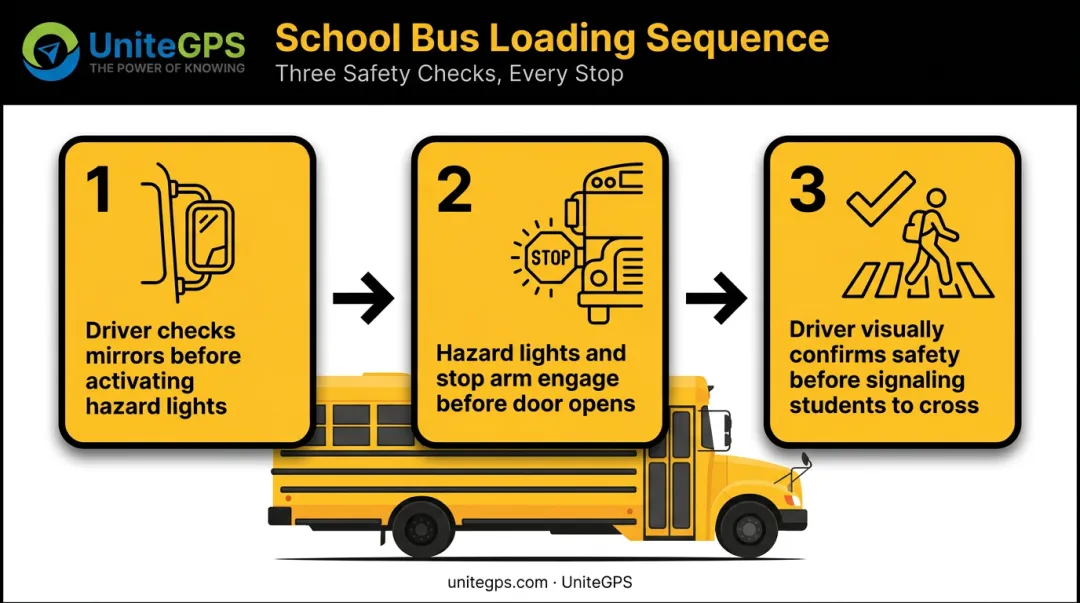
Loading sequencing should be predictable every time:
- Driver checks mirrors before activating hazard lights
- Hazard lights and stop arm engage well before the door opens
- Driver visually confirms it's safe before signaling students to cross
One overlooked factor here is how long kids wait curbside in the first place. When families have no idea whether a bus is two minutes or twenty minutes out, students either linger too long near the road or rush when it finally appears.
UniteGPS's parent-facing app addresses this directly by showing live bus location as it approaches a stop, letting families time their walk out the door instead of guessing. Fewer kids standing at the curb means less rushing when the bus rounds the corner early.
Safety While Operating the Bus
Buses carry longer stopping distances than passenger vehicles, which is why manuals like Kentucky's driver training guide call for a minimum 4-second following interval below 40 mph and 5 seconds above it, with more space added for wet or icy roads.
Transportation departments should track a short list of leading indicators rather than waiting for an incident report:
- Speeding events against posted limits
- Excessive idle time, which signals both fuel waste and inattentive habits
- Route deviations from the planned path
Platforms like UniteGPS's Crosswalk system generate automatic alerts for speeding and idling, so a pattern gets flagged before it becomes a habit rather than after a near-miss.
Behavioral risks worth watching include distracted driving, taking shortcuts across railroad crossings, and skipping mandated stops when a route is running late. None of these start as intentional recklessness. They creep in when a driver feels pressure to make up time.
Environmental and System Safety Considerations
Weather should trigger a route or schedule decision, not just a driver's personal caution. NHTSA's adverse-weather guidance directs drivers to slow down, increase following distance, and delay or cancel a route when ice, freezing rain, or fog cuts visibility. Iowa's Department of Education goes further, requiring severe-weather decisions to be discussed with school officials before a bus even leaves the lot.
School-zone traffic congestion changes the safe dwell time at a stop too. A stop that works fine at 7:15 a.m. might not have the same clearance at 7:45, once congestion builds.
Stop-arm laws exist in every state, but they don't stop illegal passing on their own. Districts should track violations along their own routes instead of assuming the law alone is a sufficient deterrent.
Common Safety Mistakes to Avoid
Most bus safety failures aren't dramatic one-time events. They're small, preventable lapses that compound over time.
- Skipping the mandated child check. Nebraska and Pennsylvania both require an interior walkthrough after every route or activity trip to catch a sleeping or overlooked student. Skipping this two-minute step is one of the most documented causes of children left on a stopped bus.
- Assuming stop-arm laws alone prevent illegal passing. They don't. NASDPTS's most recent one-day survey found 114,239 drivers reported 67,258 illegal passing incidents, roughly six per ten drivers observed, according to BusPatrol's summary of the 2025 NASDPTS survey. Track violation patterns on your own routes to justify signage, camera enforcement, or stop relocation.
- Ignoring recurring driver behavior warnings. A speeding alert or harsh-braking pattern that shows up once might be a fluke. Repeated warnings that go unaddressed are a preventable escalation, not bad luck. GPS platforms like UniteGPS flag these patterns automatically, making trends easier to catch before they turn into incidents.
How Technology Strengthens School Bus Safety
Trained people and enforced procedures form the foundation. Technology closes the gaps that even a well-run department can't monitor manually, all day, every route.
Real-time GPS tracking gives transportation directors live visibility into every bus on the road, not just a scheduled estimate. Parents benefit too — instead of guessing whether the bus is running late, they can see it approaching in real time. That visibility cuts down on both curbside waiting and last-minute rushing.
Ridership tracking solves a different problem: proving exactly who boarded and who got off, at which stop, at what time. UniteGPS's Crosswalk platform uses a barcode scan-on/scan-off system on an in-vehicle tablet, so every ride is timestamped and tied to a specific student.
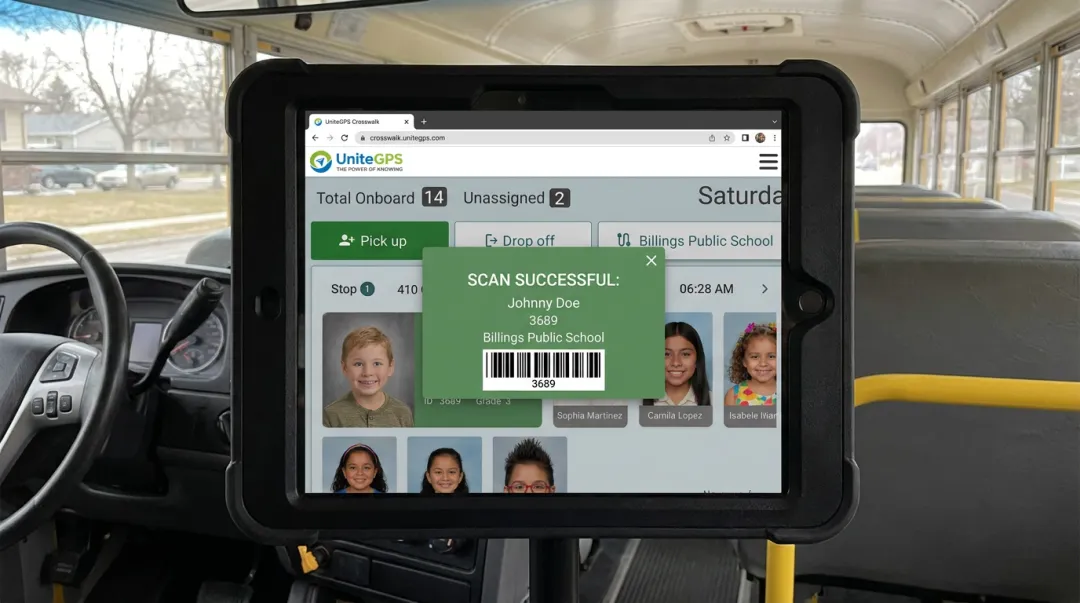
Tim Lyons, Director of Transportation at Benton Community School District, described the impact plainly:
"If a parent calls saying that the bus didn't stop, we can look and see that they were there. It has made a huge difference in our district."
That kind of verifiable record matters for more than dispute resolution, giving districts a paper trail they didn't have before for:
- IEP transportation documentation
- Medicaid billing and reimbursement claims
Route optimization identifies shorter, more direct paths across a district's stops, reducing total miles driven and eliminating unnecessary backtracking.
Turn-by-turn navigation solves a problem every transportation director knows well: the substitute driver on an unfamiliar route. Coverage stays consistent regardless of tier:
- Entry-level plans provide printed step-by-step directions with student names and stop order
- Tablet-based plans add audible, real-time turn-by-turn guidance with student information displayed at each stop
Either way, an unfamiliar route doesn't become a missed stop.
Conclusion
None of these measures work in isolation. A perfectly trained driver still needs a bus that passed inspection. A well-designed stop still needs a family that knows the danger zone rules. And even the best procedures benefit from a system like UniteGPS that flags a speeding pattern before it becomes a crash report.
Treat safety reviews as a continuous operational practice, revisited every season, not just in the weeks before the first day of school.
Frequently Asked Questions
What are the most effective school bus safety measures?
Driver training and background screening, daily vehicle inspections, consistent stop-arm law enforcement, and real-time GPS tracking together form the strongest safety foundation. No single measure covers every risk on its own.
How to make school bus stops safer?
Place stops with at least 500 feet of visibility, minimize road crossings, and reinforce danger-zone education with families. Giving parents real-time arrival visibility also reduces curbside rushing.
What is the leading cause of school bus-related injuries?
Most injuries and fatalities occur outside the bus, during loading, unloading, and pedestrian interactions near the vehicle, not while students are riding inside.
How often should school buses undergo safety inspections?
Drivers should complete a documented pre-trip and post-trip inspection every single day. States also mandate periodic mechanical inspections, ranging from every 80 days to annually, depending on the jurisdiction.
Are school buses required to have seat belts?
It depends on the state and bus size. Federal rules require restraints on small school buses, but large buses generally rely on compartmentalized seating unless a specific state law adds a belt mandate.
How can technology improve school bus safety?
GPS tracking gives real-time visibility into bus location, ridership scanning verifies exactly who boarded and exited, and route optimization reduces unnecessary miles and unsafe maneuvers. Platforms such as UniteGPS combine all three in one system, so districts aren't managing separate tools for each task.