Compliance isn't simply about avoiding fines or passing audits. It's the operational framework that protects millions of students daily while ensuring districts can defend their safety practices during legal scrutiny. From FMVSS vehicle construction standards and CDL endorsement requirements to FERPA data protection and daily pre-trip inspections, school bus safety compliance spans vehicle engineering, driver qualifications, route planning, technology integration, and community coordination. This guide examines the essential regulatory requirements, practical technology solutions, and common compliance gaps that every K-12 transportation department must address.
Key Takeaways
- Verify both federal FMVSS construction standards and state rules for drivers, inspections, and operations
- GPS tracking, digital inspections, and ridership systems build audit trails and cut manual errors
- Document initial driver certification and refresher courses with hours and topics covered
- Place stops with 500+ feet sight distance and few street crossings to cut pre-boarding risk
- Common gaps: incomplete training records, spotty inspection logs, and weak parent alerts on route changes
Essential Safety Regulations and Compliance Requirements
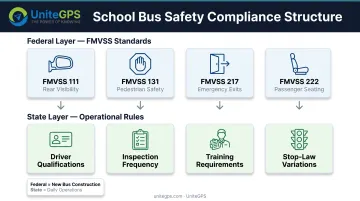
School bus safety compliance operates on two distinct regulatory layers: federal standards that govern vehicle manufacture and state laws that control daily operations.
Federal Vehicle Construction Standards
NHTSA establishes Federal Motor Vehicle Safety Standards (FMVSS) that every new school bus must meet before sale. These engineering requirements form the baseline safety foundation:
Critical FMVSS Requirements:
- FMVSS 111 (Rear Visibility): Two exterior mirror systems (A and B) with unit-magnification mirrors so drivers can see loading zones and traffic behind the bus
- FMVSS 131 (Pedestrian Safety): Stop-signal arms with red octagonal STOP signs and red warning lamps at top and bottom
- FMVSS 217 (Emergency Exits): Rear or left-side emergency exits, capacity-based extra exits, manual releases, clear markings, and retroreflective outlining
- FMVSS 222 (Passenger Seating): Forward-facing seats, minimum seat-back heights, restraining barriers, and impact-zone protections that create compartmentalization
Critical distinction: Federal law controls new-bus manufacture and sale; it does not regulate vehicle use. States set operating, driver, route, inspection, and training rules, and those rules often exceed federal minimums.
State-Level Compliance Variations
Every state establishes its own school bus operational requirements, creating a compliance landscape that varies significantly by jurisdiction.
Inspection Frequency Examples:
- New Jersey: School transportation vehicles undergo inspection by the MVC School Bus Inspection Unit twice yearly
- New York: Covered vehicles carrying pupils under age 21 must be inspected at least every six months
- Oregon: Driver vehicle inspection reports must be retained for three months; other transportation records follow varying retention schedules
Stop-Law Variations:
- New York: Traffic from both directions must stop on multilane and divided highways when a school bus displays stop signals
- California: Opposing traffic need not stop when the bus is across a divided or multilane highway with at least two lanes in each direction
Districts near state borders or in inter-district agreements need a separate compliance matrix for each jurisdiction. Federal standards alone are not enough.
FERPA and Student Transportation Data Protection
The Family Educational Rights and Privacy Act (FERPA) extends to transportation records when they are directly related to a student and maintained by the school. Bus video footage used for student discipline becomes an education record requiring specific handling.
FERPA Compliance Requirements:
- Contractors may access student records under the school-official exception only for an outsourced institutional function, under district control, with strict use and redisclosure limits
- Parents can inspect records with their child's information; other students in video may need redaction
- Student PII cannot be disclosed without consent unless a specific exception applies
- FERPA does not set destruction timelines; align retention policies with state record-retention schedules
GPS tracking, ridership platforms, and route planning tools should run under formal Data Processing Agreements. Those agreements should treat vendors as school officials with a legitimate educational interest and limit data access to transportation functions only.
Driver Qualification and CDL Requirements
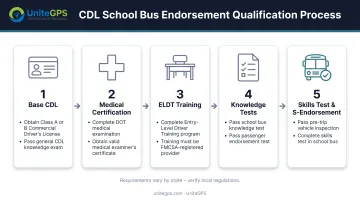
Federal regulations under 49 CFR 383.123 establish baseline commercial driver's license requirements, while states add their own certification layers.
Federal CDL Requirements:
- S-endorsement: Qualify for the P (passenger) endorsement, pass knowledge tests (loading/unloading, emergencies, railroad crossings, operating rules), then pass a skills test in the right school-bus vehicle group
- Entry-Level Driver Training (ELDT): First-time Class A/B applicants and anyone seeking P or S endorsements must train with a provider on the federal Training Provider Registry
- Medical certification: Interstate non-excepted drivers need a federal medical card; intrastate drivers follow state medical rules
State-Specific Examples:
- California: The special school-bus certificate process requires DOJ Live Scan background checks, written rules testing, first-aid examination, pre-trip and basic-control tests, and a behind-the-wheel performance test
Background checks, recertification cycles, and extra state testing vary. Confirm current rules in every jurisdiction where you operate.
Vehicle Inspection and Maintenance Record Requirements
State regulations determine inspection cycles and documentation retention periods, making compliance a state-specific obligation rather than a uniform national standard.
Essential Maintenance Documentation:
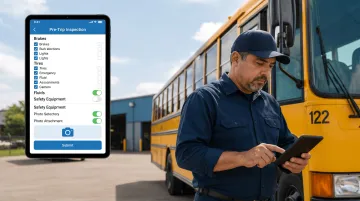
- Daily pre-trip inspections: Completed by drivers before each route, covering brakes, lights/signals, mirrors, emergency equipment, and tires
- Periodic preventive maintenance: Scheduled based on manufacturer recommendations, mileage intervals, and regulatory requirements
- State safety inspections: Annual or semi-annual comprehensive examinations conducted by certified mechanics
- Defect documentation: Written records of identified problems, repairs performed, and verification that vehicles returned to safe operating status
Keep complete, searchable inspection and repair histories. You will need them for regulatory reviews and any later legal questions about vehicle condition.
Technology Solutions for Safety and Compliance
Digital tools ease compliance only when they create real audit trails—not when they simply put the same manual process on a screen.
GPS Tracking for Real-Time Visibility and Documentation
GPS tracking systems provide compliance value beyond simple location monitoring. When vehicle positions update every 5 seconds and systems maintain timestamped historical records, districts gain defensible evidence for regulatory reviews and incident investigations.
Compliance Applications:
- Route adherence: Compare planned versus actual routes to flag deviations and fix inconsistent service
- Emergency response: Use live fleet visibility for faster incident response and clearer handoffs to emergency services
- Mileage logs: Submit GPS-verified mileage for state reimbursement and drop manual odometer errors
- Service disputes: Rely on timestamped arrival and departure records when families question delivery
Integrated Compliance Platforms
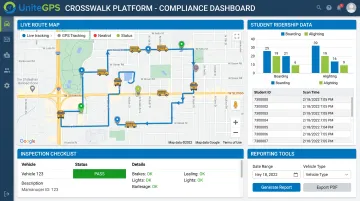
Single-purpose tools create data silos that complicate compliance reporting. Platforms like UniteGPS Crosswalk integrate GPS tracking with automated routing, student ridership tracking via in-vehicle tablets, and Student Information System (SIS) data synchronization to centralize compliance documentation while reducing manual data entry errors.
Integrated Platform Benefits:
- Automated roster updates: SIS sync pulls enrollment, addresses, and school assignments so routes stay current as students move
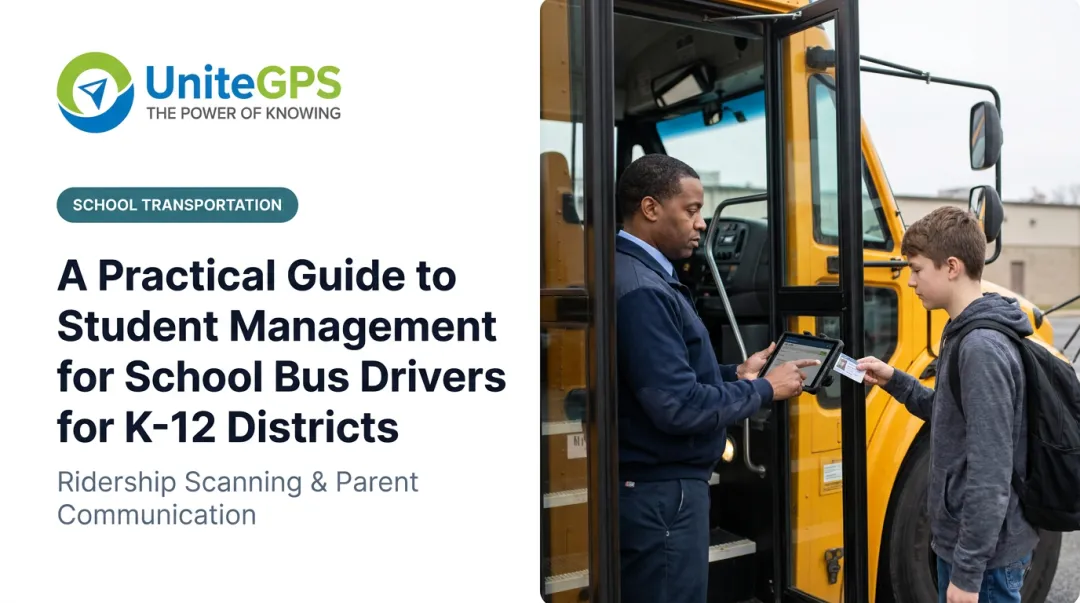
- Ridership audit trails: Barcode or card-scan boarding records show which student rode which bus and when, supporting IEP verification, Medicaid billing, and safety audits
- Consolidated reporting: One platform for routing, GPS, ridership, and inspections speeds audit prep and cuts missing records
- FERPA-compliant handling: Data Processing Agreements, role-based access, and encryption (TLS 1.2+ in transit, AES-256 at rest) protect student data
UniteGPS Crosswalk pricing is tiered so districts can start small and add capability:
- Routing Essentials: from $49/month for small fleets
- GPS Tracking & Routing: $25/bus/month, hardware included
- Tablet Suite: $39/bus/month plus one-time tablet hardware
A 90-day free trial with no credit card required lets districts evaluate fit before committing.
Digital Inspection and Maintenance Management
Paper inspection logs create compliance risks through illegible entries, missing signatures, and lost documentation. Digital systems replace paper forms with tablet-based checklists that drivers complete before each route.
Digital Inspection Advantages:
- Photo documentation: Attach images of defects (cracked glass, worn tires) to reports for mechanics and auditors
- Instant handoff: Route completed inspections to mechanics on mobile devices or shop screens without paper delay
- Compliance reminders: Track inspection schedules and alert supervisors when checks are overdue (confirm your platform supports this)
- Audit-ready records: Searchable, timestamped histories show consistent checks and corrective actions after defects
Parent Communication Technologies
Real-time arrival tools cut transportation office call volume. When parents get automated delay and route-change alerts, fewer families call asking where the bus is, and students spend less time waiting outside in extreme weather.
Parent Communication Features:
- Live location and ETA: Parents pick a bus and stop to see arrival times and limit outdoor waiting
- Delay notifications: SMS or app alerts cover route changes, mechanical issues, and weather delays
- Ride history: Timestamped boarding records let parents verify trips and give districts evidence in service disputes
Stop-Arm Camera Systems
Stop-arm cameras document illegal passing violations but show mixed evidence on deterrence. Rockland County, NY reported a 30% offense decrease during the 2024-2025 school year after implementing cameras, while a 2024 NHTSA demonstration in Pennsylvania found no meaningful behavior reduction despite increased violation awareness.
Camera System Applications:
- Evidence and enforcement: Charles County, MD logged more than 1,000 warnings in 60 days, showing documentation value even without citations
- High-risk stops: Violation data helps directors and police pinpoint stops where motorist behavior endangers students
- Adjudication support: Footage gives courts objective evidence when districts maintain review capacity and consistent follow-through
Cameras help most when paired with court coordination, clear adjudication rules, and consistent citation follow-through—not when they only archive video.
Driver Training and Qualification Standards
Driver training is the human side of school bus safety compliance. Well-maintained vehicles and optimized routes cannot make up for drivers who lack student management skills or emergency response knowledge.
Initial Training Requirements
State requirements vary significantly, but all demand substantial instruction before new drivers transport students independently.
State Training Examples:
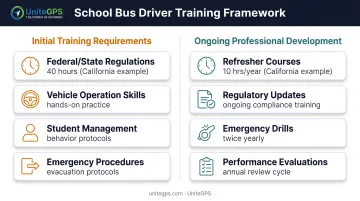
- California: 40 hours initial training (at least 20 classroom hours on regulations, vehicle operation, student management, and emergencies, plus 20 behind-the-wheel hours)
- Texas: 20-hour School Bus Safety Certification Course through Education Service Center programs, mixing classroom and practical skills
- New York: Classroom instruction, skills assessment, and practical evaluation before state certification
Essential Initial Training Topics:
- Federal and state rules specific to school bus operation
- Hands-on vehicle operation: pre-trip inspections, basic controls, and defensive driving
- Student behavior management that keeps attention on the road while handling conduct issues
- Emergency procedures: evacuations, first aid/CPR, incident communication, and responder coordination
Ongoing Professional Development
Certification is only the start. Drivers need regular refresher training to stay current on regulations, reinforce safe habits, and learn new equipment or updated procedures.
Ongoing Training Requirements:
- California: 10 hours in-service training per 12-month certificate period to keep CHP school bus certification
- Texas: 8-hour recertification course every three years through approved Education Service Center programs
- New York: At least two hours of refresher instruction twice each school year (July–October and December–May)
- Virginia: Annual evaluation by the transportation director or designee, plus emergency exit drills within the first 90 calendar days of each session
Emergency Preparedness Training
When incidents occur, driver response quality directly determines student safety outcomes. Emergency preparedness training must cover both theoretical knowledge and practical skills that drivers can execute under stress.
Emergency Training Components:
- Evacuation procedures: Hands-on exit operation, student direction, and post-evacuation accountability
- First aid and CPR: Basic medical response skills (CPR is not a universal federal requirement, but many states or special-needs assignments require it)
- Incident communication: How to notify dispatch, reach emergency services, update parents, and document what happened
- Railroad crossings: Approach protocols, visual and auditory checks, and safe crossing technique
Mandatory Emergency Drills:
- Pennsylvania: Two evacuation drills each year (first school week and March), covering exits, fire extinguishers, and evacuation steps; annual completion certification required
- Virginia: Emergency exit drill at least once within the first 90 calendar days of each session
Training Documentation Requirements
Even a strong training program fails an audit or lawsuit if the district cannot prove it happened. Records need to show what was covered, how long it lasted, who taught it, and how each driver performed.
Essential Training Records:
- Attendance logs with driver signatures, dates, and session lengths
- Training materials given to drivers (slides, handouts, reference docs)
- Trainer credentials showing instructors held the right certifications
- Performance evaluations with skills-test results and any remedial training
- Multi-year transcripts of cumulative hours and topics
Districts that cannot produce complete training documentation during regulatory reviews or litigation face significant liability exposure regardless of actual training quality.
Route Planning and Stop Location Safety
Effective school bus safety begins before students board. Strategic route design and careful stop location selection reduce risk before incidents happen.
Route Optimization Principles
Modern route planning balances efficiency with safety, using software to analyze multiple variables simultaneously while maintaining human oversight of final decisions.
Route optimization tools evaluate road conditions, traffic patterns, student locations, and time constraints to build efficient routes.
Platforms like UniteGPS Crosswalk help districts hold those routes with real-time GPS that compares planned versus actual travel, flags deviations, and supports quick adjustments. When stops are added or removed, the system recalculates downstream arrival times so parents, drivers, and administrators stay aligned without manual schedule rewrites.
Route planning objectives:
- Minimize total fleet miles to cut fuel cost, vehicle wear, and student ride time
- Balance passenger loads so buses are not overcrowded and drivers can supervise effectively
- Time routes for appropriate arrival windows—avoid excessive early pickups and late returns
- Place stops to reduce how often students must cross streets to board
Stop Location Safety Standards
NHTSA recommends specific criteria for safe bus stop placement that transportation directors should apply systematically across all routes.
NHTSA stop location guidelines:
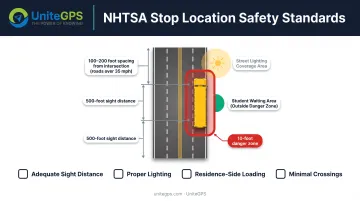
- Keep 500 feet minimum straight-line sight distance; if you cannot, request "School Bus Stop Ahead" signs from the road authority
- Prefer stops under street lighting, especially for dark winter morning and afternoon routes
- Stay off intersections; on roads posted above 35 mph, set stops about 100–200 feet away to limit conflict with turning traffic
- Give students room outside the bus danger zone (the 10-foot perimeter) and space to move at least 10 feet away after unloading
- Favor same-side boarding; avoid crossings on roads with three or more lanes
Ohio's legal implementation: Ohio Administrative Code 3301-83-13 requires residence-side loading where possible. When sight distance falls below 500 feet, districts must request warning signage from the road authority—turning NHTSA guidance into enforceable state rules.
Route Hazard Assessment Process
Safe stop locations need systematic evaluation—not only driver judgment or historical practice. A formal hazard assessment surfaces risks a single site visit can miss.
Hazard assessment steps:
- Visit each site during typical route times to check sight lines, road conditions, traffic, and waiting space
- Coordinate with traffic engineers or road authorities on crash history, speed studies, and planned improvements
- Ask police which locations see frequent stop-arm violations or aggressive driving
- Re-check stops in different weather and light—adequate October visibility can fail in December dark
- Re-evaluate when traffic patterns shift, roads deteriorate, or construction changes sight lines
Minimizing Student Street Crossings
Every street crossing represents elevated risk. Strategic planning can eliminate many crossings entirely and improve safety protocols for crossings that remain unavoidable.
Crossing minimization strategies:
- Design route direction so homes sit on the bus side of the street at the stop
- Consolidate subdivision stops at entrances so students walk inside the neighborhood instead of crossing major roads
- Set afternoon discharge so students exit toward home without crossing in front of or behind the bus
When crossings are unavoidable:
- Choose locations with the best visibility in both directions
- Avoid curves, hills, and intersections where sight lines break down
- Use driver-controlled crossing with clear hand signals
- Train students to look both ways, wait for the driver signal, and watch for turning vehicles
Vehicle Maintenance and Inspection Protocols
Comprehensive maintenance programs keep vehicles safe and compliant while building the records you need for audits and legal defense.
Daily Pre-Trip Inspection Requirements
Drivers bear legal responsibility for operating safe vehicles. Pre-trip inspections provide the first line of defense against mechanical failures that could endanger students.
Required Daily Pre-Trip Checks:
- Test service brakes and emergency brake operation before departing the yard
- Verify headlights, tail lights, brake lights, turn signals, hazard flashers, and stop-arm warning systems
- Confirm all required mirrors are properly positioned for adequate visibility
- Check that the fire extinguisher, first aid kit, body fluid cleanup kit, and emergency reflectors are present and accessible
- Inspect tires for proper inflation, adequate tread depth, and visible damage such as cuts or bulges
- Verify emergency exits operate correctly and interior warning systems function
Digital inspection systems on in-vehicle tablets replace paper forms. Drivers can attach photos, log defects on the spot, and send reports straight to maintenance—so issues surface immediately and records stay audit-ready.
Preventive Maintenance Scheduling
Reactive maintenance only fixes problems after breakdowns. That approach raises safety risk, drives up cost, and leaves compliance gaps. Systematic preventive maintenance addresses wear items before they fail.
Preventive Maintenance Framework:
- Follow OEM intervals for engine, transmission, brakes, steering, and safety equipment
- Set mileage triggers aligned with manufacturer guidance (e.g., oil changes every 6,000 miles, brake inspections every 12,000 miles)
- Schedule time-based work—coolant replacement, belt inspection, fluid analysis—even when mileage thresholds have not been met
- Increase frequency in severe conditions: harsh winters, mountain routes, unpaved roads, or high-idle urban runs
State Inspection Requirements and Documentation
State safety inspections verify that vehicles meet regulatory standards at specific intervals throughout the year.
State Inspection Examples:
- New Jersey: MVC School Bus Inspection Unit inspects registered school transportation vehicles twice yearly
- New York: Covered vehicles must be inspected at least every six months by certified inspection facilities
Essential Inspection Documentation:
- Official inspection certificates with facility name, inspector signature, inspection date, and vehicle identification
- Detailed inspection reports listing all points checked and any deficiencies identified
- Documentation of repairs performed to correct identified deficiencies before the vehicle returned to service
- Maintenance records demonstrating that required inspections occurred on schedule without gaps
Districts must retain these records on state-specific schedules. Oregon requires three-month retention for driver vehicle inspection reports; other states set longer periods for different record types.
Preventing Illegal Passing and Stop-Arm Violations
The corrected 2025 NASDPTS survey projected more than 39.3 million annual violations nationwide, down from 45.2 million the previous year. That volume still signals massive non-compliance with stop-arm laws and directly endangers students crossing at stops.
Understanding the Violation Scope
Illegal passing remains one of the most persistent school bus safety challenges despite universal state prohibitions.
2025 NASDPTS Survey Data:
- 114,239 drivers participated across 36 states plus DC (approximately 31% national participation)
- 67,258 observed illegal passes occurred in a single survey day
- Extrapolating to full national participation and 180 school days yields the 39.3 million annual violation projection
- Year-over-year drop from 45.2 million shows progress, yet the rate remains unacceptably high
The primary danger occurs when students cross streets to board or exit buses. Most illegal passes happen on multi-lane roads where motorists in distant lanes ignore stop-arm laws, but violations also occur on two-lane roads where drivers simply choose not to stop.
Safe System Approach to Reducing Violations
No single intervention eliminates illegal passing. Effective programs combine engineering improvements, enforcement strategies, and community education—the Safe System Approach that addresses multiple failure points simultaneously.
Engineering Solutions:
- Enhanced bus visibility: Upgraded lighting systems, larger stop-arm signs, and additional warning flashers make buses more conspicuous to approaching motorists
- Extended stop-arms: Longer arms project farther into adjacent lanes, creating a clearer visual barrier
- Warning signage: "School Bus Stop Ahead" signs at high-violation locations alert motorists before buses activate stop signals
Enforcement Strategies:
- Law enforcement patrols: Officer presence at known high-violation locations, particularly during the first weeks of school when violation rates peak
- Stop-arm camera programs: Automated systems that capture plates and issue citations; deterrent value depends on consistent adjudication and court follow-through
- High-visibility enforcement campaigns: Coordinated enforcement periods with public announcements that create heightened awareness of violation consequences
Community Education:
- School Bus Safety Week programs: Annual awareness campaigns coordinated with law enforcement emphasizing stop-arm laws and penalties
- Public service announcements: Media campaigns explaining that stop-arm laws apply even on divided highways in many states (verify specific state law)
- Parent engagement: Enlisting parent groups to share safety messages through school newsletters, social media, and community meetings
Important evidence caveat: Rockland County reported a 30% violation decrease during its camera program. By contrast, NHTSA's Pennsylvania demonstration found ticket awareness rose from 13.7% to 20.0%, yet observed ticketable events did not meaningfully decline.
Camera systems still help prosecution, but only when citation issuance and court review stay consistent. Technology alone does not change driver behavior.
Common Compliance Mistakes to Avoid
Audit findings from multiple jurisdictions reveal recurring compliance failures that create legal liability, endanger students, and waste limited transportation budgets.
Inadequate Training Documentation
The most thorough training program provides no legal protection if the district cannot prove it occurred.
Documentation Failures:
- Missing attendance records: No sign-in sheets or electronic attendance verification showing which drivers attended which sessions
- Incomplete course materials: Presentations or handouts not retained, so the district cannot show what topics were covered
- Undocumented training hours: No way to track actual instruction time versus scheduled session length
- Missing trainer credentials: No records that instructors held required certifications or subject-matter qualifications
Districts facing litigation after serious incidents often find that programs they thought were comprehensive left no defensible documentation trail.
Inconsistent Vehicle Inspection Records
Paper-based inspection systems create multiple failure points where required safety checks either don't occur or aren't properly documented.
Inspection Record Failures:
- Skipped pre-trip inspections: Drivers sign blank forms in batches instead of completing genuine daily checks before each route
- Incomplete defect documentation: Problems noted verbally to maintenance but never recorded in written logs
- No repair verification: Defects logged with no follow-up showing when repairs were finished and the bus returned to safe status
- Missing periodic inspection certificates: State semi-annual or annual inspections missed on schedule, or certificates lost and not replaced
Arizona's Tombstone Unified School District audit documented failed preventive maintenance and inaccurate reporting—a clear case of how weak records create safety risk and compliance exposure.
Poor Communication With Parents and Families
Inadequate parent notification floods the transportation office with calls and leaves families frustrated—and students waiting in unsafe conditions.
Communication Failures:
- No delay notifications: Mechanical issues, traffic, or weather slowdowns go unannounced, leaving students outside in extreme temperatures
- Missing route change alerts: Stop locations or pickup times change without advance notice, causing missed pickups
- Inadequate emergency communication: Accidents or serious delays aren't reported promptly, so parents panic when students don't arrive
Automated delay, route-change, and ETA alerts cut most routine "Where is the bus?" calls and keep students from waiting without information.
Neglecting Route Safety Assessments
Routes established years ago may no longer meet current safety standards due to changed traffic patterns, new construction, or deteriorated road conditions.
Common gaps include:
- Leaving stops in place after sight distance or waiting areas no longer meet safety needs
- Filing away hazard reports from parents, drivers, or neighbors without a formal evaluation
- Skipping route updates after new signals, speed-limit changes, or construction alter stop safety
NHTSA's 500-foot sight distance recommendation should trigger a formal hazard assessment and possible stop relocation whenever visibility falls below the minimum.
Treating Compliance as One-Time Achievement
Compliance is an ongoing operational discipline. Treat it like a finished project and gaps open fast.
Ongoing Compliance Failures:
- Stale training content: New regulations, equipment changes, or incident lessons learned never make it into driver programs
- Policies left untouched: Annual reviews skipped, so rules lag current regulations, operations, or technology
- Outdated systems: GPS, tablets, and routing software go unpatched, creating inefficiencies and compliance blind spots
- No stakeholder loop: Drivers, administrators, and parents aren't consulted, so written practice drifts from real operations
Conclusion
School bus safety compliance is an ongoing commitment across vehicles, drivers, routes, maintenance, and technology. Transportation directors have to hold several pieces together at once:
- Federal FMVSS construction standards paired with state operational rules
- Driver training programs backed by defensible documentation
- Safe stop selection and ongoing location review
- Digital tools that produce audit-ready records without extra paperwork
The 26 million children who ride school buses every day deserve systems built on process, not hope. Platforms like UniteGPS Crosswalk pull routing, GPS tracking, ridership records, and digital inspections into one place so compliance evidence comes from normal daily work. Technology still cannot replace judgment, training, or a real institutional commitment to safety.
Treat each requirement—FERPA data protection, CDL endorsement checks, pre-trip inspection logs—as part of the framework that protects students and supports drivers when something goes wrong. Done well, compliance also makes transportation departments clearer, faster, and harder to catch off guard.
Frequently Asked Questions
What federal regulations govern school bus safety and how do they differ from state requirements?
NHTSA’s FMVSS set minimum construction rules for new school buses (exits, mirrors, stop-arms, seating). States add operational rules for drivers, inspections, and training that often go further. Districts must meet both federal build standards and their state’s operating requirements.
How can school districts ensure FERPA compliance when using GPS tracking and student management technology?
Use vendors that sign Data Processing Agreements as school officials limited to transportation. Enforce role-based access, multi-factor authentication, and encryption (TLS 1.2+ in transit, AES-256 at rest), plus clear retention and deletion rules. Review vendor practices with annual audits when available.
What are the most effective strategies for reducing illegal school bus passing violations?
Combine engineering, enforcement, and education: upgrade lighting and stop-arms, run patrols at high-violation spots, deploy stop-arm cameras with reliable adjudication, and educate the community on laws and penalties. Cameras document violations well, but consistent citations and court follow-through are what change driver behavior.
How often should school bus drivers receive safety training and what topics should be covered?
Drivers need full initial training before transporting students. Ongoing hours vary by state: California, 10 hours yearly; Texas, 8-hour recertification every three years; New York, at least 4 hours per school year. Cover regulatory updates, defensive driving, student management, evacuations, and first aid where required, and document attendance and evaluations.
What documentation is required to demonstrate compliance during regulatory audits or legal proceedings?
Keep complete driver qualification files (CDL, medical certs, background checks, training, evaluations) and vehicle records (pre-trip inspections, state certificates, maintenance and repair logs). Operations need route hazard assessments, GPS and ridership logs, incident reports, and parent communications. Systems should export timestamped audit trails of data access and changes.
How can smaller school districts with limited budgets improve safety compliance?
Prioritize integrated platforms that combine routing, GPS, ridership, and reporting in one subscription. Pursue Section 402 or state safety grants and regional purchasing co-ops for volume discounts. Target spend at the highest-risk gaps. UniteGPS starts at $49/month for routing-only districts with a 90-day free trial that includes route setup.