Introduction
Every school day, more than 24 million students are transported at public expense across the United States — carried on roughly 480,000 yellow school buses making over 50 million trips daily, according to the National School Transportation Association. Without real-time tracking, transportation directors manage that scale largely blind: no live visibility across the school bus fleet, no confirmation of student boardings, and no way to proactively update anxious parents waiting at the curb. It's a demanding job, often handed to people who were never trained for it — and the right tools change what's possible.
That's changing fast. A 2024 School Bus Fleet survey found 48% of responding districts used rider or bus status tracking apps — up from 39% the prior year. The parent pressure driving that adoption is clear: a Harris Poll conducted for Zonar found 75% of parents wanted a better way to track their child's bus journey, with 51% wanting real-time access in an emergency.
GPS-based tracking has moved from a nice-to-have to a core operational tool. If you're the transportation director carrying that responsibility — often without a roadmap for the job — this guide is built for you. It breaks down the leading school bus tracking systems available in the US today, covering key features, pricing structures, and what to look for based on your district's size and needs, so you can make the call with confidence.
Key Takeaways
- 24M+ students ride school buses daily in the US — real-time tracking is now a safety standard, not an upgrade
- Top systems integrate GPS tracking, ridership scanning, route optimization, and parent alerts in one platform
- Prioritize FERPA compliance, SIS integration, and vendor support — not just feature counts
- Pricing varies widely — compare total cost of ownership, not just the monthly subscription rate
- UniteGPS Crosswalk offers a 90-day free trial with routes built at no cost — no credit card required
What School Bus Tracking Systems Actually Do
A school bus tracking system combines three core components: GPS hardware installed on each bus, cellular data transmission, and a software platform that delivers real-time location data to dispatchers, drivers, and parents through web portals or mobile apps.
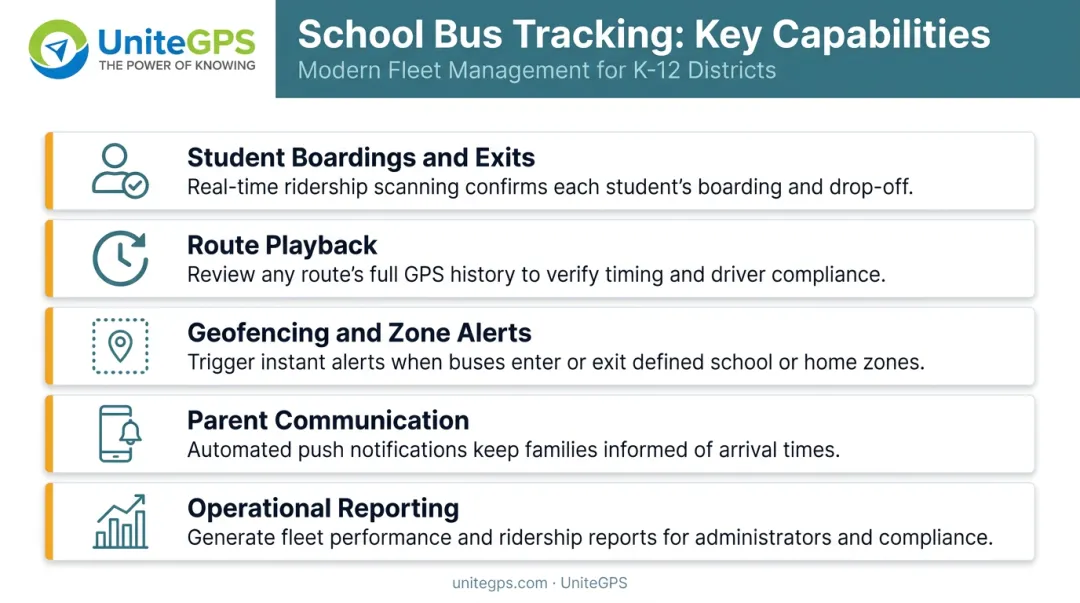
Modern systems extend well beyond a moving dot on a map. Key capabilities include:
- Student boardings and exits — confirming which students got on and off at each stop
- Route playback — reviewing historical route data to resolve disputes or audit performance
- Geofencing and zone alerts — triggering notifications when buses enter or leave defined areas
- Parent communication — push notifications, ETAs, and delay alerts delivered to smartphones
- Operational reporting — mileage tracking, on-time performance, and driver behavior data
Not all systems serve the same needs. Some are parent-notification apps layered on top of existing GPS hardware; others are full transportation management platforms covering routing, ridership, driver tools, and district-level reporting. Which category fits your district depends on whether you need to inform parents or run operations — and the five systems below cover both ends of that spectrum.
Best School Bus Tracking Systems for US School Districts
These systems were selected based on real-world district adoption, feature depth, US-market focus, and the balance they strike between safety, operational efficiency, and parent communication.
UniteGPS (Crosswalk)
Founded in 2014 in South Portland, Maine, UniteGPS was born from a frustration most parents recognize: co-founder Christopher Bunnell watched his own children wait in freezing temperatures with no idea when their bus would arrive. He partnered with Steve C. Lanning and Steven J. Lanning to build a solution, starting with a GPS tracker and parent app — then expanding into a full transportation management platform as district conversations revealed deeper operational needs.
Today, Crosswalk K-12 serves 100+ US school districts across Missouri, Iowa, Indiana, Texas, Michigan, Washington, and other states, and integrates routing, GPS tracking, student ridership, SIS sync, driver navigation, and parent communication in one FERPA-compliant platform.
What makes it genuinely different is its ownership model. UniteGPS is fully bootstrapped — every feature was funded by paying customers, not private equity. That means product decisions reflect real district needs, not investor timelines.
The platform integrates directly with PowerSchool, Infinite Campus, Skyward, and Harmony, with daily automated SIS syncs that surface enrollment changes, address updates, and disenrollments through a built-in action center — no manual re-entry required.
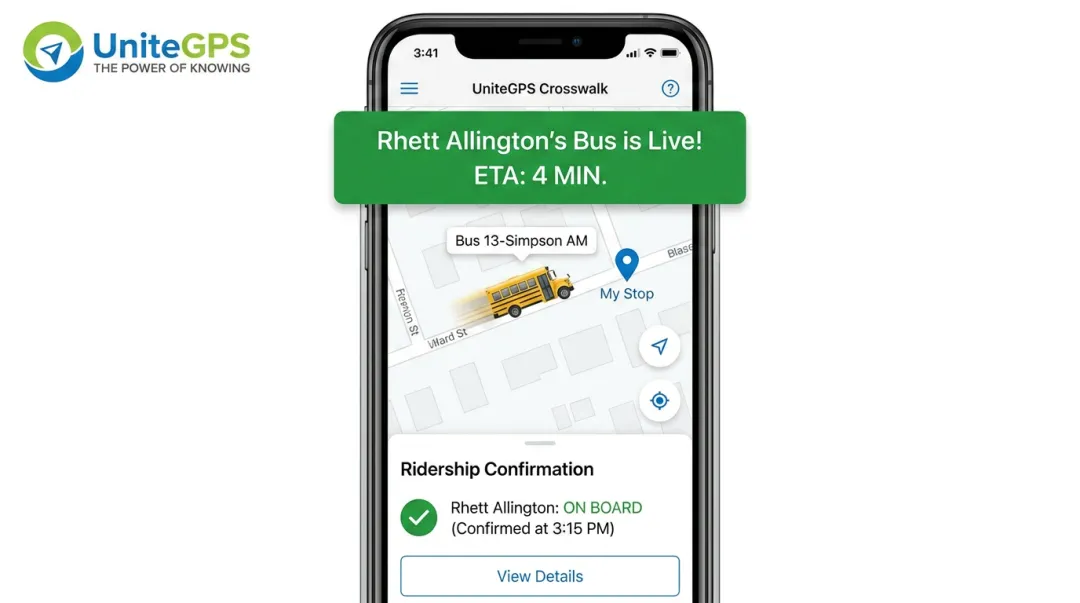
Student ridership uses barcode scanning on bus-mounted tablets, capturing who boarded, when, and at which stop to produce an exact stop manifest. That data feeds IEP/Medicaid billing documentation, parent ridership alerts, and dispute resolution. When Benton Community School District's transportation director Tim Lyons needed to verify bus presence after a parent complaint, the timestamped scan records answered the question immediately.
| Category | Details |
|---|---|
| Key Features | Real-time GPS tracking, barcode-based student ridership via bus tablets, route optimization, SIS integration (PowerSchool, Infinite Campus, Skyward, Harmony), parent app with live ETA, sub driver turn-by-turn navigation, FERPA-compliant data handling, IEP/Medicaid billing documentation |
| Best For | K-12 districts of all sizes seeking an all-in-one platform; districts that want routing, GPS, and ridership without managing multiple vendor relationships |
| Notable Differentiator | Fully bootstrapped with no private equity pressure; 90-day free trial with routes built at no cost; unlimited live US-based support with no ticket queues |
Transfinder
Transfinder is a Schenectady, New York-based transportation software company with a long track record serving large US school districts. Its platform covers advanced routing and scheduling, GPS tracking, fleet management, and parent notification tools — and it's frequently selected by districts managing geographically complex, multi-school bus fleets.
Alpine School District in Utah — serving 86,000 students across 90+ schools with 200+ buses — deployed Transfinder's full suite and reported improved route visibility, parent communication, and operational efficiency. That scale reflects what the routing engine is built for.
The trade-off is complexity. Transfinder has a steeper learning curve and typically requires significant administrative setup time, which can be a barrier for smaller districts or those without dedicated transportation IT staff.
| Category | Details |
|---|---|
| Key Features | Advanced route optimization, real-time GPS tracking, fleet management, driver timesheets, parent notification app, analytics and reporting dashboards |
| Best For | Large to enterprise-scale US districts with complex multi-school routing needs and dedicated transportation administration staff |
| Notable Differentiator | Industry-recognized routing optimization engine with deep analytics; strong large-district deployment track record |
Here Comes the Bus (Synovia / CalAmp)
Here Comes the Bus is one of the most widely recognized parent-facing tracking apps in the US. Created by Synovia Solutions and now operating as CalAmp K-12 powered by Synovia following a 2019 acquisition, it provides real-time bus location visibility and arrival alerts directly to parents' smartphones. The platform reports over 1.7 million active users across more than 325 school districts, delivering approximately 250 million notifications per month.
Its core strength is reducing "where's the bus?" calls — providing scheduled vs. actual arrival times alongside delay push notifications. Districts that have heavily invested in the Synovia/CalAmp infrastructure will find it integrates naturally.
One important note: Student ridership tracking is a separate package. Districts that want both parent-facing location data and student-level boarding confirmation will need to purchase multiple tiers.
| Category | Details |
|---|---|
| Key Features | Real-time bus location for parents, scheduled vs. actual arrival times, delay push notifications, student ridership tracking (separate package), mobile app and web portal |
| Best For | Districts primarily seeking to improve parent communication and reduce transportation office call volume; districts already using Synovia/CalAmp infrastructure |
| Notable Differentiator | High parent adoption rates; strong brand recognition among US families; 1.7M+ active users |
BusWhere
BusWhere is a North Bethesda, Maryland-based tracking solution built around fast setup and ease of use. Its patented SmartAssign technology (patent record US9640074B2) automatically assigns any bus to any route without daily configuration updates — a practical feature when buses are swapped due to maintenance or driver availability.
The plug-and-play hardware connects via J-1939/OBD2 interfaces or a cigarette-lighter solution for older buses, with no electrical rewiring required. BusWhere claims districts can be fully operational in under one hour — making it a strong fit for smaller districts or schools that want a low-friction deployment.
RFID-based student ridership is available as an optional add-on for districts ready to move beyond basic bus tracking.
| Category | Details |
|---|---|
| Key Features | Real-time GPS tracking, patented SmartAssign route assignment, parent app with ETA alerts, school bus fleet map for administrators, RFID student ridership (add-on), plug-and-play hardware |
| Best For | Small to mid-sized districts or individual schools seeking fast, low-complexity implementation with reliable parent-facing tracking |
| Notable Differentiator | Patented Auto-Detect technology removes daily bus-to-route maintenance; under one hour setup; no electrical installation required |
Edulog
Edulog is a Missoula, Montana-based transportation software company with significant scale: its software routes over 85,000 buses transporting more than 6 million students daily, serving districts ranging from 57 students to 1.8 million students. That breadth reflects a highly modular platform — districts can select the specific tools they need across routing, GPS tracking, student ridership, driver management, and parent communication.
Edulog's GPS tracking integrates directly with its routing and planning software, giving administrators a unified view of planned vs. actual routes with student-level detail. A School Transportation News case study reported one district reduced parent phone calls by 75% after deploying Edulog's parent app.
Districts with dedicated transportation IT staff will get the most from that depth. Smaller operations without a dedicated administrator may find the setup investment exceeds what their workload justifies.
| Category | Details |
|---|---|
| Key Features | Real-time GPS tracking, RFID student ridership, driver time and attendance via tablets, route planning and optimization, parent web portal and mobile app, cloud-based modular subscription |
| Best For | Mid to large US districts seeking deep integration between routing, tracking, and student ridership; districts with dedicated transportation administration teams |
| Notable Differentiator | Fully integrated routing-to-tracking platform serving 6M+ students daily; consulting services available for route and transportation optimization |
How We Chose These Systems
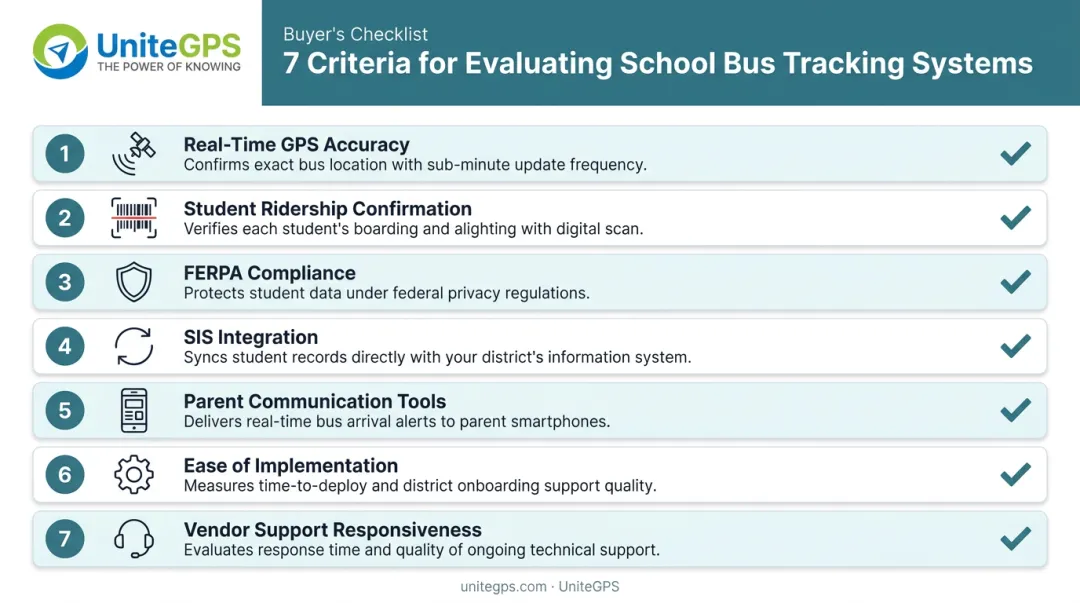
These systems were evaluated against the criteria that matter most to US transportation directors:
- Real-time GPS accuracy — update frequency and reliability under real-world conditions
- Student ridership and boarding confirmation — RFID, barcode, or scan-based verification
- FERPA compliance and data security — especially for systems handling student PII
- SIS integration capability — automated enrollment sync vs. manual data entry
- Parent communication tools — app quality, notification types, and ease of use
- Ease of implementation — hardware complexity, setup time, and onboarding support
- Vendor support responsiveness — what happens after the contract is signed
Common Selection Mistakes to Avoid
Districts that run into trouble with GPS tracking systems typically make one of these errors:
- Prioritizing low upfront price over total cost of ownership — implementation time, support quality, and hardware costs often exceed the licensing fee
- Selecting a parent-app-only solution that doesn't address operational needs like routing, ridership, or SIS sync
- Failing to assess vendor financial stability before signing multi-year contracts — acquisition activity in this space is real, and ownership changes affect support quality
- Skipping a pilot or free trial — any vendor unwilling to demonstrate value before a commitment is worth scrutinizing
Two more checks before signing: ask for US-based references from active school districts, and confirm the support model doesn't quietly degrade once the contract is in place.
Conclusion
The right school bus tracking system isn't just a live map for parents. It's the operational infrastructure that lets transportation directors run safer routes, confirm student accountability from boarding to drop-off, and manage school bus fleet performance with actual data instead of institutional knowledge.
The best fit depends on district size, existing infrastructure, staff capacity, and the specific problems a district is trying to solve. A small district replacing paper maps needs something different than a large urban district managing 300 buses across dozens of schools.
When making a final decision, look beyond the feature list. The vendors worth committing to hold up on three fronts:
- Support model — direct access to real people, not a ticket queue
- Financial stability — a company that will still exist in five years
- Track record — verifiable experience with districts similar in size and structure to yours
The systems that create long-term value are the ones still responsive to your calls three years after go-live.
The right platform matters — but so does the partner behind it. UniteGPS doesn't sell you software and walk away; we stay, we share what we know, and we help you build a transportation operation your district can be proud of. Great student transportation starts with great leaders — and we build both. Districts looking for a fully integrated K-12 platform can start a 90-day free trial of UniteGPS Crosswalk with no credit card required, with routes built for you at no cost during the trial period. Reach the team directly at 207-591-7777.
Frequently Asked Questions
Are school bus GPS tracking systems FERPA compliant?
Not all tracking products are built with K-12 student data protections in mind. Districts should require vendors to sign a formal Data Processing Agreement and confirm FERPA compliance before deployment.
Can school bus tracking systems integrate with student information systems (SIS)?
Quality K-12 tracking platforms offer direct SIS integration to automatically sync student enrollment, address, and route assignment data. This eliminates manual entry and keeps routing current throughout the school year as rosters change.
How much does a school bus tracking system cost?
Pricing varies by school bus fleet size, features, and hardware. Software-only options cost less than full tablet-equipped deployments, which carry higher upfront hardware costs. Look for vendors with transparent pricing and a free trial or pilot option so your district can validate the system before committing.
Does it work with our existing GPS hardware?
Usually, yes. UniteGPS Crosswalk is compatible with existing GPS hardware from vendors like CalAmp, Zonar, and 247Recorders — we can take that data feed and run it directly in the platform. Districts that already invested in GPS units don't have to buy a whole new system to switch.
When the bus is shut down, can I still see where it is?
Yes. You'll know where every bus is 24/7 — even when the ignition is off and the engine isn't running, the real-time GPS keeps reporting location. That's a common gap in camera-based GPS systems, where the tracking goes dark the moment the bus powers down.
Is your support a chatbot or a real person?
A real person. When you reach out, you talk to someone on our US-based team — not a chatbot, not an overseas call center, and not a ticket queue. Support is unlimited, so you're never rationing help after the contract is signed.
Is the free trial a first-year-only deal?
No — there's no first-year gimmick and no forever-free catch. Districts can start a 90-day free trial: we set up your routes and data feed at no cost, and you keep the routing even if you don't continue.
How long does implementation take, and what does it require from us?
Not much from you — that's the point. A named implementation contact builds your initial routes with your team, and GPS devices ship pre-labeled and pre-assigned, so installation is plug and play: you plug each unit into the bus it's assigned to. Most districts are up and running within weeks, and the 90-day free trial covers the entire setup, so you're never doing the heavy lifting alone.
Can we do year-to-year? Our board restricts long-term contracts.
Yes. UniteGPS contracts are year-to-year with annual invoicing — no multi-year commitment — and the terms go in writing on the quote. That matters for districts whose board or legal counsel limits agreements to a set term.