For a lot of students with disabilities, the school bus is the first place they interact with the outside world each morning and the last place before they get home. Get that ride wrong, and you're not just dealing with a logistics headache.
You're looking at a legal problem, a safety problem, and a trust problem with families who are already navigating a system that can feel stacked against them.
Transportation isn't a courtesy districts extend to students with disabilities. Under IDEA, it's classified as a related service, meaning it carries the same legal weight as speech therapy or occupational therapy when it's written into an IEP. This guide walks through eligibility rules, required accommodations, the compliance risks that trip up even well-intentioned districts, and how technology is closing the gaps that used to fall through the cracks.
The goal here is practical: help transportation directors and administrators build a program that keeps students safe and holds up if it's ever questioned.
Key Takeaways
- IEP-mandated transportation must be provided at no cost to families, including specialized vehicles and staffing.
- A disability diagnosis alone doesn't trigger special transportation; eligibility requires individualized assessment.
- Excessive ride times, improper restraints, and vague IEP language are the most common compliance failures.
- Real-time ridership tracking and SIS integration give districts the records to prove compliance and cut daily risk.
The Legal Framework Behind Special Needs Transportation
Under 34 CFR 300.34, IDEA defines transportation as a related service required to help a child with a disability benefit from special education. That definition is broader than most people assume. It covers:
- Travel to and from school
- Travel between schools
- Movement within school buildings
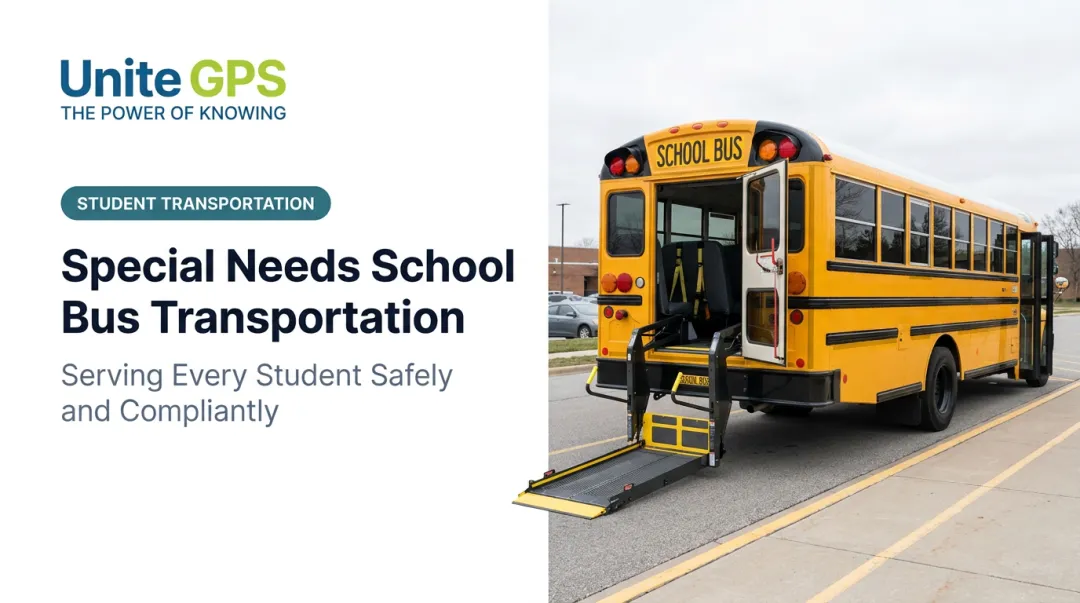
- Specialized equipment such as adapted buses, lifts, and ramps
Here's the part districts sometimes miss: once transportation is written into an IEP, it stops being optional. The district must provide it at no cost to parents - and that includes any specialized vehicles, equipment, or staffing the student needs to ride safely.
How the IEP Team Determines Transportation Needs
Transportation decisions aren't made in a vacuum by the bus garage. The IEP team typically includes:
- Parents or guardians
- Special education staff
- A district representative
- Transportation personnel
- Related-service specialists (occupational therapists, nurses, behavior specialists)
Each member brings a different lens - mobility, behavior, communication, health - to evaluate what a student actually needs during transit.
One detail that matters more than it sounds: IEP transportation language has to be specific. According to New York State Education Department guidance, it's not appropriate for an IEP to simply state "special transportation needed" without describing the nature of that service. Vague language like that is considered non-compliant.
Consequences of Non-Compliance
Failing to deliver IEP-mandated transportation isn't a paperwork error. It's treated as a denial of FAPE - Free Appropriate Public Education - and can trigger compensatory education orders, mediation, or a formal Office for Civil Rights complaint.
Real cases show how this plays out:
- A Pennsylvania hearing officer ordered a district to provide 15 minutes of compensatory education for every day a student's bus arrived late over a four-month stretch.
- After an OCR compliance review found gaps in transportation delivery, Chicago Public Schools had to reroute affected students within four school days and reimburse parents who had been driving their kids themselves.
7.5 million students, or 15% of public school enrollment, received IDEA services in the 2022-23 school year, according to NCES data.
Not all of them need specialized transportation. Even a fraction of that population still means millions of rides districts have to get right each school day.
Who Qualifies for Special Needs Transportation?
Here's a principle worth repeating because it surprises a lot of new administrators: most students with IEPs ride the standard bus. Sometimes with a behavior plan. Sometimes with a paraprofessional aide. Having a disability doesn't automatically mean a student needs a specialized vehicle or route.
Criteria That Trigger Eligibility
Districts generally evaluate need across five categories:
- Mobility: wheelchair use, nonambulatory status
- Behavioral: elopement risk, self-injury, extreme anxiety in group settings
- Communication: nonverbal students, AAC users, difficulty understanding directions
- Physical: needs for positioning support, walking or stair assistance
- Health: seizure disorders, oxygen dependency, inhaler or medication needs
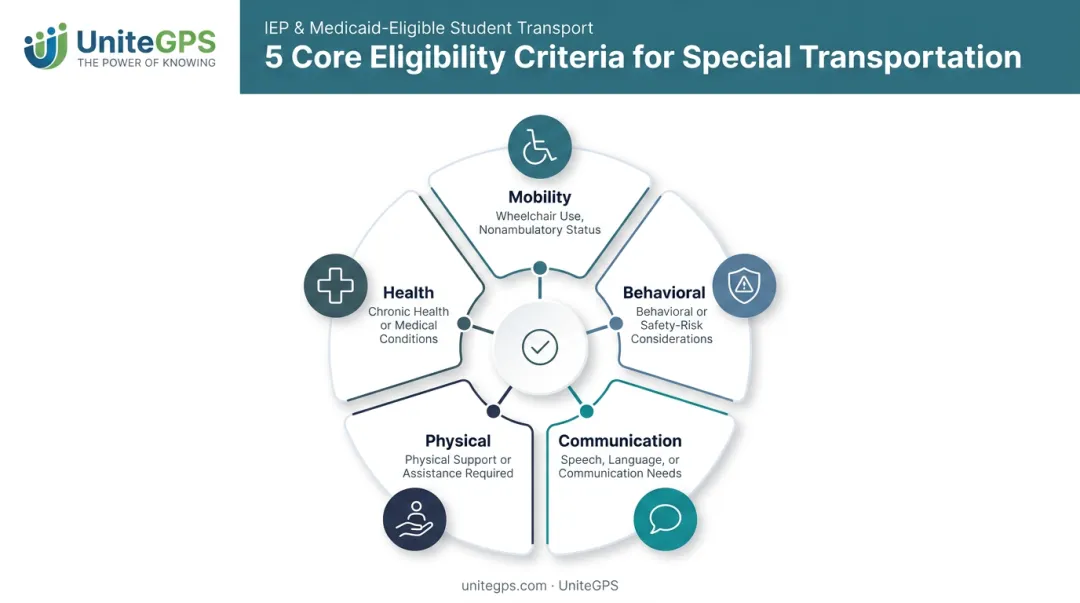
A student might trigger eligibility in one category or several. Eligibility is individualized, not diagnosis-driven.
The Determination Process
The full IEP team decides eligibility from documented assessment data, not a transportation supervisor working from a hunch or a diagnosis code on a form. Transportation staff can flag concerns, but they can't override an IEP team's decision.
A common point of confusion involves private schools. If the IEP team placed a student at a private school specifically for special education services, transportation eligibility applies just as it would at a public school.
If parents chose that private school on their own, the calculus changes. Districts may still owe limited transportation for equitable services, but not full door-to-door coverage from home.
One rule holds regardless of placement: when transportation is deemed necessary, districts cover 100% of the cost. Parents cannot be billed for IEP-mandated transportation, full stop.
Specialized Accommodations, Equipment, and Personnel for Safe Rides
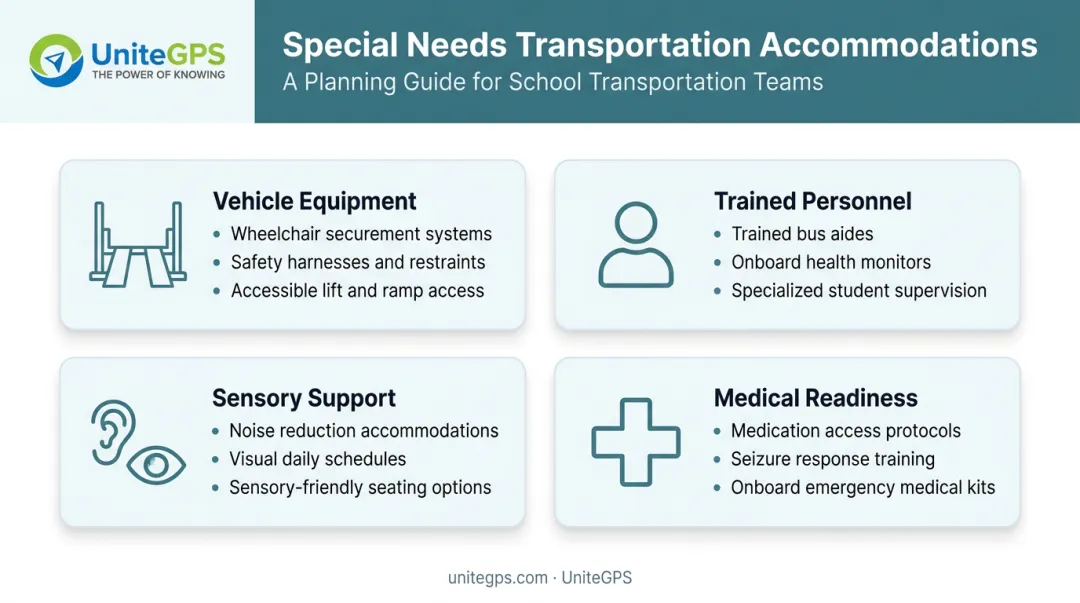
Once a student qualifies, the equipment and staffing decisions follow directly from documented needs. Common vehicle equipment includes:
- Wheelchair lifts and ramps
- Four-point securement systems for wheelchairs
- Harnesses or safety vests
- Child safety restraint systems
- Climate-controlled interiors
Personnel matter just as much as equipment. Many students need a trained bus attendant or one-on-one monitor, and drivers assigned to these routes often need specific training for medical emergencies or behavioral escalations.
Predictability Reduces Anxiety
For students with autism or sensory processing differences, uncertainty is the biggest disruptor on the ride. Autism Speaks identifies route changes, substitute drivers, and shifting passenger loads as common distress triggers. Advance preparation such as trial rides and visual schedules that show what happens next helps students know what to expect.
Keeping the same driver, same route, and same seat assignment whenever possible is a practical way to lower stress for students who rely on routine to feel safe. When the regular driver is out, clear turn-by-turn navigation and locked-in stop assignments help substitutes protect that same stability.
Sensory accommodations that help:
- Reduced noise levels or quieter seating zones
- Calming visual elements
- Noise-canceling headphones for overstimulated riders
Some students also need onboard medical readiness:
- Accessible emergency medication
- Temperature regulation for kids managing diabetes or asthma
- Staff trained to recognize seizure activity
Those same accommodation standards apply beyond the morning and afternoon run. Field trips deserve the same rigor as daily routes. If a student uses a wheelchair, the district needs a lift-equipped bus or an equivalent arrangement lined up in advance, not a last-minute scramble that leaves that student excluded from the trip everyone else is taking.
Common Compliance Risks Districts Must Avoid
Three issues account for a disproportionate share of transportation-related complaints and hearings.
Excessive Ride Times
General guidance holds that special education students' ride times should be comparable to their non-disabled peers. Massachusetts has codified this: under 603 CMR 28.06(8)(a), districts cannot transport an eligible student for more than one hour each way without the IEP team's specific approval, documented in the IEP itself.
Many other states apply similar informal thresholds, treating anything over an hour outside rural areas as a red flag worth scrutinizing.
Improper Restraint Use
Harnesses and safety vests exist to keep students safe during transport. When they are misapplied or used in place of adequate staffing, they can cause physical harm. If a student's behavior makes restraints necessary, the IEP team should first explore safer alternatives, such as adding a bus monitor, rather than defaulting to more restrictive equipment.
Shortened School Days
This one catches districts off guard. Cutting a student's school day short because the bus route is long or because it's easier for staffing doesn't hold up legally.
A shortened day is only lawful when the IEP team makes an individualized determination that it actually serves that student's needs, not when it's a workaround for a transportation scheduling problem. OCR has required districts to identify and remedy exactly this pattern in past compliance reviews.
How Technology Helps Districts Stay Safe and Compliant Every Day
Paper logs and manual roster updates were never built to handle the complexity of special education transportation. Districts running dozens of IEP-flagged students across multiple routes need real-time systems.
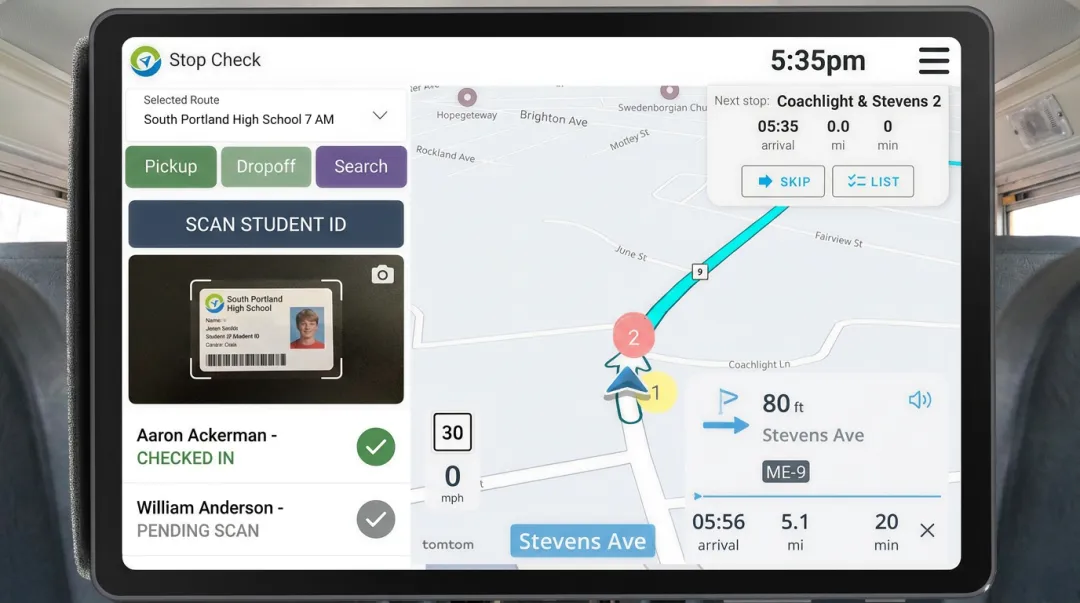
Ridership verification confirms who's actually on the bus. Platforms like UniteGPS use tablet-based scanning so students check in and out with a card or barcode, generating timestamped boarding and exit records. For a nonverbal student or one at elopement risk, that scan-on, scan-off record is the difference between assuming a pickup happened and knowing it did.
SIS integration cuts down on manual errors. UniteGPS's Crosswalk platform syncs directly with systems like PowerSchool, Skyward, and Infinite Campus, keeping enrollment status, addresses, and school assignments current automatically. That means:
- Student data already in the SIS never gets re-typed
- Rosters stay current when a student transfers schools mid-year
- Upload cycles that introduce transcription mistakes go away
UniteGPS stays FERPA-compliant by design. It does not pull IEP content, medical records, or academic data into the transportation system. It syncs only the logistics data (enrollment, address, school) that routing depends on, while IEP details stay where they belong.
Ridership data supports Medicaid billing. Scan-verified rides compile into billing-ready records districts can use for Medicaid reimbursement claims on eligible special education transportation. A compliance requirement becomes a potential funding recovery stream.
Turn-by-turn navigation helps substitutes follow the plan. When a regular driver is out, a substitute running an unfamiliar route with medically fragile or behaviorally complex students is a real risk. Tablet-based navigation displays the full route plus stop-level student information, so a substitute knows which stop needs extra time and which student needs help boarding.
Frequently Asked Questions
Who is eligible for special needs school transport?
Eligibility depends on an individualized IEP team assessment of mobility, behavioral, communication, physical, or health needs. A disability diagnosis alone doesn't automatically qualify a student.
Do parents have to pay for special education transportation?
No. Transportation written into an IEP as a related service must be provided at no cost to the family, including any specialized equipment or staffing required.
What equipment might a special needs school bus require?
Common examples include wheelchair lifts, four-point securement systems, harnesses, child safety restraints, and climate-controlled interiors. The exact equipment is determined by individual student needs documented in the IEP.
Can a student who uses a wheelchair be included on regular class field trips?
Yes. Districts must ensure equal access to field trips, typically through lift-equipped buses or comparable arrangements. Accommodations should be discussed with the family rather than defaulting to separate transportation.
What happens if a school district doesn't provide adequate special needs transportation?
This can be treated as a FAPE violation, potentially leading to a formal complaint, mediation, a due process hearing, or a compensatory education order against the district.
How long can a special needs student's bus ride legally last?
Ride times should generally be comparable to those of non-disabled peers. Many guidelines, including Massachusetts regulations, flag rides over one hour each way outside rural areas as a compliance concern that needs IEP team review.