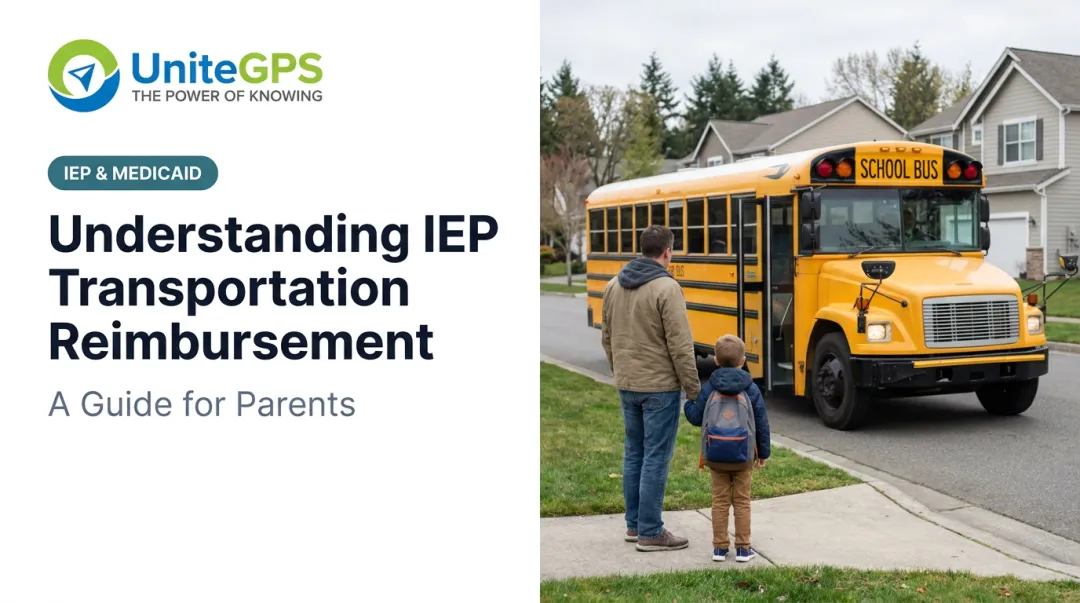
Many parents discover — often the hard way — that their child's IEP includes transportation as a required service, but nobody explained what that actually means financially or how to claim it. Transportation isn't a favor districts grant when it's convenient. Under federal law, it's a protected right.
Under 20 U.S.C. § 1401(26)(A), transportation is explicitly defined as an IDEA "related service" — meaning when a student's disability creates a barrier to safely accessing school, the district must provide transportation at no cost to the family. That includes the possibility of reimbursing parents directly when they do the driving themselves.
This guide covers what IEP transportation reimbursement is, who qualifies, what types of support exist, and how to navigate the process step by step.
Key Takeaways
- Transportation is a federally protected "related service" under IDEA — families pay nothing when it's required for FAPE
- Parents can sometimes be reimbursed directly when they transport their child instead of using district-provided service
- No single federal reimbursement rate exists — rates and processes vary by state and district
- The IEP team determines what transportation a student needs; parents are full members of that team
- Parents can formally dispute transportation denials using IDEA's procedural safeguards
What Is IEP Transportation Reimbursement?
The Federal Foundation
34 CFR § 300.17 defines FAPE — Free Appropriate Public Education — as special education and related services provided at public expense, without charge. When a student's IEP team determines transportation is necessary for the student to benefit from special education, that transportation must be free.
The district can't charge a co-pay, limit service based on budget, or simply decline because routes are difficult to arrange. That obligation is non-negotiable.
Two Different Meanings of "Reimbursement"
Parents often encounter the word "reimbursement" in two distinct contexts:
- District reimbursement — the state or federal government reimburses school districts for the cost of providing mandated special education transportation (this is a government-to-district funding mechanism)
- Parent reimbursement — the district pays parents directly when parents agree to transport their own child in place of district-provided service
This guide focuses on the second scenario: what parents can claim when they drive their child themselves.
When Parent Reimbursement Applies
Parent reimbursement typically comes up when:
- A district cannot arrange appropriate transportation on its own
- A parent and district mutually agree that parent-provided transport is more practical
- A student attends an out-of-district placement far from the district's normal service area
OSEP's 2009 Questions and Answers on Transportation confirms that when transportation is included in a student's IEP, the school district must provide appropriate assistance to parents seeking mileage reimbursement — and must ensure that reimbursement is timely.
How Rates Are Set
That obligation to reimburse raises an immediate question: at what rate? There's no single federal figure — most districts follow one of two approaches:
- A per-mile rate tied to the IRS standard mileage rate (the 2026 IRS business rate is $0.725 per mile)
- A state-defined flat or per-mile rate that may differ from the IRS benchmark
Nebraska's Department of Education, for example, sets a special education reimbursement rate of $0.725 per mile for 2026, matching the current IRS business rate. Other states set their own figures.
Always verify your state's specific rate with your district's special education coordinator.
Who Qualifies for IEP Transportation Services?
Eligibility isn't automatic. The IEP team decides on a case-by-case basis whether transportation is required for a specific student to benefit from special education.
The core question is whether a student's disability creates a barrier to safely accessing school without transportation support. Three conditions typically support eligibility:
- The disability creates safety challenges traveling to or from school independently
- The student requires specialized accommodations — a wheelchair-accessible vehicle, a trained aide, or a low-stimulation environment during transit
- The student cannot receive FAPE without transportation being provided
Distance alone does not control eligibility. A student living close to school may still qualify if their disability-related needs make that walk unsafe or impractical.
What the IEP Team Considers
The IEP team — defined under 34 CFR § 300.321 — includes:
- Parents or guardians — full members with equal standing, not observers
- Special education teachers or service providers
- A district representative with authority to commit resources
- Relevant specialists — therapists, evaluators, or medical professionals as needed
- Transportation personnel who can assess vehicle and routing requirements
The team weighs the student's individual needs against the realities of the travel environment: the route's safety, distance, any medical requirements during transit, and what accommodations are available.
That evaluation leads to two possible outcomes. Some students qualify for standard school buses with minor modifications — assigned seating, safety vests, or an aide. Others require specialized vehicles entirely. Both are covered under IDEA's transportation provisions.
Types of IEP Transportation Support — Including Parent Reimbursement
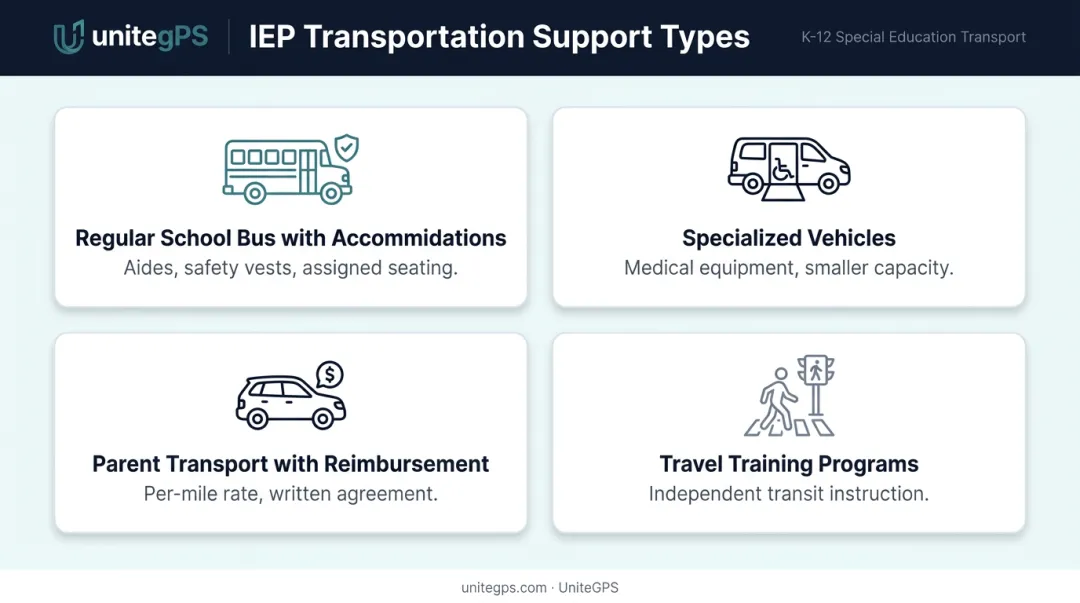
The four main options districts use to fulfill IEP transportation obligations:
- Regular school bus with accommodations — assigned seating, aides, safety equipment, modified boarding procedures
- Specialized or alternative vehicles — wheelchair-accessible vans, smaller-capacity vehicles, medically equipped transport
- Parent or guardian transport with district reimbursement — parent drives, district pays per mile
- Travel training programs — for students working toward independent transportation (classified under IDEA as special education instruction, not a transportation related service)
How Parent Reimbursement Works in Practice
Parent reimbursement kicks in when a district and family reach a written agreement that the parent will provide transportation in place of district service. Verbal arrangements are not sufficient — the agreement must be documented in the IEP.
Reimbursement is typically calculated as:
Per-mile rate × Round-trip miles × School days transported
Districts only reimburse for verified trips. That means parents need to track actual miles driven and actual school days their child attended. Estimates won't hold up if a district audits the claim.
Out-of-District Placements
The same reimbursement framework applies even when a student is placed outside their home district — and these situations come with their own logistics.
When a student's IEP places them in a specialized school outside their home district, transportation costs — even for longer distances — remain the responsibility of the home district. Massachusetts is a clear example: the state's Department of Elementary and Secondary Education explicitly includes out-of-district transportation costs as eligible for Circuit Breaker reimbursement. That program reimburses districts for high-cost special education placements overall. Parent reimbursement agreements are common in these scenarios because longer distances make district-arranged transport logistically difficult.
How to Request IEP Transportation Reimbursement: Step by Step
Step 1 — Request an IEP Meeting in Writing
Don't wait for the annual review if a transportation need has emerged or changed. Parents can request an additional IEP team meeting at any time by submitting a written request to the district's special education office.
Put the request in writing — email or a signed letter. This creates a documentation trail for your records.
Step 2 — Make Your Case at the Meeting
Come prepared with:
- Documentation of specific safety or disability-related barriers (medical records, therapist letters, past incident reports)
- A clear explanation of what accommodations the student needs during transit
- If requesting parent reimbursement: a written rationale for why parent-provided transport is the most appropriate option
Be specific. "My child has difficulty" is less persuasive than "my child's occupational therapist has documented that sensory overstimulation during transit causes behavioral dysregulation, and we're requesting a low-stimulation vehicle or parent transport with reimbursement."
Step 3 — Get Everything in Writing
Whatever is agreed upon must be written into the IEP document. The written IEP should specify:
- Type of transportation service or accommodation
- Frequency and schedule
- Required vehicle specifications or aide support
- If applicable: reimbursement rate, mileage calculation method, and payment schedule
Many districts use transportation management platforms that generate records directly useful for reimbursement documentation. For instance, UniteGPS's Crosswalk K-12 platform produces GPS-verified mileage logs, scan-verified boarding and alighting records, and IEP/Medicaid invoicing reports — all in standard exportable formats.
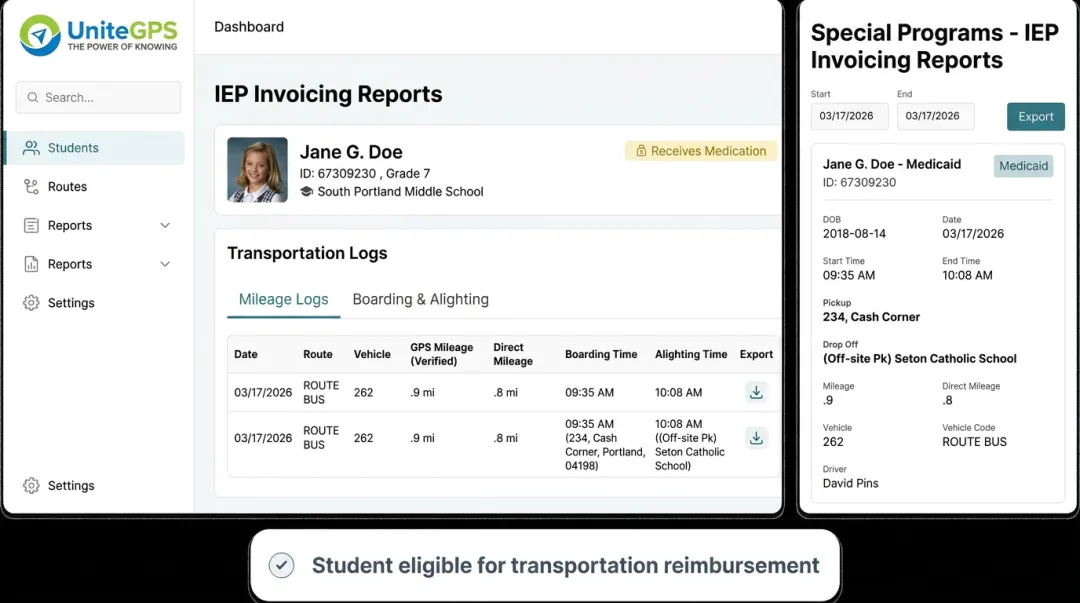
Parents can request these records from the district's transportation office to confirm that trip and mileage data match submitted reimbursement claims.
Documentation Tips and What to Do If Your Request Is Denied
What Parents Should Track
Maintain a dedicated folder — physical or digital — with:
- All IEP documents that reference transportation
- Every written communication with the district about transportation (emails, meeting notes, letters)
- A personal mileage log if you're providing your own transport: date, destination, round-trip miles
- Copies of the signed reimbursement agreement
- Proof of school attendance on reimbursed days
Good records keep payments on track — and give you solid footing if a dispute comes up.
How Reimbursement Gets Paid
Parents submit monthly or quarterly mileage logs to the district's special education or transportation office. Confirm the submission deadline and expected payment timeline at the IEP meeting — turnaround times vary widely between districts.
If the District Denies Transportation or Reimbursement
Parents have meaningful legal options under IDEA's procedural safeguards:
- Request a Prior Written Notice (PWN) — the district must explain in writing why transportation was denied, what options were considered, and what evidence informed the decision (34 CFR § 300.503)
- File a state complaint with the state's department of education under 34 CFR § 300.153
- Request mediation — a less adversarial option that resolves many disputes without a formal hearing
- Request a due process hearing — the formal legal route for unresolved disputes
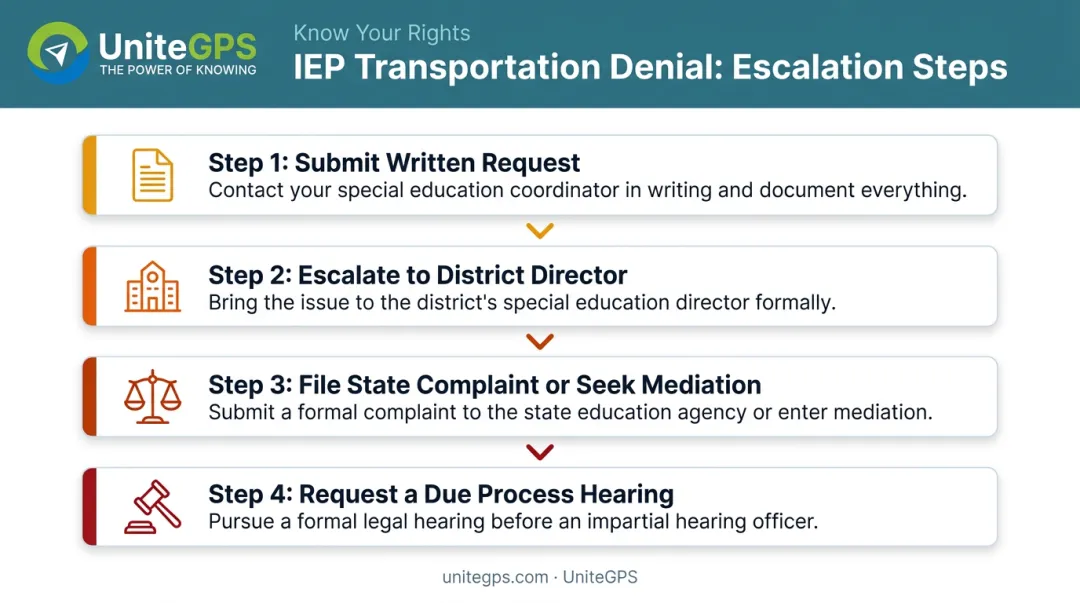
If you need to escalate, follow this sequence:
- Submit a formal written request to the special education coordinator
- If unresolved, escalate to the district's special education director
- If still unresolved, file a state complaint or request mediation
- Use due process as a last resort
At any stage, your state's Parent Training and Information (PTI) Center can help. These federally funded centers provide free advocacy support for families navigating IDEA disputes.
You don't have to be an expert in special education law to advocate effectively for your child, and you don't have to navigate this alone. The right information, careful records, and the right support turn a confusing process into one you can manage with confidence. Great student transportation starts with great leaders — and the parents who advocate for safe, reliable rides are leaders too.
Frequently Asked Questions
What is a transportation reimbursement program?
A transportation reimbursement program compensates either school districts for mandated transportation costs or parents who transport their child with an IEP in lieu of district service. Parent programs are typically based on a per-mile rate and require a written agreement documented in the IEP.
What does IEP mean in transportation?
In a transportation context, an IEP (Individualized Education Program) determines whether a student with a disability is entitled to transportation as a "related service" under IDEA. It specifies what accommodations or vehicle type the student needs to travel safely to and from school.
Can transportation be added to a 504 plan?
A 504 plan can include transportation accommodations, but Section 504 is an equal-access framework — it doesn't guarantee specialized transportation or parent mileage reimbursement the way IDEA does. A 504 plan does not automatically entitle a student to a dedicated vehicle or a separate reimbursement agreement.
How much can parents be reimbursed for transporting their child?
Reimbursement rates are set at the state or district level. Most districts reference the IRS standard mileage rate — $0.725 per mile for 2026 — but there is no single national figure. Ask your district's special education coordinator for the current applicable rate in your area.
What documentation do parents need to submit for reimbursement?
Most districts require:
- A signed reimbursement agreement documented in the IEP
- A completed mileage log with dates, destinations, and miles driven
- Proof that trips correspond to actual school days the student attended
Confirm your district's specific submission requirements at the IEP meeting.
How do districts verify the mileage and trips submitted for reimbursement?
Many districts now use transportation management platforms to document trips for IEP and Medicaid billing. Systems like UniteGPS Crosswalk capture GPS-verified mileage and scan-verified boarding and drop-off records, producing timestamped documentation in standard exportable formats. If your reimbursement is district-provided rather than parent-driven, you can ask the transportation office for these records to confirm that trip and mileage data match your submitted claims.