Tablets mounted on dashboards. Barcode cards clipped to backpacks. GPS pins moving across a dispatcher's screen in real time. This is what student ridership tracking looks like inside most K-12 transportation departments today, and it has quietly replaced the clipboard roster that drivers used to juggle while merging onto a highway.
School buses remain the backbone of the daily school commute. NCES reported that 87% of public schools had buses available for getting students to and from school, and roughly 40% of public-school students relied on that ride in 2024, according to a June 2024 NCES press release. That's a massive daily operation to get right.
Yet many districts still misunderstand how the technology behind it actually functions, leading to manual roll-call errors, missed Medicaid paperwork, or a slow response when a parent calls asking where their child is. This guide breaks down exactly how bus attendance tracking works, stage by stage.
Key Takeaways
- Ridership tracking logs boarding and exit times on a specific bus, separate from classroom attendance
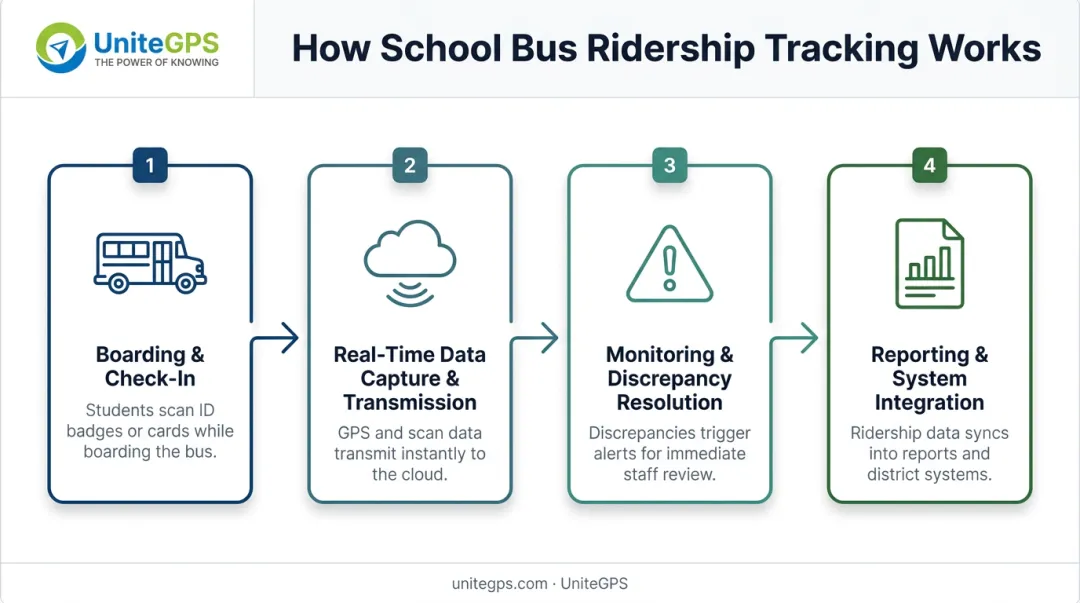
- The process runs through four stages: check-in, data transmission, discrepancy monitoring, and reporting
- The system connects directly to SIS platforms, parent apps, and Medicaid billing documentation
- Reliable, tracked transportation measurably lowers chronic absenteeism rates
What Is School Bus Attendance Tracking?
Bus attendance tracking, often called ridership tracking, is the process and technology districts use to record which students board and exit a specific bus, at what time, and at what location. It's a separate data stream from the attendance a teacher takes at 8:15 a.m.
Paper rosters created the problem this technology solves. A driver managing 40 kids across a dozen stops can't reliably mark a clipboard while watching traffic. That approach leaves no real-time visibility and produces a shaky paper trail when a safety incident or funding audit demands proof.
Ridership tracking is not classroom attendance, though the two increasingly sync together through SIS integrations. A student marked present in first period tells you nothing about whether they actually rode the bus that morning, and vice versa.
Even when GPS already shows exactly where the bus is, that location data answers a different question than ridership tracking does.
| Data Point | GPS Tracking | Ridership Tracking |
|---|---|---|
| Confirms | Vehicle location | Student presence on board |
| Answers | "Where is the bus?" | "Who is on the bus?" |
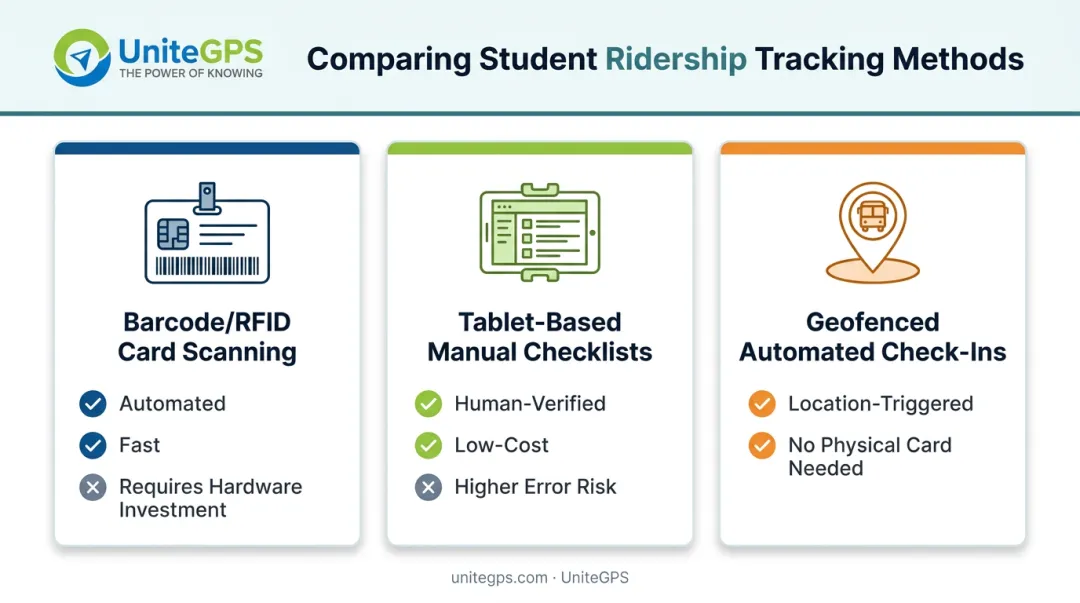
Districts generally use one of three approaches:
- Barcode or RFID card scanning: students scan an ID at boarding and exit
- Tablet-based manual checklists: a driver or monitor marks presence by hand, common on smaller or rural routes
- Geofenced automated check-ins: location-triggered records tied to a bus's route boundaries
Special education and field-trip routes often need an extra layer of manual verification on top of whichever method a district uses, since these runs carry documentation requirements tied to IEPs and Medicaid billing.
How Does School Bus Attendance Tracking Work?
The process runs through a defined sequence, from the moment a student steps onto the bus to the moment an administrator opens a report. Here's how each stage functions in practice.
Boarding & Check-In
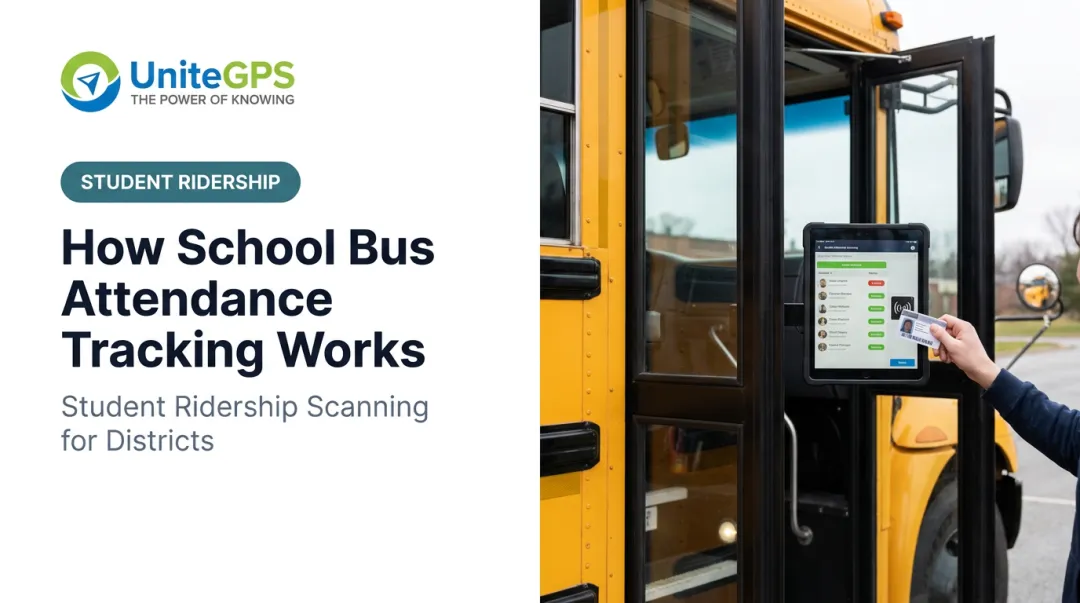
The sequence starts the second a student boards. With an automated system, they tap an ID card or badge against a reader mounted near the door. With a manual system, a driver or monitor marks presence on an onboard tablet as each child gets on.
RFID and barcode systems automate this step entirely. Smaller or rural routes, though, still frequently rely on a driver manually marking a roster, simply because the ridership volume doesn't justify the hardware investment.
Common bottlenecks at this stage include:
- Forgotten ID cards or badges
- Driver distraction during multi-stop pickups
- Students boarding out of their assigned route order
UniteGPS's Crosswalk platform, for example, uses barcode scanning through its Tablet Suite tier, where students scan a card or even a picture of their code. If a student forgets that card, the system still tracks them securely, even if they end up riding a bus they weren't originally assigned to.
Real-Time Data Capture & Transmission
Once a scan happens, three things occur almost instantly. The event gets timestamped, geotagged using the bus's onboard GPS, and matched against the student's roster profile. This is the working principle that makes ridership data useful rather than just a log file.
The tablet or scanning device then transmits that record over a cellular connection to a central cloud dashboard continuously throughout the route, not just at the end of the day.
Here's the part districts often overlook: signal reliability and sync speed determine how "real-time" the resulting alerts really are. A weak cellular connection on a rural route can delay a parent notification by several minutes, which matters when someone is standing outside waiting for confirmation their child made it on board.
Monitoring & Discrepancy Resolution
This is the stage that keeps the whole system honest under real-world conditions. Dashboards surface mismatches automatically, such as a student scanned onto the wrong bus or an expected rider who never scanned in at all.
When an exception occurs, dispatchers or transportation staff typically:
- Verify status manually by checking live GPS location against the ridership log
- Contact the driver directly for confirmation
- Trigger a parent notification if the discrepancy can't be resolved quickly
This step is the safeguard against a missing-child incident and the backbone of chain-of-custody accountability for the district.
"If a parent calls saying that the bus didn't stop, we can look and see that they were there. It has made a huge difference in our district." — Tim Lyons, Director of Transportation, Benton Community School District
Reporting & System Integration
The final stage produces automatically generated ridership reports showing boarding and drop-off timestamps by student, route, and stop. That data doesn't just sit in a dashboard, though.
It flows downstream into:
- SIS attendance records, syncing with platforms like PowerSchool, Skyward, and Infinite Campus
- Medicaid billing and reimbursement documentation for eligible special education transportation
- Parent-facing ETA and notification apps showing scan-on and scan-off confirmations
Districts that give parents independent access to a bus's live location and expected arrival time see a real drop in inbound calls, since families can check the app themselves instead of calling the transportation office.
Where School Bus Attendance Tracking Fits Into the Bigger Attendance Picture
Ridership tracking touches several distinct points across a district's day: morning pickup, mid-route transfers, afternoon drop-off, field trips, and special education transport. Each one carries slightly different verification needs.
The technology delivers the most value in specific conditions:
- High-ridership routes where manual tracking becomes unmanageable
- Districts with strict Medicaid reimbursement requirements, since documentation gaps mean lost funding
- Multi-school transfer hubs, where students switch buses mid-route and errors compound easily
The connection between reliable transportation and school attendance holds up under research scrutiny. A quasi-experimental study of 23 Michigan districts found that bus eligibility increased attendance among economically disadvantaged students by 0.63 percentage points, roughly one additional day across a 180-day year, according to research published in Education Finance and Policy.
The same study found bus eligibility cut the probability of chronic absence by 3.8 percentage points, a 20% to 25% reduction.
That's a strong case for treating ridership data as more than a logistics tool. Repeated no-shows on an assigned route can flag a student worth a phone call before absences become a chronic pattern. That data is already sitting in the system, waiting to be reviewed.
K-12 districts rely on SIS-integrated ridership tracking tied to individual student identities. Public transit agencies, by contrast, typically use GTFS-based occupancy counts that describe crowding, not who specifically boarded. The two serve different purposes and carry very different privacy requirements.
Choosing the Right Attendance Tracking System for Your District
Not every district needs the same level of tracking on day one. Here's what to evaluate before committing to a platform:
| Feature to Evaluate | Why It Matters |
|---|---|
| SIS synchronization | Eliminates duplicate data entry as enrollment changes |
| Real-time GPS-linked scanning | Confirms both bus location and rider identity |
| FERPA-compliant data handling | Protects student PII under federal requirements |
| Automatic parent/staff alerts | Reduces phone volume to the transportation office |
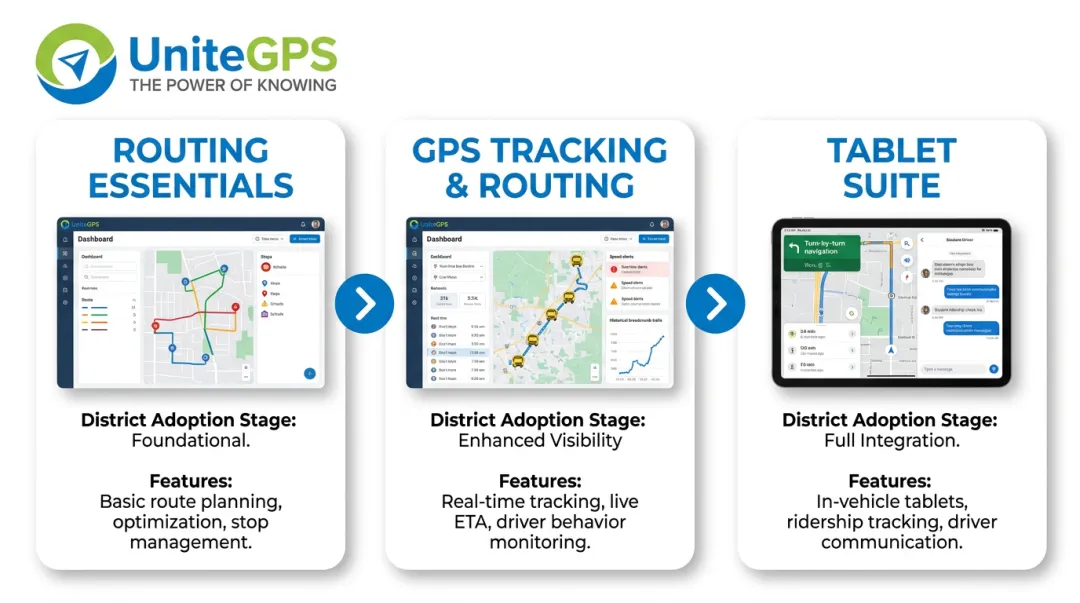
Most districts don't replatform everything at once. A common path starts with basic routing software, then expands into GPS tracking, and finally adds tablet-based ridership scanning once special education documentation or Medicaid recovery becomes a priority.
UniteGPS built its Crosswalk platform around that same progression:
- Routing Essentials replaces paper maps with digital routing
- GPS Tracking & Routing adds live, map-based fleet visibility
- Tablet Suite delivers scan-verified proof of which students rode which bus
The company serves 100+ school districts nationwide and offers a 90-day free trial with routes built at no cost, letting districts evaluate the platform before spending a dollar.
Conclusion
Attendance tracking works as a connected chain: scan, transmit, monitor, report. Each link supports the one after it, and a weak link anywhere, whether that's a forgotten card or a spotty cellular connection, shows up downstream as a discrepancy someone has to chase down.
Understanding that chain helps districts decide where to invest, whether in sturdier scanners, backup connectivity, or clearer reporting dashboards. Platforms like UniteGPS's Crosswalk K-12 automate each link, letting transportation teams shift from reactive troubleshooting to proactive attendance intervention.
Frequently Asked Questions
What is bus attendance?
Bus attendance, or ridership tracking, is the record of which students boarded and exited a specific bus, at what time and location. It's distinct from the classroom attendance a teacher records each morning.
How many days of school can you miss and still have 95% attendance?
In a standard 180-day school year, 95% attendance means being present for 171 days. That leaves room for 9 missed days total.
How many days off equal 80% attendance?
At 80% attendance across 180 days, a student has been present for 144 days. That means 36 days missed, roughly two full months of school.
How many absences equal 70% attendance?
Seventy percent attendance over a 180-day year means 126 days present and 54 days absent, close to a third of the entire school year.
How does GPS tracking work together with student ridership tracking?
GPS confirms where the bus physically is at any given moment. Ridership tracking confirms which specific students are on board. Combined, the two data streams let a district verify both the vehicle's location and its passenger list simultaneously.
Is school bus ridership tracking required by law?
Requirements vary by state. Some mandates tie directly to Medicaid documentation or special needs transportation under IDEA. Most districts, however, adopt ridership tracking voluntarily for safety and operational efficiency rather than as a blanket legal requirement.