Every weekday morning, a fleet of yellow buses rolls through neighborhoods before most parents have finished their coffee. It's such a routine sight that it's easy to underestimate what's actually happening: a coordinated safety net that touches attendance rates, household budgets, road congestion, and a district's ability to keep families enrolled.
Most people will nod along with "buses are safe and convenient" without thinking twice. But the real value shows up in the details — the day a kid doesn't miss school because a parent's car wouldn't start, the fuel a district didn't burn because 40 cars stayed off the road, the phone call a transportation office never had to answer because a parent could already see the bus on a map.
This article breaks down what the evidence actually says about school bus transportation, what happens when it's under-resourced, and how technology is reinforcing benefits that have existed for decades.
Key Takeaways
- School buses remain one of the safest ways to get kids to school.
- Consolidating trips into buses cuts household costs, traffic, and emissions.
- Reliable bus access improves attendance for economically disadvantaged students.
- GPS and ridership tracking now make these benefits visible in real time.
What Is School Bus Transportation?
School bus transportation is the coordinated system of vehicles, routes, drivers, and oversight that gets students safely between home and school every day. Framed this way, school bus transportation serves broader outcomes: student safety, equitable access to education, dependable attendance, and controlled transportation costs. When any piece of that system breaks down, those outcomes suffer.
Key Advantages of School Bus Transportation
Districts and families track a handful of outcomes when they evaluate whether transportation is working: safety, cost and environmental impact, and attendance equity. Each one compounds over time. A safer, more reliable system protects a district's budget, its reputation, and the trust families place in it, well beyond simply moving students from point A to point B.
Safety and Risk Reduction
School buses are engineered specifically for child safety. Compartmentalization (closely spaced, high-backed seats with energy-absorbing padding) is designed to cushion passengers in a crash without relying on seat belts in every case. Federal rules also require mandated stop-arms and flashing warning lights, and every state makes it illegal to pass a stopped bus while those lights are active.
Drivers go through layered vetting before they ever transport a student, including background checks, road tests, and recurring safety training.
Why this matters: NHTSA's crashworthiness research found school buses had a fatality rate of just 0.2 per 100 million vehicle-miles, compared to 1.5 for passenger cars. That figure comes from a 2002 NHTSA crashworthiness study, so treat it as historical context rather than a current benchmark. NHTSA's current guidance still confirms that riding the bus is far safer than being driven in a car.
The risk isn't zero, though. In a single day in 2025, over 114,000 participating drivers across 36 states reported 67,258 illegal passes of stopped school buses. That's a reminder that the danger often comes from other drivers, not the bus itself.
KPIs this impacts:
- Student injury and accident rates
- Insurance and liability costs
- Driver incident reports
This advantage matters most in poor weather, in high-traffic school zones, and for younger children who can't yet navigate roads independently.
Cost-Effectiveness and Environmental Impact
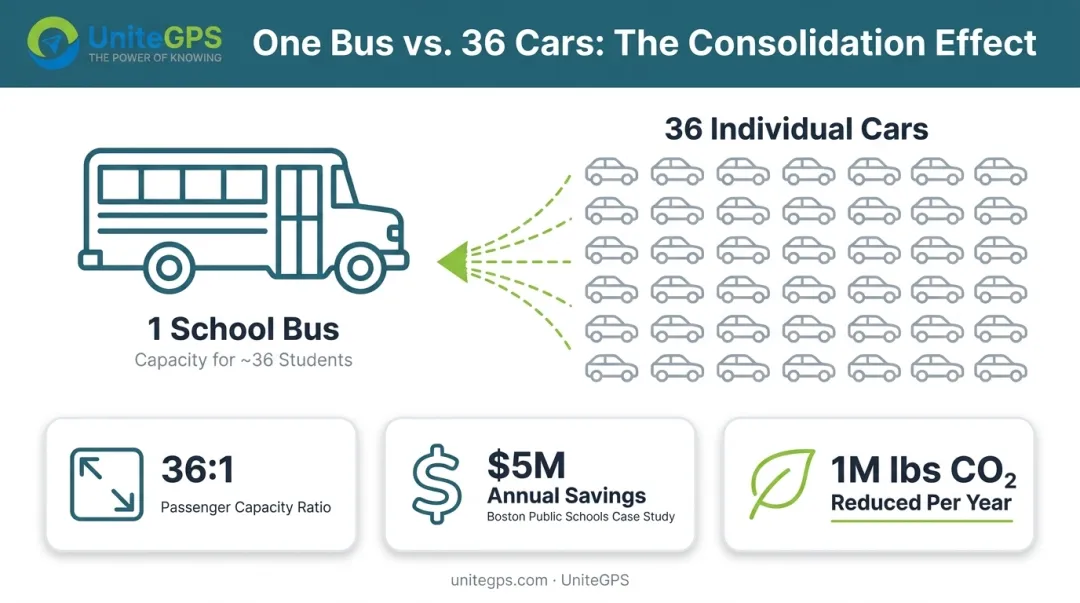
A single bus route replaces dozens of individual car trips. Instead of 40 families driving separately to the same school, one vehicle handles the run, cutting fuel spend, vehicle wear, and household transportation costs all at once.
The American School Bus Council estimates that one school bus carries roughly as many passengers as 36 cars, based on a capacity-equivalence calculation from its community benefits fact sheet. It's an estimate, not a measured trip count, but the logic holds: fewer cars on the road near schools means less congestion and lower emissions during the exact hours when traffic is worst.
Real-world results back this up. Boston Public Schools implemented a route optimization system that cut its required fleet from 650 buses to 600, saving roughly $5 million annually and an estimated 1 million pounds of CO2 per year, without reducing service quality.
Districts don't need Boston's budget to see comparable savings. Route optimization platforms such as UniteGPS's Crosswalk software apply the same logic at any fleet size, flagging redundant stops and consolidating routes without adding staff hours.
Metrics this affects:
- Cost per student transported
- Fuel consumption and emissions output
- Traffic congestion near schools
These savings compound fastest for large or spread-out districts, rural communities with long commutes, and districts working toward sustainability goals like electric bus transitions.
Attendance, Equity, and Social Development
For families without a reliable car, the school bus is often the only guaranteed way a child gets to class. That dependable daily schedule removes one of the biggest logistical barriers to consistent attendance.
A regression-discontinuity study across 23 Michigan districts found that bus eligibility raised attendance among economically disadvantaged students by 0.63 percentage points, roughly one additional school day per year, and lowered their odds of chronic absence by 3.8 to 4.0 percentage points — according to research published through ERIC. Notably, the effect wasn't significant for students overall, only for the subgroup with fewer transportation alternatives. That's the point: transportation access matters most when there's no backup plan.
What this shapes:
- Attendance rate and chronic absenteeism
- Enrollment retention
- Student socialization and wellbeing
The impact runs deepest in underserved communities, for students without alternate transportation, and for younger kids still building independence and social skills.
What Happens When Bus Transportation Is Underfunded or Mismanaged
When routing is inefficient or driver shortages go unaddressed, the cracks show up fast: canceled routes, longer ride times, and pickup schedules that shift week to week.
The ripple effects spread beyond the bus itself:
- Parent complaints and calls flood the transportation office
- Families fall back on individual driving, adding traffic and emissions right when districts are trying to reduce both
- Chronic absenteeism climbs for students who lose reliable transport
The driver shortage is making this worse nationwide. A 2025 AP-NORC survey of transportation-responsible administrators found 81% called driver shortages a problem, 46% called it a major problem, and 26% said their district had already cut or shortened routes in response.
That's a structural issue, reshaping how districts plan their entire transportation calendar.
How Technology Is Amplifying These Benefits
Technology doesn't replace the traditional benefits of bus transportation. It makes them measurable, visible, and reliable in real time, for districts and for the families waiting on the curb.
Real-Time Visibility Replaces Guesswork
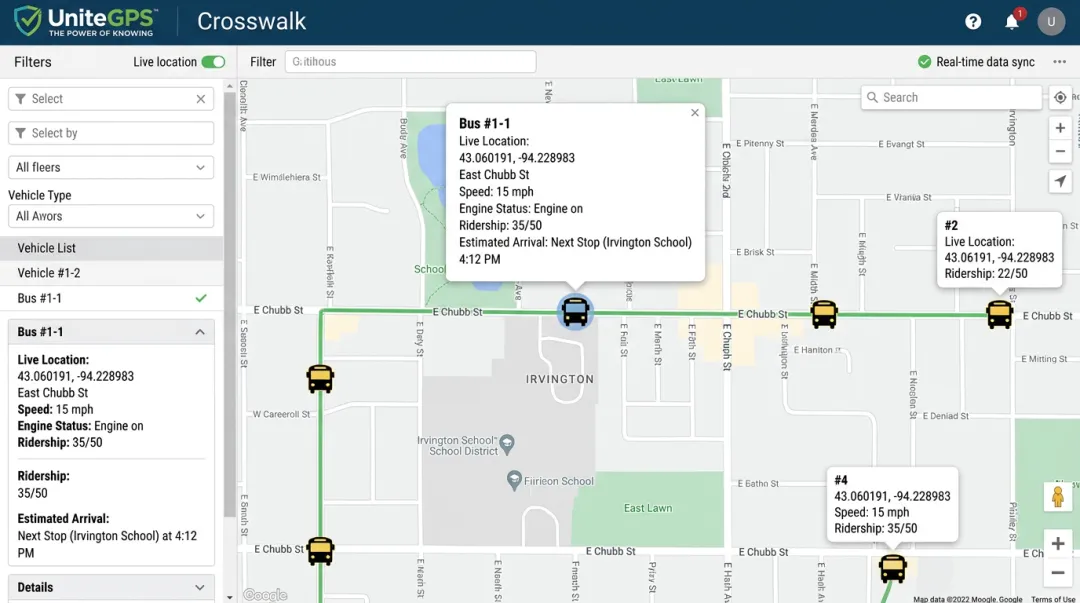
Live GPS tracking eliminates the "wondering in the cold" problem. Parents see exactly where the bus is and get an accurate ETA instead of standing outside hoping it shows up on time.
This is how UniteGPS started. Co-founder Chris Bunnell built the first version of Crosswalk after watching his own kids wait for a bus in the Maine winter with zero visibility into when it would actually arrive.
That frustration became a GPS tracking platform now used by 100+ districts nationwide. It combines live location updates every 5 seconds (even with the ignition off), ridership tracking, and SIS data sync into one system.
Ridership Tracking Adds Accountability
Beyond physical safety design, tablet-based ridership tracking confirms exactly which students boarded and exited each bus. Students scan a barcode card (or a photo of it) and the system logs a timestamped record automatically.
That data does more than confirm attendance:
- Tracks students even when they ride a different bus than assigned, as long as they scan
- Resolves parent disputes ("the bus didn't stop") with an actual timestamped record
- Supports Medicaid reimbursement documentation for eligible special education transportation
As Tim Lyons, Director of Transportation at Benton Community School District, put it: "If a parent calls saying that the bus didn't stop, we can look and see that they were there. It has made a huge difference in our district."
Route Optimization Cuts Administrative Hours
SIS integration (synced automatically with platforms like PowerSchool, Skyward, and Infinite Campus) pulls enrollment data directly into routing, eliminating manual roster uploads every time a student moves or changes schools. Combined with automated route optimization, this frees transportation staff to focus on safety and service instead of spreadsheets.
These technology-driven benefits matter most for districts scaling to more routes, battling substitute driver turnover (where turn-by-turn digital directions keep service consistent), or facing pressure to do more with tighter budgets.
Maximizing the Benefits of School Bus Transportation
Getting the full value out of a transportation system requires treating it as an ongoing practice, not a "set it and forget it" utility.
A few practical priorities:
- Review routes and performance data regularly: track safety incidents and on-time performance instead of assuming things are working
- Invest consistently in driver recruitment and retention: every other benefit, from safety to reliability, depends on having enough qualified drivers
- Evaluate integrated platforms that combine routing, GPS, ridership tracking, and SIS sync, rather than juggling disconnected tools that don't talk to each other. UniteGPS's Crosswalk platform, for example, was built around this exact need
The value of school bus transportation isn't static. Safety, cost-efficiency, and reliability improve when districts actively manage them, and they decline just as fast when nobody's watching.
Frequently Asked Questions
How do school buses help children every day?
Buses provide consistent, safe transport that removes daily stress from families. This routine also supports peer socialization and gets kids to school on time, directly supporting steady attendance.
How does a school bus driver help us?
Drivers manage safe boarding and exiting while enforcing road safety rules like stop-arm compliance. For younger students especially, they often become a trusted, familiar face on the daily route.
Why is school bus transportation important for communities?
It reduces traffic congestion and emissions near schools by consolidating dozens of car trips into one vehicle. This system also gives every family, regardless of income or vehicle access, a reliable path to education.
Are school buses safer than parents driving kids to school?
Yes. Buses are built with safety features like compartmentalization and are operated by drivers who pass background checks and recurring training, giving them a historically much lower fatality rate than passenger cars.
How much can school bus transportation save families and districts?
Families avoid daily fuel and maintenance costs tied to individual driving, while districts can cut costs through optimized routing. Boston Public Schools, for example, saved roughly $5 million a year by reducing its fleet size through route optimization.
How is technology like GPS tracking improving school bus transportation?
Real-time GPS, like the live tracking built into platforms such as UniteGPS, gives parents actual bus location instead of guesswork. Ridership tracking gives districts a verified record of who boarded each bus, while automated routing cuts the manual workload on transportation staff.