A bus pulls up to the curb. Kids climb the steps, find their seats, and the driver pulls away without a second thought. That routine only stays routine because someone checked the brakes, the tires, and the stop arm before the engine ever started.
**Every day, 26 million children ride school buses** in the United States, according to NHTSA. A missed brake defect, a stop arm that won't extend, or tires worn past their legal limit turns a routine ride into a genuine risk.
School bus inspections fall under federal rules like FMCSR 396.13 and 49 CFR Part 396, plus whatever additional requirements your state layers on top. The core safety checks, though, stay consistent everywhere.
This guide walks through a complete zone-by-zone checklist, explains how to read your results correctly, and flags the mistakes that cause the most failed inspections.
Key Takeaways
- A complete inspection covers six zones: engine, exterior/tires, brakes, bus equipment, interior, and documentation.
- Daily DVIRs are federally required, while annual and 90-day emergency exit checks follow separate schedules.
- Brake failures, a broken stop arm, or worn tires ground a bus immediately.
- Misread gauges or tread measurements cause most missed defects.
- Districts using GPS-connected tablets can flag mechanical holds instantly, cutting down on parent calls.
What You Need to Know Before You Start
Knowing which inspection you're performing determines how deep the checklist needs to go. A driver's daily walk-around and a mechanic's annual teardown are not the same task, even though they share a common goal.
Types of School Bus Inspections
- Pre-Trip Inspection: Drivers must confirm the bus is safe before driving and review the prior day's DVIR under 49 CFR 396.13.
- Post-Trip DVIR: 49 CFR 396.11 requires a written inspection report at the end of each day's work, even when no defects are found.
- Annual/Periodic Inspection: A comprehensive mechanical inspection performed by a qualified inspector under 49 CFR 396.17, required at least once every 12 months.
- Emergency Exit Inspection: Required every 90 days under 49 CFR 396.3, covering push-out windows, roof hatches, and rear doors.
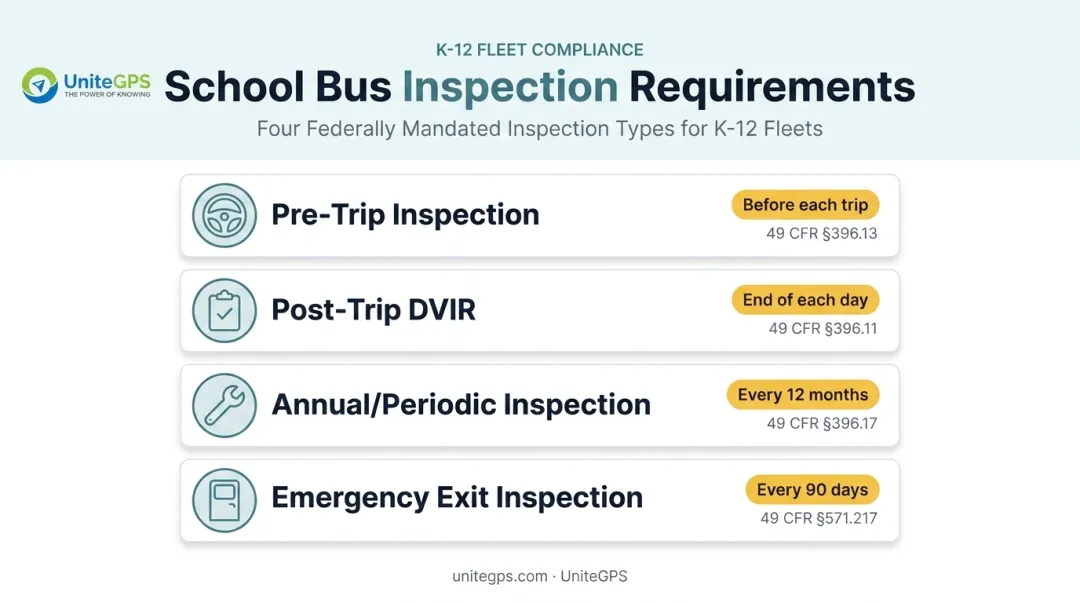
Each of these ties back to a specific federal code section. The table below maps out what each one covers and how often it applies.
Key Federal Regulations to Reference
| Regulation | What It Governs | Frequency |
|---|---|---|
| 49 CFR 396.13 | Before-driving safety determination, review of prior DVIR | Before each trip |
| 49 CFR 396.11 | Written driver vehicle inspection report | End of each day's work |
| 49 CFR 396.17 | Periodic mechanical inspection | Every 12 months |
| 49 CFR 396.3 | Emergency exit inspection | Every 90 days |
| 49 CFR 393.75 | Tire tread depth and condition | Continuous, in-service |
| 49 CFR 393.95 | Fire extinguisher rating and mounting | Continuous, in-service |
These frequencies determine which tools you'll need on hand for each inspection type.
Tools and Preconditions Needed
Keep these on hand for every inspection:
- Tire tread depth gauge and tire pressure gauge
- Flashlight for dark corners of the engine bay and undercarriage
- Wheel chocks for any under-vehicle work
- DVIR form or a digital inspection app
Before starting, confirm the bus sits on level ground, verify you have enough light for the full walk-around, and review yesterday's DVIR. Some checks need the engine running (air pressure buildup); others require it off (fluid levels). Mixing those up skews your readings.
The Complete School Bus Inspection Checklist by Zone
Starting at the driver's door and moving through the same sequence every time prevents skipped items. It's the single easiest habit that separates a thorough inspection from a rushed one.
Engine Compartment & Fluids
With the engine off and cool, check:
- Engine oil level and condition
- Coolant, power steering fluid, and washer fluid levels
- Transmission fluid (if accessible with engine off)
- Belts and hoses for cracking, fraying, or looseness
- Battery connections for corrosion
- Any visible fluid leaks under the vehicle
A cracked hose or slipping belt rarely announces itself before it fails, so a visual check here matters more than the checklist suggests.
Exterior, Tires & Wheels
Walk the full perimeter of the bus and check:
- Tire tread depth: minimum 4/32 inch on front wheels, 2/32 inch on all other tires
- Sidewall condition, including cuts, bulges, and exposed cord
- Wheel and rim integrity, lug nut tightness
- Mirrors, body panels, and bumpers for damage
- All exterior lighting, including brake lights and turn signals
Federal rules prohibit regrooved, recapped, or retreaded tires on a bus's front wheels. It's a rule inspectors check closely, and a common reason buses fail this section.
Brakes & Steering
Air brake testing follows a specific sequence:
- Build air pressure to governor cutout, typically 110-130 psi per FMCSA guidance
- Run the one-minute leak test: less than 2 psi drop with brakes released, less than 3 psi with brakes applied
- Confirm the low-air warning activates before pressure drops below 60 psi, per 49 CFR 393.51
- Verify spring brakes activate in their proper range as pressure continues to fall
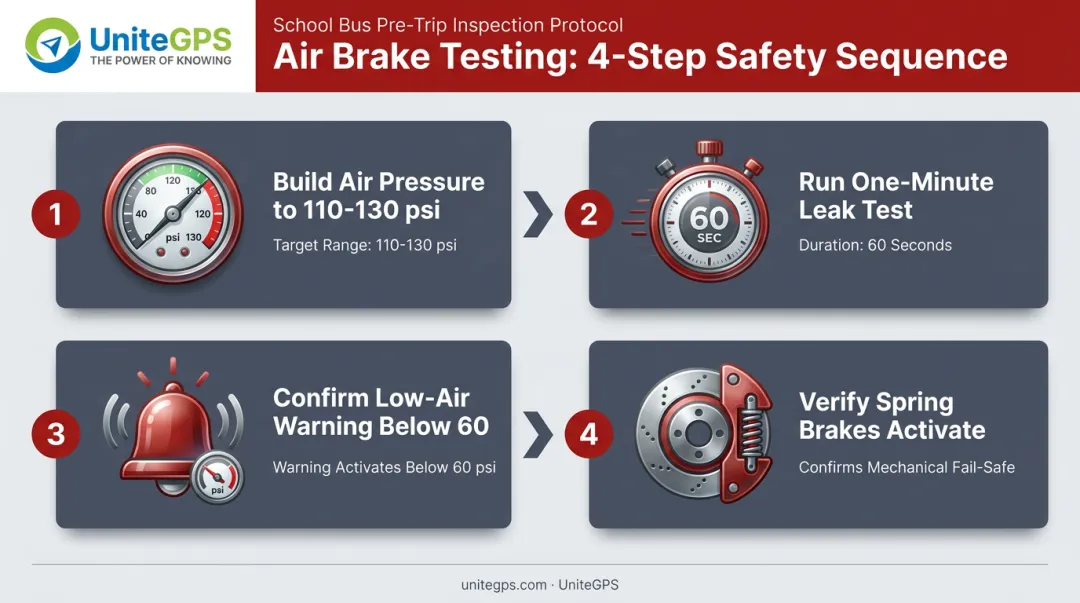
For steering, check free play at the wheel (roughly 10 degrees, or about 2 inches of movement on a 20-inch wheel, as a pre-trip screening point). Also check steering column security, plus tie rod or drag link condition.
School Bus-Specific Safety Equipment
This is the zone that makes a school bus different from any other commercial vehicle:
- Stop arm deployment, lamps, and synchronization with red warning lights
- Crossing control arm (where state-required)
- Emergency exit doors, windows, and roof hatches, plus their alarms
- Fire extinguisher: charged, mounted securely, rated at least 5 B:C
- First aid and body fluid cleanup kits
- Student warning lights and strobe function
Interior, Documentation & In-Cab Systems
Finish inside the bus:
- Seat security and clear aisle access
- Dashboard warning lights, horn, wipers, and defroster function
- CDL and medical certificate on the driver's person
- Current registration and insurance on board
- Written certification that any defects from the prior DVIR were repaired
How to Interpret Your Inspection Results
A reading is only useful if you know what it means. Misjudging a gauge or a tread measurement sends a defective bus onto the road just as surely as skipping the check entirely.
Normal/Acceptable: Air pressure builds and holds within spec, tread sits comfortably above minimums, and every light and alarm functions on the first try. Once these checks pass and the DVIR is signed, the bus can enter service.
Minor Issues: Tread just above the 2/32 or 4/32 minimum, light cosmetic wear on upholstery, or a slightly stiff mirror adjustment. Log these and monitor them; they don't require pulling the bus.
Out-of-Service/Critical Defects: These conditions demand the bus be pulled immediately:
- Excess air pressure drop during the leak test
- Tread depth below the federal minimum
- An inoperative or non-synchronized stop arm
- Steering play beyond acceptable range
A mechanic must certify repairs on the DVIR before the bus returns to service.
Common Mistakes That Lead to Failed Inspections
Most failed inspections trace back to process, not equipment. Watch for these:
- Rushing the walk-around or checking zones out of order, which causes skipped items
- Testing air brakes or lights with the engine in the wrong state — some checks need it running, others need it off
- Skipping the prior day's DVIR review before starting a new inspection
- Logging defects on paper that sits in a folder for days before reaching the shop
That last one is worth sitting with. A defect written on paper is only as useful as the person who eventually reads it. If that's three days later, the bus has already made dozens of trips in the meantime. Districts that move DVIR logging into a fleet management platform, such as UniteGPS, get defects to the shop the same day instead of the same week.
Safety Best Practices & Simplifying Compliance with Technology
A few habits protect both the inspector and the accuracy of the results:
- Chock the wheels and set the parking brake before any under-vehicle work
- Wear appropriate PPE, especially around fluids and moving parts
- Never test brakes with the bus in gear
- Keep gauges and inspection surfaces clean and calibrated: a dirty gauge reads wrong, and a wrong reading is worse than no reading at all
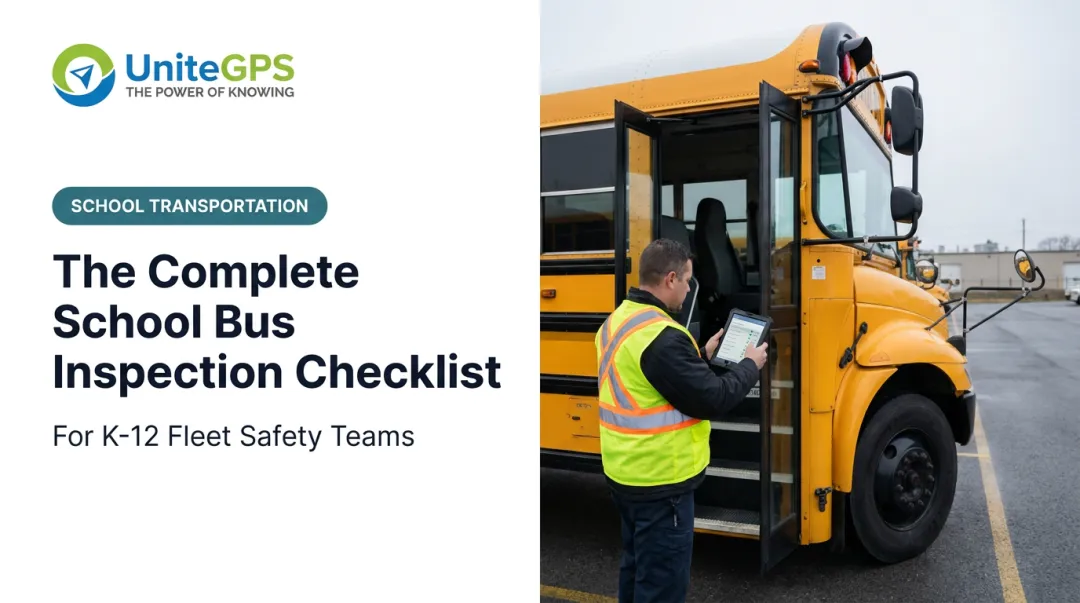
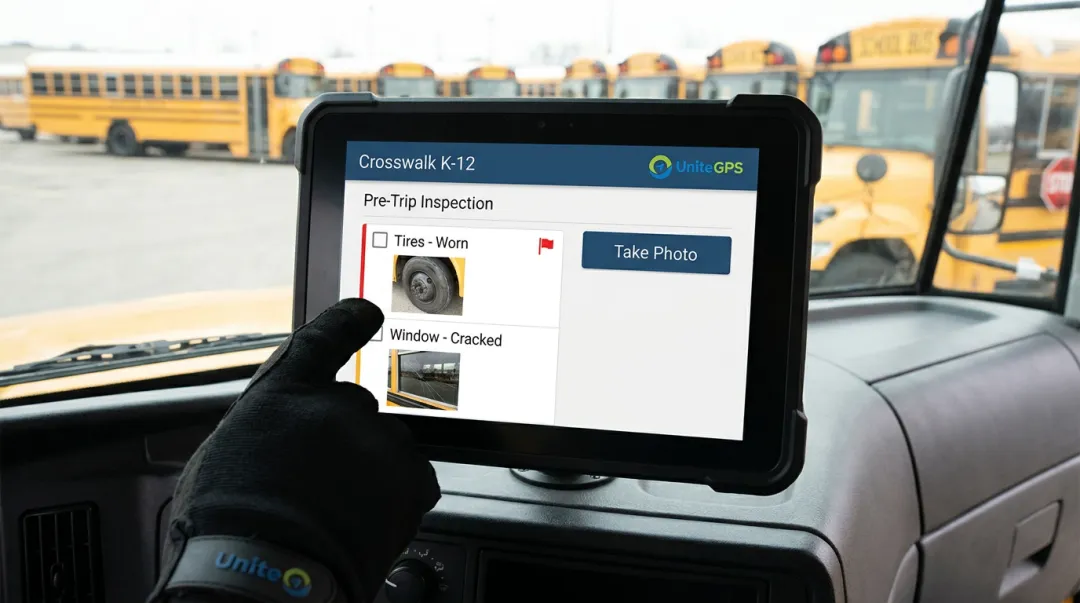
Beyond these manual precautions, technology can reinforce consistency across the fleet. Many districts already run GPS-connected tablets on their buses for routing and student ridership. That same hardware can extend into inspection workflows. UniteGPS's Tablet Suite, part of its Crosswalk K-12 platform, lets drivers complete pre- and post-trip inspections digitally, attach photos of a cracked window or worn tire, and send that report straight to the maintenance team's screen the moment it's submitted.
Tim Lyons, Director of Transportation at Benton Community School District, put it simply: "If a parent calls saying that the bus didn't stop, we can look and see that they were there. It has made a huge difference in our district."
That same real-time visibility resolves parent disputes, and it applies to mechanical holds too. A transportation director can see a flagged issue without waiting for a paper form to land on a desk, which keeps the office phone quieter during a hold.
Districts curious about how this fits into their existing routine can book a short call to walk through the workflow.
Frequently Asked Questions
How long should a school bus pre-trip inspection take?
There's no official federal minimum. Pennsylvania's school bus driver manual recommends about 15 minutes for a thorough walkaround. Completeness matters more than speed.
What's the difference between a daily pre-trip DVIR and an annual DOT inspection?
The daily DVIR is a driver-level certification before and after each trip. The annual inspection is a comprehensive mechanical review performed by a qualified inspector under 49 CFR 396.17.
What items are most likely to place a school bus out of service?
Brake defects, an inoperative stop arm, under-tread tires, and excessive steering play are the leading causes. Any one of these grounds the bus until repairs are certified.
Who is qualified to perform a school bus inspection?
CDL drivers self-certify their daily pre-trip and post-trip inspections. Annual inspections require a qualified inspector who meets the training and experience standards under 49 CFR 396.19.
How often must emergency exits be inspected on a school bus?
Every 90 days, per 49 CFR 396.3. This covers push-out windows, roof hatches, and rear door alarms.
What should a driver do if they find a defect during inspection?
Document it on the DVIR and report it immediately. Critical defects ground the bus until a mechanic certifies the repair on the report.