Introduction
In the winter of 2013, Chris Bunnell stood outside with his kids in South Portland, Maine, waiting for a school bus that never seemed to show up on time. No app. No ETA. Just freezing temperatures and guesswork.
That frustration became the seed for what eventually grew into UniteGPS.
More than a decade later, districts nationwide face a version of that same problem, just at a larger scale. Driver shortages, tightening budgets, and rising safety expectations are colliding with transportation systems still held together by spreadsheets and paper routes.
This article breaks down the biggest challenges facing student transportation today and the technology solutions districts are using to fix them.
Key Takeaways
- Driver shortages force route consolidations and longer ride times in most districts
- Manual routing wastes staff hours and invites costly errors
- Real-time GPS tracking cuts parent calls and closes safety gaps at drop-off
- Route optimization software can shrink fleet size and operating costs
- Integrated platforms replace fragmented tools with unified routing, GPS, and SIS sync
What Is Student Transportation?
Student transportation is the full system that gets K-12 students safely to and from school and school-related activities. That includes the vehicles, the routes, the drivers and dispatchers, and increasingly, the software running all of it.
The scope covers more than the bus ride itself:
- Traditional yellow bus routes for general education students
- Special education transport, often mandated under IDEA for students whose disabilities require it
- McKinney-Vento transportation for students experiencing homelessness or in foster care
- Contracted transit and rideshare services for individualized or supplemental trips
- After-school and activity transportation, including athletics and clubs
The definition has shifted in recent years, too. It now regularly includes GPS-enabled buses, parent communication apps, and integrated software platforms that manage routing, ridership, and compliance in one place, not just the vehicles themselves.
Top Challenges Facing Student Transportation Today
The scale here is enormous. Roughly 26 million U.S. students ride about 480,000 yellow buses every school day, according to School Transportation News. That volume means even small inefficiencies compound quickly across a district's budget and schedule.
The School Bus Driver Shortage
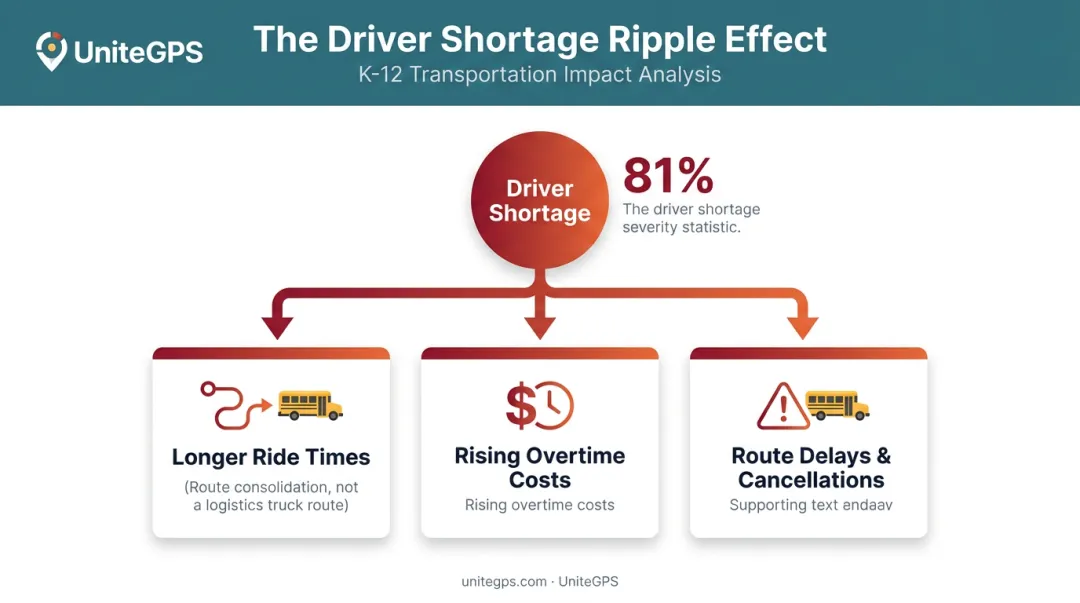
Driver shortages have moved from a seasonal headache to a structural problem. In a 2025 AP-NORC/HopSkipDrive survey of school administrators, 81% called driver shortages a problem in their district, and 46% called it a major problem, according to the 2025 State of School Transportation report.
The knock-on effects show up fast:
- Stretches ride times through route consolidations
- Increases overtime pay for existing drivers
- Delays or cancels routes with little notice
Rising Costs and Manual Inefficiencies
Fuel, maintenance, and insurance costs keep climbing. A recent NAPT-coalition diesel survey found over a third of districts running well past their approved fuel budgets, some by more than 20%.
Layer manual processes on top of that, and the pressure multiplies. Many districts still route buses using paper maps, spreadsheets, or one dispatcher's memory of the roads. Every time a student moves or transfers schools, someone has to manually update rosters and recalculate stop times by hand.
That's hours lost every week to work a synced system would handle automatically.
Safety Gaps and Communication Breakdowns
Without live GPS tracking, parents have no reliable way to know where the bus actually is. Administrators, meanwhile, can't quickly confirm which students boarded during an emergency.
This visibility gap matters most at the exact moment risk is highest, as NHTSA notes:
The greatest risk to a child is not riding a bus but approaching or leaving one. (NHTSA, Reducing the Illegal Passing of School Buses)
Students are most vulnerable while waiting at the stop, loading, or walking between the bus and home. That same gap widens when routing software, Student Information Systems, and parent communication tools don't talk to each other.
A student's address changes in the SIS, but the transportation team never sees it. A route gets misassigned, and parents start calling because nobody sent an update. Each disconnected system becomes another place for data to go stale — one more reason the phone won't stop ringing.
Modern Solutions Transforming Student Transportation
Districts are moving away from fragmented, manual processes and toward integrated, purpose-built platforms that handle routing, tracking, and compliance in one place.
Real-Time GPS Tracking and Parent Communication Apps
Live GPS tracking paired with a parent app removes the guesswork at the bus stop entirely. Parents see exactly where the bus is, get an ETA, and know when their child is safely on board.
UniteGPS's platform, for example, offers a Basic Parent App with live location and stop selection, plus an Advanced Parent App that adds scan-on/scan-off ridership notifications. Tim Lyons, Director of Transportation at Benton Community School District, put it this way:
"If a parent calls saying that the bus didn't stop, we can look and see that they were there. It has made a huge difference in our district."
That kind of self-service visibility is exactly what cuts down the flood of calls to the transportation office.
Route Optimization Software
Manually built routes tend to leave mileage, fuel, and driver time on the table. Automated routing software recalculates the most efficient paths across an entire fleet, something a human dispatcher simply can't do at scale.
The clearest example comes from Boston Public Schools, which replaced a labor-intensive manual process with an optimization algorithm. The result: an 8% reduction in fleet size (50 fewer buses) and roughly $5 million in operational savings.
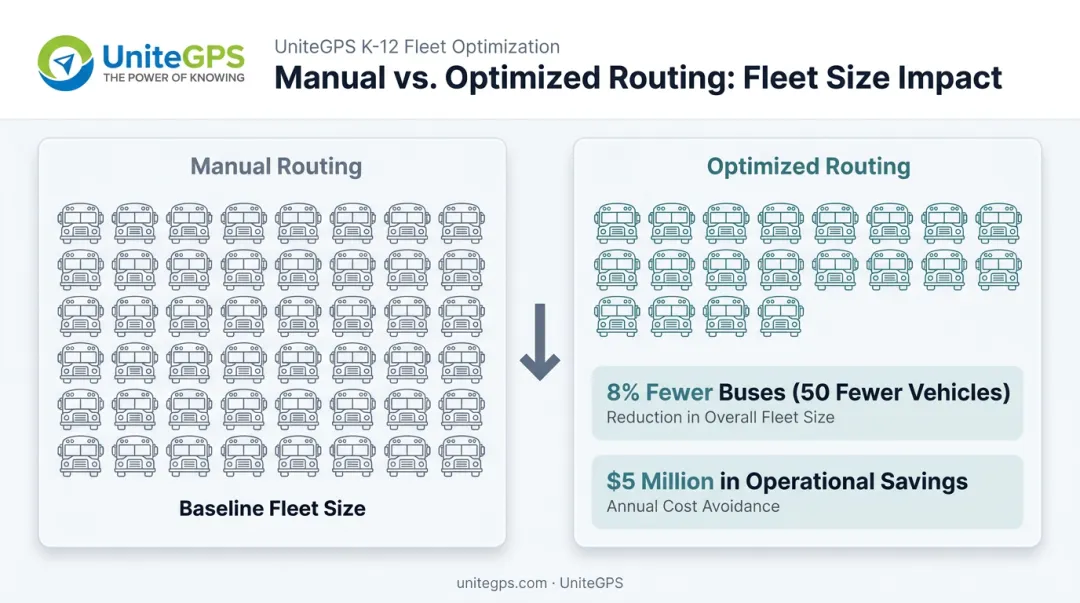
That case combined route and bell-time optimization, so results vary by district. Still, it shows what's possible when routing stops depending on memory and paper maps.
Ridership Tracking for Accountability and Safety
Knowing exactly which students boarded and exited a specific bus matters for both safety and compliance. Tablet-based scan systems solve this directly.
Students scan a barcode card (or a photo of the code) when boarding. The system:
- Captures both boarding and exit events with timestamps
- Tracks students even if they forget their card or ride an unassigned bus
- Feeds scan data into IEP and Medicaid billing documentation
- Builds a safety-compliance audit trail administrators can pull during disputes
That last point matters more than districts often expect. Reimbursable transportation costs go unclaimed all the time because documentation was incomplete.
Automated SIS Integration
Syncing routing software directly with a district's Student Information System eliminates duplicate data entry. When a student's address or school assignment changes in the SIS, that update flows into the transportation system automatically, with no manual roster upload required.
UniteGPS integrates with major platforms including PowerSchool, Skyward, and Infinite Campus, keeping routes, stop assignments, and ridership records aligned with the district's authoritative enrollment data in real time.
How Integrated Platforms Like UniteGPS Bring It All Together
Individually, each of these tools solves one problem. Together, they solve the whole operation.
UniteGPS's Crosswalk platform combines GPS tracking, route optimization, ridership tracking, and SIS synchronization into a single system, built from more than a decade of direct feedback from transportation directors nationwide. It's grown from its first live district in 2015 to serving 100+ districts across the country today.
A few things set it apart for districts wary of long vendor lock-in:
- FERPA-compliant data handling, with a signed Data Processing Agreement and AES-256 encryption
- A 90-day free trial with no credit card required, including routes built by the UniteGPS team during onboarding
- Unlimited live support from K-12 specialists, no tickets, no queues
That last piece reflects a broader positioning: UniteGPS is bootstrapped and founder-led, without private equity pressure pushing pricing or priorities.
Alternative Transportation Options for Students
Not every student rides a yellow bus, and districts increasingly lean on alternatives to fill the gaps.
Contracted rideshare services like HopSkipDrive and Zum handle individualized trips for students covered under McKinney-Vento, foster care, or IEP transportation needs. Zum, for instance, expanded its partnership with Fresno Unified to cover 172 special-education routes in early 2026.
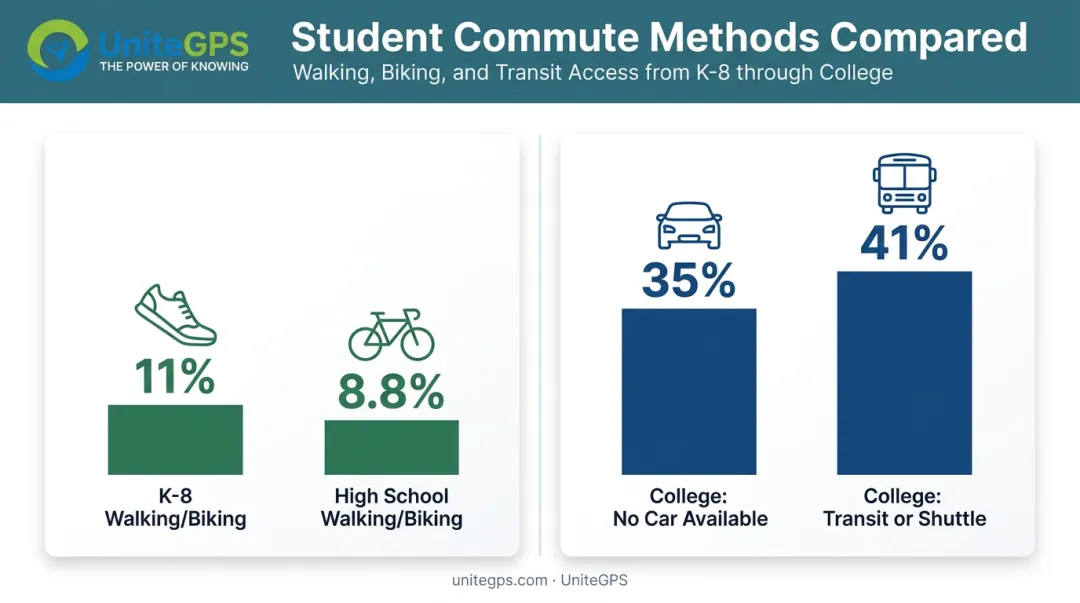
Walking and biking programs remain common too. National data from 2017 shows 11% of K-8 students and 8.8% of high schoolers walked or biked to school, a mode share schools continue to support through Safe Routes-style programs.
For older students without a car, the options widen further:
- Public transit passes subsidized through district or city partnerships
- Campus shuttles at colleges and universities
- Carpools organized informally among families
- Walking or biking, especially for those living within a mile or two of campus
A 2024 San Jose State University survey found nearly 35% of students had no car available for commuting, with transit or shuttle use as the top alternative at roughly 41%.
Having an alternative only helps if students can actually find accurate schedule and route information when they need it. Small transit agencies are increasingly closing that gap through GTFS data integration, publishing route and schedule data that syncs with Google Maps and rider apps. UniteGPS's Town Transit product, used by agencies like Clallam Transit and Grays Harbor Transit, supports this kind of real-time feed publishing for smaller agencies that serve school-adjacent communities.
How to Choose the Right Student Transportation Technology
Not all platforms are built the same, and the wrong choice can mean months of disruption. Districts evaluating options should look for:
- FERPA compliance and data protection — a formal Data Processing Agreement, encryption standards, and clear limits on what student data the vendor can access
- Ease of SIS integration — automated syncing with your existing enrollment system, not manual exports
- Live customer support — real specialists, not ticket queues, especially during route changes or emergencies
- Scalability — the ability to start with basic routing and grow into GPS tracking and tablet-based ridership tools without rebuilding from scratch
Before committing, test the platform through an extended trial period. A 90-day trial, for example, gives transportation staff enough time to run real routes and catch problems before a contract is signed.
Prioritize vendors focused on long-term partnership rather than short-term contracts or pricing driven by private equity ownership.
Rollout success also depends on the people using the system daily, not just the administrators signing off on it. Involve drivers, dispatchers, and parents early to build buy-in before launch.
Frequently Asked Questions
What is the meaning of student transport?
Student transportation is the full system of vehicles, routes, staff, and technology used to safely move K-12 students to and from school and school-related activities. It covers everything from yellow bus routes to special education and contracted transit.
How do college students get around without a car?
Common options include public transit passes, campus shuttles, carpools, biking, and walking. Many students rely on transit or shuttle service as their primary commute option, especially on urban campuses.
What is the biggest challenge in student transportation today?
Driver shortages and rising operational costs top the list for most transportation directors, who cite both as ongoing, year-over-year pressures. Manual, disconnected systems compound both problems further.
How does GPS tracking improve school bus safety?
Real-time GPS tracking gives parents and administrators live visibility into bus location, reducing uncertainty at the stop. Paired with ridership scanning, it also verifies exactly which students boarded and exited, closing a major safety gap.
What technology do school districts use for bus routing?
Most districts now use route optimization software that automates path planning and integrates directly with their Student Information System and GPS tracking tools. This replaces manual routing built on paper maps or spreadsheets.
Is student transportation software expensive for small districts?
Not necessarily. Scalable platforms offer flat, affordable entry pricing, sometimes starting under $50 a month, with free trials that let small districts test the system before committing to anything larger.