Today's innovative safety technologies extend beyond traditional compartmentalization and stop-arm laws to deliver real-time visibility, automated accountability, and proactive incident prevention throughout the entire transportation ecosystem.
Key Takeaways
- Real-time GPS improves emergency response with live fleet visibility, route optimization, and geofence alerts
- Integrated platforms beat point solutions by unifying routing, GPS, ridership, and parent communication
- Barcode and tablet ridership systems create timestamped records that verify pickups and drop-offs
- Implementation success hinges on FERPA compliance, SIS integration, and long-term vendor partnerships
Current State of School Bus Safety: The Foundation for Innovation
School buses transport millions of American students daily with an exceptional safety record. NHTSA confirms that children are nearly eight times safer riding a school bus than traveling in cars with parents or guardians. Fatality rates sit at 0.2 per 100 million vehicle miles traveled for school buses, versus 1.5 for passenger cars.
From 2015 through 2024, NHTSA recorded 119 occupants killed in school transportation vehicles: 49 drivers and 70 passengers.
This record rests on decades of safety innovation: compartmentalization with energy-absorbing seats and high padded seat backs, federal stop-arm laws for loading and unloading, and entry-level driver training requirements that mandate formal instruction before commercial skills tests.
Yet most school-bus-related fatalities occur outside the vehicle. Children are struck by motorists who fail to stop, or incidents happen at loading and unloading zones.
Meanwhile, transportation departments face operational pain points that compromise both safety and efficiency:
- Limited real-time visibility into fleet locations during emergencies or delays
- Communication gaps between drivers, dispatchers, and parents
- Inability to confirm which students are actually on which buses
- Reactive incident response instead of proactive monitoring
A 2025 audit of New York City's school bus program found that GPS and complaint data were available, yet the Department of Education did not use that technology to flag problematic vendors or routes. Even well-resourced districts struggle to turn tools into better operations.
That gap between available tools and day-to-day use is why districts need integrated safety platforms they can actually run.
Innovative Technology Categories Transforming School Bus Safety
GPS Tracking and Fleet Management Systems
Satellite-based GPS tracking provides real-time location data for every bus in a fleet, with modern systems updating positions as frequently as every five seconds. Transportation directors gain a unified dashboard showing the entire fleet on a single map, color-coded by status and on-time performance. This visibility enables:
- Route optimization that reduces miles driven, fuel consumption, and driver time
- Geofencing around school zones and designated stops, triggering alerts when buses deviate from approved routes
- Speeding and idle alerts that support driver accountability and fleet compliance
- Instant location access during emergencies, eliminating time spent calling drivers
A 2019 peer-reviewed study of Boston Public Schools' algorithmic routing solution found the district cut its fleet from 650 buses to 530 (18%) while holding average ride time at 23 minutes. First-year savings totaled $5 million.
North Carolina's Smart School Bus Safety Pilot reported that Mt. Airy City Schools used integrated routing and GPS to eliminate two bus routes and free operational capacity.
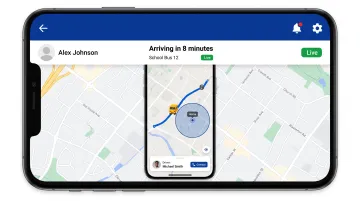
GPS systems also support parent transparency. Districts including Urbana School District 116 and McMinnville School District allow families to create custom geofences and receive push or email notifications when their child's bus enters that zone, reducing anxiety and inbound calls to transportation offices.
Student Ridership Tracking and Accountability
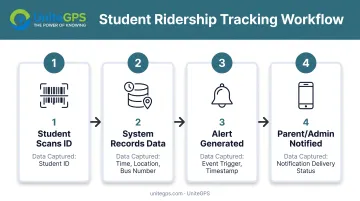
Ridership systems create a digital chain of custody by recording every boarding and exit event. Students scan a barcode from an ID card or use an RFID-enabled card swipe when entering and leaving the bus. Each scan generates a timestamped record identifying:
- Which student boarded which bus
- The exact time and GPS location of the boarding event
- Which stop the student exited at
- Verification that students rode their assigned buses
North Carolina's 2021 pilot program added tablets and RFID readers so staff, students, and parents could track buses and see which students boarded or exited at specific stops.
Brevard Public Schools' 2022 GPS and student tracking procurement stated the purpose plainly: "to show when, where, and which students board and exit buses and support ridership reporting audits."
This accountability prevents two critical safety gaps:
Wrong-bus incidents: When a young student boards the incorrect bus, often due to similar-looking vehicles or dismissal confusion, ridership tracking immediately flags the mismatch. Parents receive alerts showing their child did not board the expected vehicle, and administrators can quickly locate the student.
Wrong-stop incidents: If a child exits at an unauthorized location, the system generates an alert. Transportation staff can verify the event using timestamped GPS coordinates and boarding records, allowing rapid response instead of discovering the problem hours later.
Tim Lyons, Director of Transportation at Benton Community School District, explained that when parents call claiming a bus didn't stop, staff can check the system and verify whether the bus was actually there. That turns unresolvable disputes into fact-based conversations backed by GPS and ridership data.
Video Surveillance and AI-Powered Monitoring
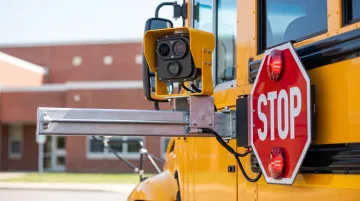
Onboard camera systems serve dual purposes: interior monitoring of student behavior and exterior visibility for blind spots and stop-arm violations.
The NTSB formally recommended that states allow stop-arm cameras to capture images and issue citations for illegal passings. At least 25 states currently have laws permitting exterior cameras to document violations and support citations.
Emerging AI capabilities include:
- Pedestrian proximity alerts warning drivers of children near the vehicle
- Driver distraction detection monitoring for phone use or inattention
- Automatic incident flagging that identifies events requiring administrative review
Results remain mixed. NHTSA's 2024 demonstration project in Allentown and Bethlehem, PA installed stop-arm cameras and tracked violations. Operators reported 5,890 citations in Allentown and 2,090 in Bethlehem, yet NHTSA found no meaningful drop in ticketable events and called the results inconclusive.
The agency recommended standardizing definitions of ticketable events and improving how AI systems flag violations to cut false positives.
Video systems deliver the greatest value when integrated with GPS tracking, ridership data, and communication platforms rather than operating in isolation. North Carolina's pilot combined automated safety cameras with internal cameras, tablets, GPS, routing software, and parent notifications. That mix builds a full safety ecosystem instead of relying on cameras alone.
Real-Time Visibility and Communication Systems
Modern parent communication apps have evolved far beyond simple "dot on a map" tracking. Today's platforms deliver predictive arrival times based on live traffic and route progress, proactive delay notifications, and two-way messaging between parents and transportation staff.
New York City's School Bus App adds real-time bus locations plus boarding and exiting alerts for yellow-bus families, in 10 languages with WCAG accessibility compliance.
Value compounds when GPS data feeds routing software that syncs with the student information system. Districts then share one accurate picture across every role:
Parents
- Real-time ETAs and customizable geofence alerts
- Timestamped ride history that settles "the bus never came" disputes
- Ridership scan notices when their child boards and exits
Administrators
- Fleet-wide on-time performance with color-coded status
- Speeding, idle, and route-deviation alerts
- Historical tools that flag weak routes or vendors
Drivers
- Turn-by-turn navigation with stop sequence
- Expected students at each stop—especially useful for substitutes
Emergency responders
- Instant bus location during incidents
- No more phone chains to find a vehicle
Districts that deploy transparent real-time communication consistently report reduced call volume to transportation offices. The key is giving parents the information they need before they feel compelled to call. When a family can check an app to see their bus is five minutes away and their child has already boarded, the transportation office phone stays quiet.
FERPA compliance remains critical. Systems should:
- Restrict access with role-based controls
- Encrypt data in transit (TLS 1.2+) and at rest (AES-256)
- Require multi-factor authentication
- Limit access to authorized users with legitimate educational interests
Federal FERPA regulations allow contractors and vendors to act as school officials only when they perform institutional services, stay under direct district control for record use and maintenance, and follow redisclosure rules.
Overcoming Implementation Challenges
Three barriers consistently surface when districts evaluate safety technology: budget constraints, infrastructure readiness, and privacy concerns.
Budget constraints are real, but funding options exist. Federal funding through the DOJ COPS Office School Violence Prevention Program (SVPP) offers up to $73 million annually, with individual awards capped at $500,000 and a required 25% local cost share. Eligible purposes include technology for expedited law enforcement notification during emergencies, though SVPP is not transportation-specific.
State transportation funding varies widely. North Carolina's 2021 pilot used $115,000 in state funds plus $2,703 in local funding to deploy cameras, tablets, RFID readers, routing, GPS, parent notifications, and student tracking across multiple buses.
Actual costs depend on fleet size and selected features. Brevard Public Schools' 2022 contract for GPS and student tracking totaled $2,525,544.56 over three years. That covered implementation, training, hardware, support, dashboards, reports, and parent apps for a large district.
The contract also flagged hidden costs:
- Custom reports may incur additional fees
- Lost or damaged equipment can cost $1,000 per unit
- GPS hardware deinstallation runs $100 per vehicle
Phased implementation spreads cost and complexity across stages:
Core routing and optimization: Start with software that builds efficient routes, syncs enrollment data, and ends manual schedule recalculation. Minimal hardware is needed, and savings show up quickly through fewer miles and less driver time.
GPS tracking: Add real-time location, geofence alerts, and basic parent communication once routing is stable. Many GPS subscriptions include the device, so districts avoid large upfront hardware buys.
Student ridership and advanced features: Deploy tablets for barcode scanning, turn-by-turn navigation, digital inspections, and scan-on/scan-off parent alerts. Tablet hardware and cellular data raise per-bus cost, but they build on the foundation from earlier phases.
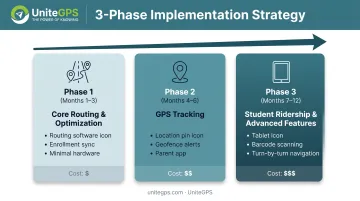
North Carolina's pilot followed this path: cameras and temperature monitoring first, then tablets and RFID readers. New York City's app rollout started with driver training and login tools before expanding to full location reporting.
Infrastructure readiness depends on fleet age, IT capacity, and staff expertise. Older buses may need extra wiring or mounting hardware.
Before procurement, inventory readiness:
- How many buses already have power outlets or mounting points?
- Does the district have enough IT staff for vendor integrations and troubleshooting?
- Can drivers and dispatchers adopt tablet-based workflows?
Privacy and data security need early attention. The U.S. Department of Education's PTAC guidance notes that FERPA does not mandate specific security controls, but institutions must safeguard student records, and breaches can count as FERPA violations. Best practices include:
- Secure file transfer with strong encryption
- Access controls so officials see only records tied to legitimate educational interests
- Authentication for parents, students, and authorized users
- Vendor contracts that require FERPA compliance, data-use limits, and breach notification
Districts should tell parents how location and ridership data will be used, who can access it, and how long it will be kept. Clear privacy policies build trust and make safety technology easier to adopt.
Choosing the Right Safety Technology Partner
Vendor selection matters as much as technology features. The wrong partner can saddle a district with disconnected systems, poor support, hidden costs, and short-lived commitment to the K-12 market.
Key evaluation criteria:
Integration capabilities: Does the platform connect with your student information system (PowerSchool, Skyward, Infinite Campus)? Can it sync enrollment, addresses, and school assignments on its own, or will staff keep uploading roster files by hand?
Brevard's 2022 procurement required real-time cloud synchronization, administrator dashboards, reports, and parent app integration. Disconnected tools create more work, not less.
Ease of use: Transportation directors, dispatchers, drivers, and parents all use the system. Interfaces should be intuitive, with minimal training required. Substitute drivers should handle routes with clear turn-by-turn directions and stop-by-stop student information, even without prior route familiarity.
Customer support quality: When a bus breaks down or the app stops updating, districts need immediate help, not a ticket queue. Ask whether the vendor offers live support, response-time commitments, and proactive monitoring. Check references about support during the first few weeks of school.
Data privacy commitment: Go beyond FERPA checkboxes. Ask how the vendor protects student data:
- Encryption standards (TLS 1.2+ in transit, AES-256 at rest)
- Access controls (role-based permissions, multi-factor authentication)
- Breach notification timelines
- Data ownership terms and deletion procedures after contract end
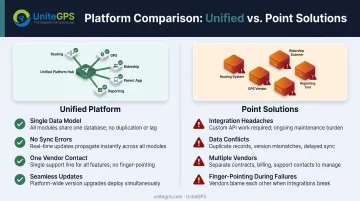
Unified platform vs. point solutions: Separate vendors for routing, GPS tracking, ridership scanning, and parent communication create integration headaches and finger-pointing when systems fail to talk. Platforms that combine these functions share one data model, cut sync errors, and give staff a single operational view.
Long-term commitment to K-12: Private equity-backed vendors often face pressure to maximize short-term returns and exit within 3-5 years. Ownership changes can disrupt product development, support relationships, and pricing stability.
Look for partners with:
- Decade-plus track records serving school districts
- Profitable operations without external investor pressure
- Founder involvement in product direction
That profile matches how specialists such as UniteGPS have operated since 2014: bootstrapped, founder-led, and built on district feedback rather than investor timelines.
Selection is only half the job. New York City's 2025 audit found the Department of Education did not adequately oversee technology vendors or use available data to flag problematic vendors and routes. Choose partners that expose the data you need for ongoing accountability, then use it.
Frequently Asked Questions
How can students stay safe on a school bus?
Student safety pairs good habits (staying seated, using seat belts when available, following the driver) with tools like GPS tracking, ridership checks, and cameras. Parent and admin alerts also speed response when buses run late or something goes wrong.
Are school buses the safest vehicles in America?
Yes. School buses are among the safest vehicles on American roads, with less than 1% of traffic fatalities involving children on school transportation. NHTSA reports students are nearly eight times safer on school buses than in cars. GPS tracking, ridership checks, and AI monitoring continue to strengthen that record.
What are the privacy concerns with GPS tracking and student monitoring technology?
FERPA requires that personally identifiable student information stay protected from unauthorized disclosure. Districts should use access controls, encryption, FERPA-compliant vendor contracts, parental consent, role-based permissions, and clear breach notification steps.
How much does it cost to implement school bus safety technology?
Costs depend on fleet size and features. GPS tracking often runs $25–$35 per bus per month; full tablet systems may add about $1,699 per bus in hardware plus software and data plans. Federal SVPP grants and state transportation funds can offset startup costs.
What is the ROI of investing in school bus safety technology?
Strong returns show up in fuel and fleet size: Boston Public Schools saved $5 million in the first year by cutting 50 buses without longer ride times. Districts also see fewer parent calls, better on-time performance, and clearer liability records from timestamped GPS and ridership data. Mt. Airy’s pilot estimated $3,500 or more per week in staff time recovered during screening periods.
UniteGPS is a FERPA-compliant K-12 transportation platform that combines routing, GPS tracking, student ridership monitoring, and parent communication. Founded in 2014 and serving 100+ districts nationwide, it offers a 90-day free trial with routes built at no cost, unlimited live support, and phased pricing from $49/month. Call 207-591-7777 to talk through your district’s needs.