By 2026, this category has entered a new phase. Instead of chasing flashy new features, districts are consolidating tools and demanding AI that actually works. Driver shortages, tighter budgets, and parents who expect Uber-level visibility have made staying current on these trends less optional and more survival.
Transportation directors who understand where the market is heading avoid costly software mistakes. Those who don't often end up locked into fragmented systems that cost more to run than they save.
TL;DR
- On-bus technology is consolidating into unified platforms instead of scattered point solutions
- AI-powered routing and predictive maintenance are becoming standard operating procedure
- Districts are leaning on technology to offset ongoing driver shortages
- Electric bus adoption remains uneven as federal funding priorities shift
- Real-time communication and ridership tracking are now baseline parent expectations
Key Trends Shaping School Bus Management Software in 2026
These five trends reflect what districts are actually asking vendors for right now. The common thread: a shift away from siloed tools toward connected systems that give transportation directors one source of truth.
Trend 1: Consolidation of On-Bus Technology into Unified Platforms
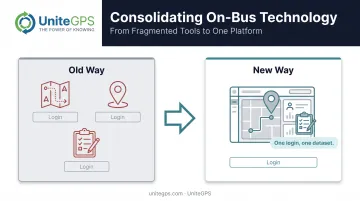
Districts have historically cobbled together separate systems for routing, GPS tracking, and ridership, each requiring its own login, its own data entry, and its own learning curve. That's changing fast.
A 2025 School Bus Fleet survey found 68% of districts now use rider-tracking or parent apps, nearly double the rate from two years earlier. That jump shows transportation departments are actively expanding their tech stacks, and increasingly expecting those tools to work together instead of standing apart.
Platforms like UniteGPS's Crosswalk combine routing, GPS, and ridership tracking into one system, so drivers aren't juggling multiple apps mid-route and staff aren't re-entering the same student data three times. When a student moves or changes schools, that update flows through routing and ridership records automatically instead of requiring manual fixes in three places.
Why it matters:
- Fewer systems mean fewer opportunities for data entry errors
- Transportation directors get a single dashboard instead of tab-switching between platforms
- Onboarding new staff takes less time when there's one system to learn, not four
Trend 2: AI-Driven Route Optimization and Predictive Maintenance
AI-assisted routing is no longer a proof-of-concept. It's becoming a working part of daily operations, using ridership patterns and stop data to trim mileage and balance loads across a fleet.
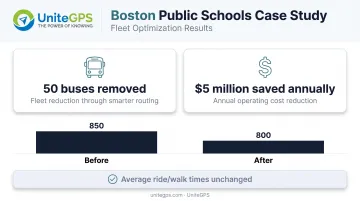
The clearest evidence of what's possible comes from Boston Public Schools. Using an optimization algorithm, the district removed 50 buses from its fleet and saved roughly $5 million annually — without increasing average student ride or walk times. That's not a projection; it's a measured outcome.
Crosswalk's routing tools apply the same kind of logic for district fleets: finding shorter, safer paths, cutting total miles and fuel costs, and recalculating arrival times when stops change. For special education routing especially, this kind of automatic recalculation eliminates hours of manual schedule rework every time a student's needs shift.
Predictive maintenance is trailing routing in terms of documented savings, but the direction is clear. Districts are using real-time diagnostics and automated alerts to catch engine, brake, and tire problems before they become breakdowns, moving from reactive repairs to proactive fleet management.
Trend 3: Technology-Driven Responses to the Driver Shortage
The driver shortage hasn't eased. According to a 2025 AP-NORC survey of school administrators, 81% called driver shortages a problem, and 26% said their school or district had cut or shortened routes as a result.
Software can't create drivers out of thin air, but it can make the drivers you have (and the substitutes filling in) more effective, and do it faster.
Tablet-based navigation that shows the full route, stop order, and student details helps substitutes cover unfamiliar routes without guesswork. Audible turn-by-turn directions mean a sub doesn't need weeks of training to run a route safely.
This is becoming a real competitive differentiator among vendors:
- Districts want tools that reduce the learning curve for new and substitute drivers
- Printable, step-by-step route sheets serve as backup when tablets aren't an option
- Simplified digital pre- and post-trip inspections cut down on paperwork drivers dread
The districts winning the retention battle aren't necessarily paying the most. They're the ones making the job less frustrating day-to-day.
Trend 4: Real-Time Parent Communication as a Baseline Expectation
Live bus tracking used to be a premium add-on. Now it's table stakes. A Harris Poll commissioned by Zonar found 76% of parents want to track their child's transportation via mobile phone, with 51% wanting real-time updates during emergencies.
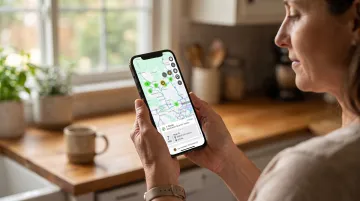
Parents who can watch a food delivery move across a map in real time expect the same for a school bus carrying their kid. Automated notifications for delays, route changes, and boarding confirmations have shifted from nice-to-have to assumed.
This shift benefits transportation offices directly:
- Fewer calls asking "where's the bus" when parents can check an app themselves
- Boarding and alighting alerts reduce disputes over whether a student made it on the bus
- Timestamped ride history gives staff a fast way to resolve parent questions
One Crosswalk customer, Benton Community School District, said the platform made "a huge difference" in verifying bus-stop disputes — staff could pull up exactly when and where a student boarded instead of relying on memory or guesswork.
Trend 5: Data Integration with SIS and Compliance Systems
Manual roster uploads are a liability. Every time a student enrolls, moves, or changes schools, someone has to update routing and ridership records by hand, and every manual update is a chance for an error that follows a student around all year.
Synchronizing with Student Information Systems like PowerSchool, Skyward, and Infinite Campus eliminates that re-entry. Enrollment, addresses, and school assignments flow directly into routing software, keeping ridership records current and audit-ready.
This matters more each year because:
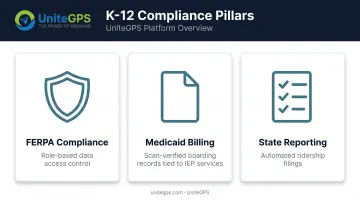
- FERPA compliance requires districts to control who accesses student-linked data and how it's used — digital, permissioned systems make that easier to prove
- Medicaid billing documentation for special education transport increasingly depends on scan-verified boarding records that tie to IEP services and export as billing-ready reports
- State reporting (such as Wisconsin's annual ridership filing) pushes districts toward systems that produce compliant records without manual compilation
What's Driving These Trends in Student Transportation
These shifts aren't happening in a vacuum. They're a direct response to budget, labor, and regulatory pressure specific to K-12 transportation.
A 2026 AASA/NAPT survey found 54% of districts paying at least 6% more for diesel, with 14% blowing past budget by 20% or more. That pressure is pushing transportation directors toward measurable efficiency gains, not just nice-sounding features.
Other forces at play:
- Technology maturity: Cloud platforms and AI tools have gotten affordable enough for small and midsize districts, not just large urban fleets
- Market demand: Parents and administrators expect the visibility that consumer apps normalized
- Labor constraints: Driver shortages and overtime costs push districts to get more from every route and every seat
- Regulatory pressure: FERPA and state DOT reporting requirements push districts toward digital, auditable record-keeping
- Competitive dynamics: Transportation directors compare notes at conferences, and nobody wants to be the district still running paper route sheets
How These Trends Are Impacting School Transportation Departments
These shifts show up in daily operations, budgets, and staffing, not just in vendor marketing decks.
Operational Impact
Workflows are becoming proactive instead of reactive. Routing changes, maintenance alerts, and driver reassignments that once took days of phone calls and paperwork now happen in minutes through a connected platform.
Business Impact
Districts are evaluating vendors differently. Lowest upfront cost matters less than long-term partnership and support quality. UniteGPS is one example of that model: bootstrapped since 2014, with no private equity pressure to chase short-term profit at districts' expense. In practice, that looks like:
- Unlimited live support with no ticket queues
- Full district ownership of data, without vendor lock-in
Workforce Impact
Transportation staff are spending less time on manual data entry and fielding "where's my kid's bus" calls. That frees them up for oversight and safety-focused work, the parts of the job that actually require a human.
Future Signals to Watch in School Bus Management Software
Over the next one to three years, watch for:
- Flexible contract terms — growing demand for free trials and lower-commitment agreements instead of long multi-year lock-ins
- Deeper AI applications — predictive maintenance and driver behavior coaching will expand as camera and telematics hardware gets cheaper
- Software ROI over vehicle type — EPA's Clean School Bus Program ($5 billion through FY2026) was under revision as of early 2026 with no confirmed next funding round, so districts are prioritizing software efficiency gains they control over electric bus grants that may not materialize
Conclusion
Integrated, data-driven, parent-transparent transportation systems are replacing fragmented legacy tools. Districts that move early gain smoother daily operations and stronger trust with the families they serve.
Chasing every new feature matters less than choosing a partner built for the long haul. Look for a platform that will still improve five years from now, not one headed for the next investor flip.
Frequently Asked Questions
What are the current trends in the school bus industry?
Districts are consolidating fragmented tools into unified platforms and adopting AI for routing and maintenance. They also use technology to support driver retention and treat real-time parent communication as standard.
How is AI being used in school bus management software?
AI optimizes routes based on ridership and stop data, helps predict maintenance needs before breakdowns occur, and analyzes usage patterns to improve efficiency. Boston Public Schools saved roughly $5 million annually using route optimization technology.
Why are school districts consolidating their transportation technology?
Fragmented tools create data silos, duplicate entry, and more room for error. A unified platform gives transportation directors one source of truth instead of juggling multiple disconnected systems.
How does school bus tracking software help with the driver shortage?
Tablet-based turn-by-turn navigation and simplified route sheets help substitute and new drivers cover unfamiliar routes confidently, reducing the training burden during staffing gaps.
Is school bus tracking software FERPA compliant?
Yes. Reputable K-12 platforms are built for FERPA compliance. UniteGPS, for example, uses encryption, role-based access controls, and signed data processing agreements to protect student data.
How much does school bus management software typically cost?
Pricing varies by fleet size and feature tier, ranging from basic routing tools to full GPS and tablet suites. UniteGPS offers a 90-day free trial with no credit card required, so districts can evaluate fit before committing.