This guide breaks down where the money actually is: federal programs, state clean-bus initiatives, and lesser-known funding pathways built specifically for school transportation departments — not student scholarships or tuition aid.
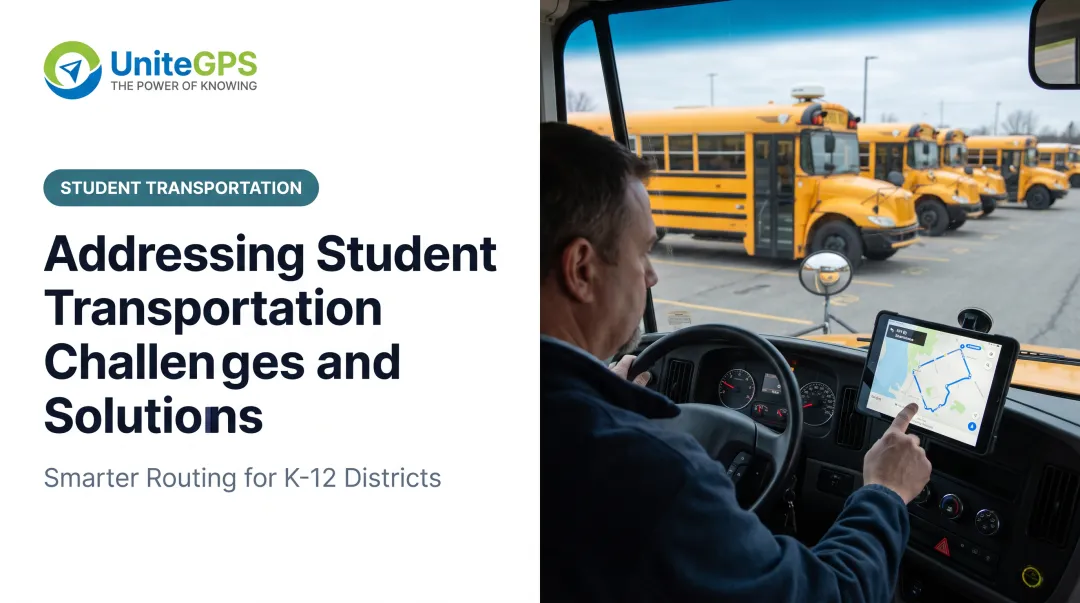
One thing districts often miss: technology investments like GPS tracking, ridership scanning, and routing software frequently qualify under the same safety and efficiency grants that fund buses themselves.
Key Takeaways
- Federal programs like the EPA Clean School Bus Program can fund entire fleet replacements, not just individual vehicles
- State-level clean bus grants (New Jersey, Pennsylvania, Texas) offer reimbursement rates up to 100% for retrofits
- GPS tracking, ridership scanning, and routing software often qualify as safety technology under existing grant categories
- Route optimization software can free up operating budget to use as grant matching funds
- A simple deadline spreadsheet keeps districts from missing narrow grant application windows
Why Transportation Funding Matters for School Districts
Pupil transportation ranks among the largest line items in most district budgets. The National Center for Education Statistics puts the national per-student transportation cost benchmark at $1,152, a figure that's likely climbed further given fuel and labor inflation since NCES last reported it.
Several pressures are pushing districts toward outside funding:
- Aging diesel fleets — the average school bus is now over 9 years old, according to School Bus Fleet's industry survey
- Emissions and health concerns — the EPA notes that diesel exhaust exposure can aggravate asthma, a condition affecting 6.3 million American schoolchildren
- Safety technology gaps — incidents continue to drive demand for better tracking and communication tools
- Parent expectations — families want real-time visibility into where their child's bus actually is
Grants don't just cover buses. Many programs also fund field trips, STEM-related transportation, safety technology, and clean energy infrastructure. Those categories rarely come up alongside "school bus grants," yet they can meaningfully cut operating strain.
Federal Grants for Student Transportation
Several federal programs can fund bus replacements, safety technology, and specialized student transport. Match your need to the right stream before you apply.
EPA Clean School Bus Program
This is the largest dedicated funding source for replacing diesel buses with low- or zero-emission alternatives. The Infrastructure Investment and Jobs Act authorized $5 billion over FY2022-2026 for the program.
The most recent completed competitive grant round shows demand far outpaced supply. EPA initially offered at least $400 million; applications requested nearly $1.9 billion. Final awards totaled $965 million, with school districts eligible to apply for 15-50 buses per application.
Grants vs. rebates:
| Feature | Competitive Grants | Rebates |
|---|---|---|
| Process | Scored, narrative application | Short application, first-come, first-served |
| Award caps | Varies by priority | Up to $325,000/bus (priority districts, Class 7+ zero-emission) |
| Best for | Districts with strong narratives around need | Districts wanting a faster, simpler path |
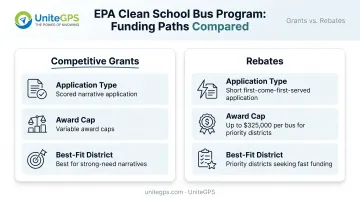
As of 2026, EPA is revamping the program after a request for information closed in April. No new grant announcement had been issued at time of writing. Check the EPA Clean School Bus Program page directly before assuming past-round caps still apply.
Safety and Preparedness Grants
- DOJ School Violence Prevention Program (SVPP): Up to $73 million in FY2026; max $500,000 federal share per award (25% local match). Funds emergency-notification technology; ordinary GPS or routing software is not explicitly allowable.
- FEMA Homeland Security Grant Program: $1.008 billion nationally; only State Administrative Agencies apply directly. Districts need a state or local subaward, and equipment must support terrorism preparedness, not routine fleet operations.
Education Funding Streams
These federal education dollars can support transportation, but only under narrow conditions:
- Title I-A: Covers the excess cost of transporting homeless students to their school of origin, not general fleet expenses
- IDEA: Transportation counts as a related service when required by a student's IEP, including adapted vehicles and lifts
- McKinney-Vento (EHCY): Covers excess transport cost for students experiencing homelessness (parallel to Title I-A)
- Perkins V: May cover CTE-related transportation costs when documented in the local needs assessment
- Title IV-A: Explicitly excludes transportation as an allowable use (worth knowing before you waste an application)
Every federal opportunity funnels through Grants.gov, the central search hub. The awarding agency still makes final decisions.
State Grants and Clean Bus Funding Programs
State programs vary widely, but most run annual cycles focused on fleet modernization, safety technology, and alternative fuels.
Three current examples show the range:
- New Jersey Electric School Bus Grant (Round 3): $15 million available, with per-bus-plus-charger caps reaching $350,000 for overburdened communities. At least half of funds are reserved for those communities.
- Pennsylvania Alternative Fuels Incentive Grant (AFIG): Roughly $5 million per cycle, capped at $300,000 per application. Priorities include first-time applicants and environmental-justice areas.
- Texas Clean School Bus Program: Covers up to 80% of incremental replacement cost, or 100% of retrofit costs, for buses model year 2006 or older. Applications are first-come, first-served.
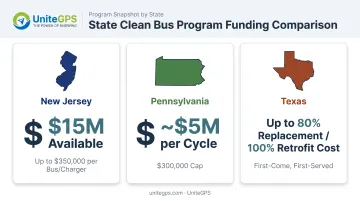
Many states also fund non-bus safety technology (tablets, ridership tracking, GPS systems) as part of broader student safety initiatives, not just clean-air programs.
To find open programs in your state, bookmark these two resources:
- SchoolSafety.gov Grants Finder Tool lets you filter by eligibility, deadline, and funding agency
- Your state Department of Transportation and Department of Education websites; many state programs aren't listed in any central database
Other Funding Pathways for Transportation Technology
Beyond the obvious federal and state programs, several overlooked pathways can fund transportation technology—or free up budget for it:
- Arts and enrichment grants — Kentucky's Arts Miles reimburses round-trip field-trip mileage; Nebraska's School Bus for the Arts offers up to $2,000 (1:1 match)
- Corporate foundation grants — Alabama Power Foundation offers up to $2,500 for field trip transportation costs
- Capital bonds and budget reallocation — often the fastest path for replacing outdated routing systems, with no competitive grant cycle required
- Clean vehicle tax incentives — IRS Commercial Clean Vehicle Credit (up to $40,000 for heavy vehicles) ended for vehicles acquired after September 30, 2025; DSIRE tracks state and utility incentives that may still stack with grants
Always verify anti-duplication rules before assuming grant funds can stack with tax credits or other incentives.
How to Maximize Your Grant Strategy and Technology Investments
Winning grant funding takes organization as much as eligibility. A few practices separate districts that consistently secure funding from those that miss deadlines.
Build a tracking system. A simple spreadsheet listing grant names, award amounts, deadlines, and eligibility rules prevents narrow application windows from slipping by unnoticed. Many state programs (like Texas's Clean School Bus program) run first-come, first-served. Missing a deadline by a day means waiting a full year.
Lead with measurable safety outcomes. Grant reviewers weigh safety metrics more heavily than convenience features. Position GPS tracking, ridership scanning, and routing software accordingly:
- SIS integration reduces manual data entry errors and keeps student stop assignments accurate
- Real-time GPS tracking updates every few seconds to support incident response and route verification
- Ridership tracking creates timestamped, scan-verified attendance records for safety audits and Medicaid/IEP billing
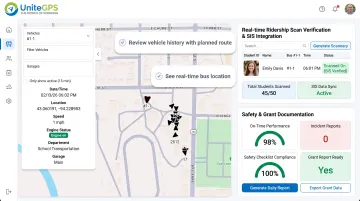
Platforms like UniteGPS's Crosswalk K-12 combine these capabilities in one system, so districts can document safety outcomes more easily in grant applications.
Use route optimization to fund your match. Many grants require local matching funds. Route optimization software finds shorter paths and cuts total mileage, which lowers fuel costs and frees operating budget you can redirect toward the match.
UniteGPS also offers a free, no-obligation route optimization study that produces a documented savings plan suitable for board presentation.
Start with a free trial before committing. If you're weighing whether GPS tracking or ridership technology fits your grant strategy, UniteGPS offers a full 90-day trial with no credit card required. Setup support and SIS integration configuration are included at no cost. A free 15-minute consultation can also walk through current routing challenges before you commit budget or apply for tool-specific grants.
Frequently Asked Questions
What is the transportation assistance program in FL?
Florida provides an annual district-level allocation under Florida Statutes section 1011.68, not a direct family grant. It funds transportation for students living 2+ miles from school, students with disabilities, and other specified categories through a state funding formula.
How much is the QLD conveyance allowance?
This refers to Queensland, Australia's school transport subsidy, not a U.S. program. Rates reach roughly A$212.95 per week at maximum distance bands. It's unrelated to U.S. school transportation grants and shouldn't be used as a funding benchmark.
Are there grants specifically for school bus GPS tracking and routing software?
Dedicated GPS-only grants are rare, but the technology often qualifies under broader safety technology or clean-transportation infrastructure grants. Framing GPS and routing tools as safety investments improves your odds with reviewers.
How do school districts find funding for electric or low-emission buses?
Start with the EPA Clean School Bus Program, though it's currently under revision with no active 2026 grant round announced. State programs (like those in New Jersey, Pennsylvania, and Texas) often remain active even when federal funding pauses.
Can Title I or IDEA funds be used for student transportation?
Title I can cover the excess cost of transporting homeless students to their school of origin. IDEA covers transportation only when it's a required related service documented in a student's IEP. Neither works as general fleet funding.
What is the easiest way to track multiple grant deadlines and requirements?
A simple spreadsheet listing each grant's name, amount, deadline, and eligibility rules works well for most districts. Update it regularly, since many state programs run first-come, first-served cycles with hard cutoffs.