This tension is real. GPS tracking and bus cameras genuinely make student transportation safer. But when those systems mishandle data, they create risks parents never signed up for. A 2021 study found 76% of parents rated preventing geolocation data collection as "very important" — yet most had no idea what policies their school actually followed [source: PMC study].
This article covers the real privacy risks, documented incidents, operational safety gaps, and what districts should demand from any tracking vendor.
Key Takeaways
- Real-time tracking boosts safety and cuts parent phone calls, but poor security design can expose location data to unauthorized users
- The 2024 Edulog vulnerability showed how weak authentication let anyone with a free account view student routes and parent contact information
- FERPA compliance, role-based access, and vendor transparency are baseline requirements for any tracking system
- Districts must weigh operational gains (routing, ridership tracking) against their duty to protect student data
What Privacy Risks Come with School Bus Tracking Technology?
GPS units, parent apps, and RFID ridership scanners collect a surprising amount of sensitive data: live location, pickup and drop-off timestamps, home addresses, and route assignments tied to individual kids. When that data is mishandled, the consequences aren't abstract.
The Edulog Parent Portal Vulnerability
Security firm Tenable disclosed a serious flaw in Edulog's Parent Portal in late 2023, with The 74's reporting on the issue breaking wider in 2024. The core problem: access restrictions were enforced only on the client side, not the server.
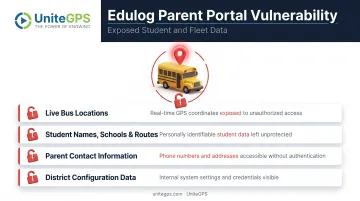
That meant anyone could register a free account without a verification code, then query API endpoints directly to pull:
- Live bus GPS locations and bus-stop proximity
- Student names, schools, and route assignments
- Parent contact information
- District configuration data, including usernames tied to third-party integrations
Edulog's own counsel acknowledged the company wasn't contractually required to notify districts or parents about the fix. That's a gap many families don't realize exists.
Why Exposed Location Data Matters
Parents raised an obvious concern: if a stranger can see where a specific child's bus stops every day, that's a stalking and safety risk, not just a data hygiene issue.
Edulog's own chief experience officer, Nhu Nguyen-Bull, flagged a second problem: the "personal optimizer" effect. When ETA data is off by even a few minutes, parents time their arrival to the app instead of leaving early. Kids then dash across streets unsupervised because the bus arrived sooner than predicted.
Federal regulators have taken notice. CISA's Secure by Design pledge asks K-12 ed-tech vendors to commit to proactive vulnerability disclosure and clear security practices. Edulog reportedly declined to sign, citing a lack of clear standards. Districts evaluating vendors should treat that choice as a due-diligence signal, not a footnote.
Who Has Access to School Bus Cameras and Tracking Data?
Access should follow a simple rule: only people with a legitimate need see the data, enforced through role-based permissions rather than trust alone.
In a properly configured system:
- Transportation staff and administrators see fleet-wide routing and ridership data needed to run operations
- Law enforcement may access stop-arm violation footage, typically only with a valid legal request
- Parents see only their own child's bus location and ETA — not the whole fleet, not other families' data
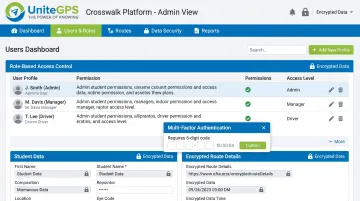
UniteGPS's Crosswalk platform, for example, uses role-based access control with least-privilege defaults and requires multi-factor authentication for every login. A compromised password alone isn't enough to reach student data. Data is encrypted with TLS 1.2+ in transit and AES-256 at rest.
Ask any vendor directly:
- How is footage stored?
- Who can view it, and for how long?
- Is data shared with law enforcement without a court order?
A vendor that hedges on these questions is telling you something.
Safety Challenges Beyond Privacy: Accuracy, Reliability, and Operational Gaps
Privacy isn't the only concern. Tracking systems that simply don't work well create their own safety risks.
When GPS Data Doesn't Match Reality
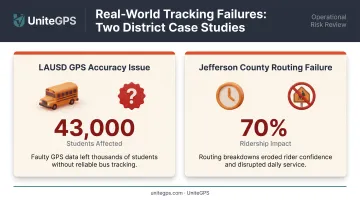
LAUSD rolled out GPS tracking through its parent app in 2023, covering roughly 2,700 daily routes and 43,000 students. The results were mixed.
Parents and drivers reported buses shown miles from their actual location — one parent estimated the app was "50% accurate" at best. The district said the system was at full capacity, but the gap between what families saw and what was happening on the road undercuts the point of tracking.
When Routing Software Fails Outright
Louisville's Jefferson County Public Schools learned this the hard way in August 2023. A botched routing software rollout left insufficient time between stops, compounded by a severe driver shortage.
Per CBS News, the fallout included:
- Kids stranded on buses until nearly 7 p.m. or later
- Most schools in the district canceled for the week
- A district that serves 70% of its students by bus scrambling for vans and extra drivers
A later audit blamed both the district and its vendor.
The takeaway: an app is only as reliable as the system behind it. Overreliance on any tracker can create false confidence, so families may stop watching for the bus. Treat ETAs as estimates, not guarantees.
How Districts Can Evaluate a Secure, Trustworthy Tracking Vendor
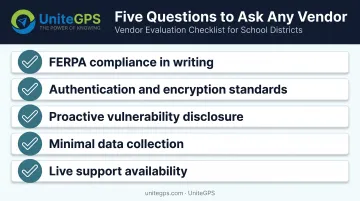
When districts choose a tracking vendor, they are choosing who holds student data. Features matter, but security and contractual accountability come first. Ask these questions before signing anything:
- Is the platform FERPA compliant, in writing? Not just "aligned with best practices." Demand a documented Data Processing Agreement that names the vendor as a school official.
- What authentication and encryption protects the parent portal? Look for multi-factor authentication, TLS 1.2+ in transit, and AES-256 at rest as a minimum.
- Will the vendor proactively disclose vulnerabilities? Edulog's contractual silence should be a cautionary tale, not the norm.
- How much data does the vendor actually collect? Minimal data collection reduces the damage if something does go wrong.
- Is support live, or ticket-based? When something breaks on a Tuesday morning with 40 buses on the road, a ticket queue isn't good enough.
UniteGPS's Crosswalk platform, for instance, is FERPA compliant and limits collection strictly to transportation data: name, address, grade, route, and contact info. It explicitly excludes grades, IEPs, and medical records.
The platform notifies districts within 24-48 hours of any confirmed security incident and backs that commitment with annual third-party audits of its data-handling practices. Districts should hold every transportation partner to that same bar.
Building a Culture of Safety and Trust Around Bus Tracking
Software alone won't solve this. Districts need policies and communication habits that back it up.
- Write clear, plain-language privacy policies that spell out what's collected, why, and who sees it
- Train transportation staff on data-handling procedures, not only day-to-day system operation
- Run regular security audits and share summaries with administrators, not only internal teams
- Notify parents promptly if any exposure occurs; silence is what turned the Edulog story into a trust crisis
Parents weren't upset just because a vulnerability existed. They were upset because districts didn't tell them up front. Saying what went wrong—and what you're doing about it—builds more trust than staying quiet.
Frequently Asked Questions
Who has access to school bus cameras?
Access is typically limited to authorized transportation directors, school administrators, and law enforcement requesting stop-arm violation footage. Vendors should enforce this through role-based permissions and encrypted storage.
Is school bus tracking data protected under FERPA?
Yes, when the data is linked to identifiable students and maintained by or for the district. Compliance still depends on how the vendor stores, accesses, and shares that data. Always confirm protections contractually.
Can parents see other students' bus locations or information?
No, not in a properly configured system. Parent apps should restrict visibility to the user's own child's route and ETA only.
What should a district do if a bus tracking vendor has a security breach?
Coordinate with the vendor immediately, notify affected parents promptly, and review access logs to determine exactly what data was exposed and to whom.
Are GPS bus trackers accurate and reliable?
Accuracy varies by vendor and connectivity. Some parents and drivers have reported discrepancies between app data and actual bus location, so treat ETAs as estimates, not guarantees.
How can schools protect student privacy while still using tracking technology?
Prioritize data minimization and strong authentication such as MFA. Require written vendor transparency agreements, and keep staff and parents informed about what is collected and why.