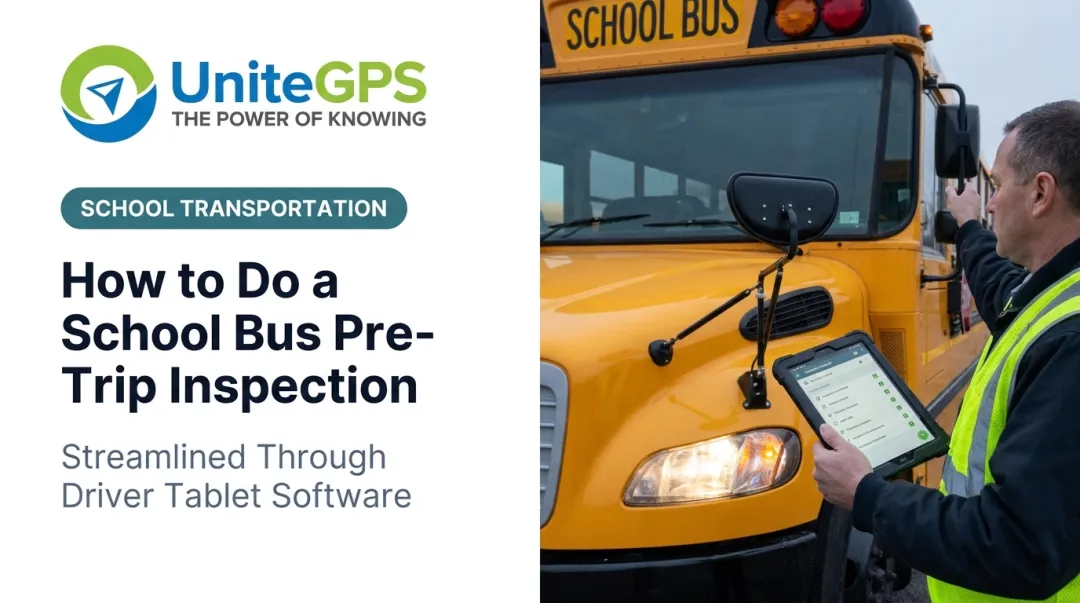

Driver Vehicle Inspection Reports aren't optional paperwork. They're federally mandated for school buses under 49 CFR 396.11, and the requirement applies every day a bus operates. This guide covers what the rule actually requires, what a complete inspection checklist looks like, how the driver-mechanic-next-driver signature chain works, and how districts are moving from clipboards to tablets — including how UniteGPS's tablet-based tools fit into that shift.
Key Takeaways
- School bus DVIRs are required every operating day under 49 CFR 396.11 — no blanket exemption for passenger-carrying vehicles.
- Electronic DVIRs meet FMCSA rules when they capture required signatures and stay retrievable for audits.
- Retain daily DVIR records for at least 3 months; keep annual inspection reports for 14 months.
- Districts already using ridership tablets can cover inspections on the same hardware instead of adding a separate system.
What Is a School Bus DVIR and Why It's Required
A Driver Vehicle Inspection Report (DVIR) is a written record of a bus's mechanical condition, completed at the end of each day of operation. The requirement comes from 49 CFR 396.11, with the pre-trip review obligation covered under 396.13.
Which vehicles are covered? A school bus is defined as a vehicle designed to carry more than 10 passengers in addition to the driver. Most district fleets clear this threshold easily, and once they do, they fall under FMCSA's Part 396 framework.
Current federal text says a driver doesn't have to file a written report when no defect is found. Don't confuse that exception with skipping the inspection: the daily walk-around and review still happen. Only the paperwork requirement changes when nothing's wrong.
Home-to-School vs. Everything Else
The exemption under 390.3T(f) is narrower than many districts assume:
- Exempt: Standard home-to-school and school-to-home routes.
- Not automatically exempt: Field trips, extracurricular routes, and any interstate travel.
A bus used for a Friday night sports trip across a state line doesn't get to lean on the same exemption as the morning route. Districts should classify each trip type rather than assume "it's a school bus, so it's covered."
Why this matters beyond fines: NHTSA tracks roughly 26,000 school bus crashes per year over an 11-year average. That figure underscores why mechanical condition checks matter, even though NHTSA's own data doesn't isolate DVIR failures as a direct cause.
A missed or incomplete DVIR isn't just a paperwork risk. It's a gap in the one system designed to catch a failing brake line before it fails on a route full of kids.
The Complete School Bus Inspection Checklist
FMCSA's minimum coverage under 396.11(a)(1) includes 11 categories:
- Service brakes and trailer brake connections
- Parking or hand brake
- Steering mechanism
- Lighting devices and reflectors
- Tires
- Horn
- Windshield wipers
- Rear-vision mirrors
- Coupling devices
- Wheels and rims
- Emergency equipment
That's the federal floor, not the ceiling. Most districts layer on school-bus-specific items:
- Stop arm and warning light function
- Crossing arm operation
- Emergency exits
- Student observation mirror
- Post-route student sweep (checking every seat before the bus is parked)

Structuring the Walk-Around
Breaking the inspection into zones reduces the odds of skipping something under time pressure:
- Engine compartment
- Exterior front, sides, and rear
- Interior cab
- Passenger compartment
A driver moving zone by zone is far less likely to miss a check than one working from memory.
School Transportation News quotes an industry estimate of about eight minutes for a proper pre-trip inspection, longer on older buses. Treat that as a practical benchmark, not a federal minimum. Some buses genuinely need more time.
One rule that matters more than timing: any defect noted must be specific enough for a mechanic to act on. "Brakes soft" tells a mechanic nothing useful. "Rear left brake pedal travels to floor before engaging" gives them something to work with immediately.

The Three-Signature Compliance Chain
The DVIR isn't complete until three checkpoints happen in sequence:
- Driver documents — At the end of the day, the driver records any defect that could affect safe operation or cause a breakdown, then signs.
- Carrier or agent certifies — Someone authorized (typically a mechanic) either repairs the listed defect or certifies that repair isn't necessary before the bus operates again.
- Next driver reviews and signs — Before driving, the next driver must review the prior report and sign to acknowledge it.
This chain sits across two regulations: 396.11 governs the documentation itself, while 396.13 governs the next-driver review.

Where paper breaks down:
- Signatures get skipped when a driver is rushing at the end of a shift
- Repair certifications get signed on the wrong copy of a multi-part form
- The next driver never physically sees the prior day's report because it's sitting in an office folder
Electronic systems address this structurally. A digital form that requires each signature before the record is marked complete makes it harder for a bus to leave the lot without every checkpoint documented.
Districts should still confirm with any vendor exactly how—and whether—their system enforces that sequence. Not every electronic DVIR tool blocks dispatch the same way.
Paper DVIR vs. Electronic DVIR: What Actually Changes
FMCSA's rule confirms electronic DVIRs are just as legally valid as paper ones, provided they meet the standards under 390.32: accurate content, valid signatures (electronic ones count), retrievable records, and accessibility to anyone entitled to review them.
Paper remains legal. It's just harder to manage well.
| Factor | Paper DVIR | Electronic DVIR |
|---|---|---|
| Completion | Handwritten, easy to skip fields | Digital form, required fields can't be left blank |
| Defect notification | Waits until paper reaches the shop | Reaches mechanic's device instantly |
| Audit retrieval | Manual search through filed folders | Searchable digital record |
| Photo documentation | Not practical | Attach photos directly to the defect note |
Where UniteGPS fits in: Districts already running tablets on buses for ridership tracking can use that same hardware for inspections. UniteGPS's Tablet Suite lets drivers complete pre-trip and post-trip inspections directly on the onboard tablet — no separate paper form. If a driver spots a cracked windshield or a worn tire, they can attach a photo right there, and the report routes straight to maintenance staff on mobile devices or shop screens.

That's a real shift from a driver writing a vague note and hoping someone reads it before the next shift.
Documentation may not spell out every workflow rule, such as whether a mechanic sign-off blocks dispatch. When you evaluate any electronic system, ask how signature enforcement works in practice.
What to look for when evaluating a switch:
- Does inspection data live in the same platform as routing and GPS, or is it a bolt-on app?
- Can defect reports reach maintenance instantly, with photos attached?
- Is the record exportable for audits, and in what format?
DVIR Record Retention and Audit Readiness
Retention requirements differ by document type, and mixing them up is a common district mistake:
- Daily DVIR, repair certification, and next-driver signature: minimum 3 months, per 396.11(a)(4)
- Annual periodic inspection reports: minimum 14 months, per 396.17/396.21
DOT audits rarely come with much notice. A district with paper records has to physically dig through filed folders to prove three months of daily compliance across an entire fleet. With digital records, the same proof is available in minutes.
UniteGPS districts own 100% of their inspection and operational data and can export it in CSV or JSON format from the administrator dashboard at any time. That export access supports audit prep, but districts should still confirm their retention configuration meets federal minimums for both daily and annual records.
Frequently Asked Questions
How long does a school bus pre-trip inspection take?
A thorough zone-by-zone walk-around typically takes about eight minutes, longer for older buses. Digital checklists can speed this up by guiding drivers through each zone without letting them skip steps.
Are DVIRs required by DOT?
Yes. Under 49 CFR 396.11, passenger-carrying CMVs, including school buses, require a daily inspection process. The written report itself is only required when a defect is found or reported.
Can school districts use electronic DVIRs instead of paper forms?
Yes. Electronic DVIRs are fully compliant as long as they capture required signatures, route defects to maintenance, and stay retrievable for audits under 390.32.
What happens if a school bus DVIR is not completed?
Missing or false records can trigger civil penalties. Federal schedules list maximums in the tens of thousands of dollars for repeat or falsified violations. Unsafe mechanical conditions found during roadside checks can separately trigger out-of-service orders.
Do home-to-school bus routes require a DVIR?
Standard home-to-school routes fall under the 390.3T(f) exemption for DVIR paperwork. Field trips, extracurricular travel, and interstate trips generally do not qualify and require full compliance.
What's the difference between a pre-trip inspection and a DVIR?
The pre-trip inspection is the physical walk-around checking brakes, tires, lights, and other components. The DVIR is the written or electronic record documenting what that inspection found.