
Introduction
It's 3:40 p.m. and your phone won't stop buzzing. A parent wants to know if their daughter actually boarded the bus this morning. Another is asking why the bus hasn't reached the stop yet. You don't have a clean answer for either, because your ridership records are still a driver's memory and a clipboard.
That gap between "I think so" and "I know so" creates daily anxiety for families and constant firefighting for transportation departments. School buses carry more than 50 million trips per day nationwide, according to the National School Transportation Association, and most of those trips happen without a verified digital record of who got on and off.
RFID badges often get framed as a tech upgrade. In practice, their value shows up in practical, measurable ways:
- Fewer parent calls to the transportation office
- Faster incident response with verified boarding records
- Ridership data you can actually trust
This article breaks down what RFID badges are, how they work alongside GPS and tablets, and why they matter for K-12 transportation teams.
Key Takeaways
- RFID badges automatically log which students board and exit which bus, replacing manual roll calls
- Passive RFID cards need no battery, store no personal data on the chip, and are safe for daily use
- Timestamped ridership records speed up incident investigations and support Medicaid documentation
- Combining RFID with GPS and tablets gives staff and parents real-time visibility
- Many districts can extend existing school ID cards instead of issuing new badges
What Is a School Bus RFID Badge?
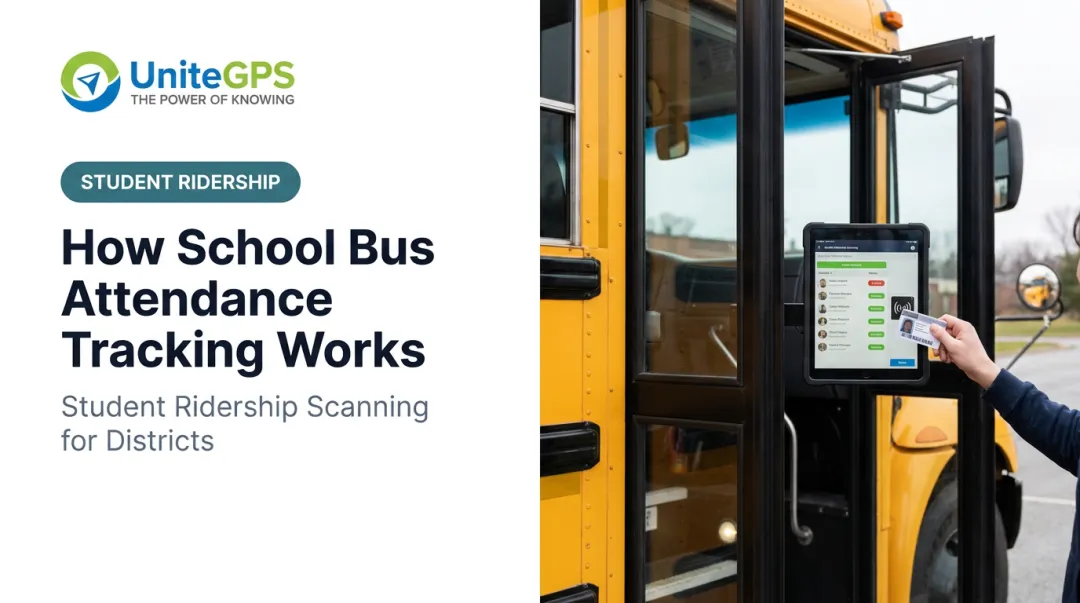
A school bus RFID badge is a passive card or tag assigned to a student. When it passes near a reader mounted on the bus, the system logs a boarding or exit event, complete with time and location.
There's no button to press and no battery to charge. The card draws power from the reader's electromagnetic field the instant it's scanned, then goes dormant again, according to AIM Global's RFID FAQ.
These badges rarely work alone. They're typically paired with a tablet or telematics device near the bus entrance that houses the reader and sends scan data in real time.
School Transportation News describes each scan as capturing:
- Date, time, and location of boarding or exit
- A coded rider identifier (not visible personal information)
- A record sent to a secure database for the transportation office
That record is what matters: accurate ridership data and safety accountability a district can stand behind when someone asks a hard question.

Key Advantages of School Bus RFID Badges
These advantages show up as measurable operational outcomes: safety, cost, and communication.
Real-Time Ridership Visibility and Accountability
Every scan creates a permanent record. No driver has to remember which of 60 kids got on at which stop. That matters most for younger students or those who are non-verbal and can't confirm their own boarding status.
This replaces:
- Manual roll calls prone to miscounts
- Driver memory, which fades fast on a packed route
- Paper logs that get lost or filled out after the fact
Zillah School District in Washington added RFID card-based ridership verification in 2023, connecting it to their existing routing software while transporting roughly 662 students daily, per School Transportation News. The district moved off spreadsheet-based tracking entirely.
A timestamped digital record turns "was my child on the bus?" from a guessing game into a data lookup. That matters most during large district rollouts, special education transport, or after an incident that demands a clean paper trail.
KPIs impacted: ridership accuracy, parent call volume, incident response time.

Reduced Administrative Burden and Parent Calls
Automated scans eliminate the manual data entry that eats up transportation office hours. Instead of staff cross-referencing paper sheets, the system already has the answer.
Benton Community School District's Transportation Director, Tim Lyons, described the shift plainly: being able to see "where the buses and students are at" and "how much they ride" made "a huge difference" — including verifying whether a bus actually stopped when a parent called to dispute it.
When families get direct visibility through a parent app or portal, fewer of them call the office at all. That frees transportation staff for higher-value work:
- Route optimization
- Driver support and training
- Following up on actual exceptions, not routine questions
KPIs impacted: staff hours saved, call center volume, data entry errors.
Stronger Emergency Response and Compliance Support
During an evacuation or route incident, administrators need to know instantly how many students, and which ones, were on a given bus. RFID-based ridership counts deliver that answer fast:
- Who boarded and exited, with timestamps
- Headcounts by bus without a manual roll call
- A clean roster for first responders and administrators
The same scan data also supports special education transport documentation.
Medicaid guidance under CMS's SMD 23-006 memo requires specialized transportation to be tied to a student's IEP and medically necessary. States must retain accurate records showing transportation was furnished as claimed.
Crosswalk, UniteGPS's platform, turns those requirements into reimbursement-ready reports. It pairs scan-verified boarding and exit timestamps with mileage by travel category. The platform captures transportation data only; it does not access IEPs or medical records.
KPIs impacted: audit readiness, reimbursement accuracy, compliance documentation time.

For districts running special education routes or serving Medicaid-eligible students, tighter documentation protects reimbursement that paper gaps often leave on the table.
Using Existing School ID Cards vs. Issuing New RFID Badges
Many districts already hand out RFID-enabled ID cards for building access, cafeteria lines, or library checkouts. Some bus tracking platforms can read those same cards for ridership tracking, skipping a separate badge rollout entirely.
The tradeoff:
| Approach | Pros | Cons |
|---|---|---|
| Extend existing ID cards | Faster rollout, lower cost, one card per student | Less control over card format/durability |
| Issue dedicated bus badges | Purpose-built, easier to replace | New printing/distribution process |
Either approach works when the platform can read your cards and stay in sync with enrollment. Crosswalk's Student Ridership feature supports card and barcode scans. It syncs continuously with student information system (SIS) data, so enrollment changes, address updates, and school transfers flow into routing and ridership records automatically.
A district extending an existing card system doesn't have to manually reconcile rosters every time a student moves or changes schools.

What Happens When Ridership Tracking Is Missing
Skipping digital ridership tracking creates real operational risk:
- Unverifiable incident records: no way to confirm who was on a bus during an investigation
- Higher call volume and data entry errors from manual, paper-based tracking
- Reactive handling of wrong-stop or missed-student situations after the fact
- Rising administrative costs as paper processes scale poorly
- Difficulty scaling as enrollment and route counts grow
Real-world consequences show up in local news regularly. A kindergartner in Ladson, South Carolina boarded the wrong bus and was left in an apartment complex parking lot before a school resource officer located her, according to Live 5 News.
In Liberty County, Georgia, two siblings boarded an incorrect bus and weren't located for over an hour, WTOC reported. Neither incident involved RFID verification, and neither should have taken that long to resolve with RFID verification.
How to Get the Most Value from RFID Badge Systems
RFID scanning delivers the most value when it's not a standalone system. Pair it with:
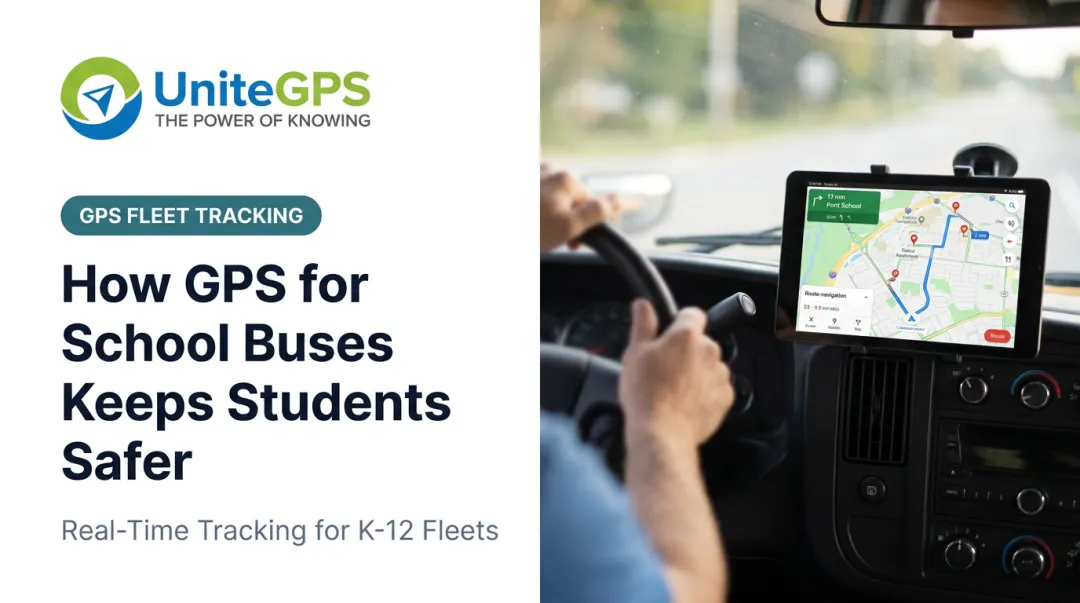
- GPS tracking for full visibility into bus location alongside ridership events
- Tablets that house the reader and transmit data in real time, rather than storing it for later upload
- SIS integration so rosters and stop assignments stay accurate as students enroll or move
- Regular staff review of ridership data, not just a system that runs in the background unchecked
When evaluating a provider, look for:
- FERPA compliance built into how data is stored and shared
- Unlimited live support, not ticket queues, for when something goes wrong mid-route
- A trial period to confirm fit before committing budget
UniteGPS includes a 90-day free trial with its Tablet Suite, with no credit card required and free route-building support. Districts can test ridership tracking on their own routes before signing anything.
Conclusion
RFID badges succeed because of the clarity and accountability they create for transportation teams. A verified boarding record turns a stressful parent call into a two-minute lookup.
Their value compounds over time. As ridership data accumulates and connects with routing, SIS records, and parent communication tools, districts get sharper visibility with every semester that passes. Treat ridership tracking as an operational standard your department runs on, not a pilot program you revisit next year.
Frequently Asked Questions
What is an RFID badge?
A passive card or tag with a unique identifier. A reader scans it to log events like boarding a bus, without storing personal student data on the chip itself.
How does the RFID attendance system work?
When a student scans their badge on a bus-mounted reader, the system matches the tag ID to a student record and logs the event with time, location, and bus ID in real time.
How can I get an RFID card?
Districts or transportation offices issue them, often by encoding existing student ID cards already used for building or cafeteria access.
Can RFID badges be tracked?
No. Passive RFID badges don't transmit location on their own. The bus-mounted reader and GPS unit record location at the moment of the scan, not continuous tracking of the badge.
Are RFID student badges safe and private?
Passive RFID chips don't store personal information on the chip itself. Student records stay on secure district systems, and when run under district data policies, the setup aligns with FERPA requirements.
What happens if a student loses their RFID badge?
Most districts issue a free or low-cost replacement quickly. Students can generally still board and depart at their designated stop while the replacement is processed.